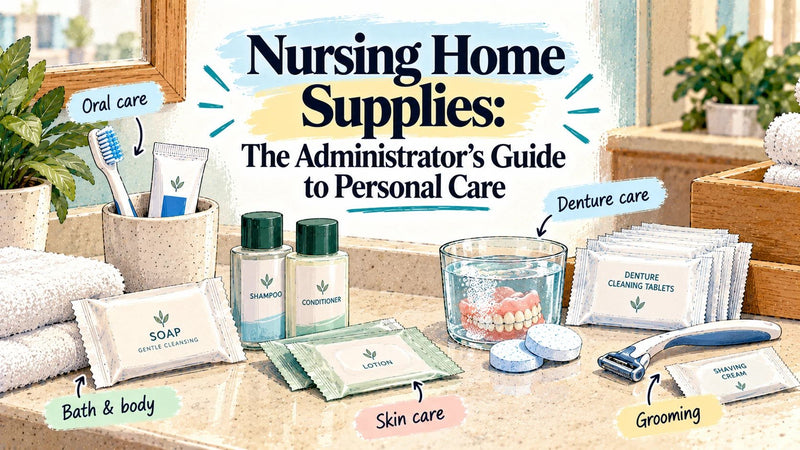
Nursing home administrators are responsible for stocking personal care supplies across every resident room, shift, and inspection, not packing one family member's suitcase. The job requires a defensible product list, a reliable supplier, infection control logic, and cost-per-resident math, none of which most sourcing resources address. This guide does.
What This Guide Is Actually For
Most resources on nursing home supplies were written for families: what to pack when moving a loved one in, what to label with their name, what to bring to make a room feel like home. That's a real need, and those guides serve it well.
But you're not a family member doing one-time packing. You're the person responsible for ensuring that 50, 80, or 200 residents have what they need, every day, in every room, without fail, keeping costs in line, passing CMS surveys, and not spending your Thursday afternoon on the phone because a vendor shorted the order again.
That's a completely different job, and it deserves a completely different guide.
What Federal Regulations Actually Say About Personal Care Supplies
Before we get into product specifics, it helps to know where you stand legally. Nursing homes that participate in Medicare or Medicaid (which is virtually all of them) are governed by CMS regulations under 42 CFR Part 483.
The short version: facilities are required to maintain personal hygiene for residents who cannot provide for themselves, and they cannot charge residents separately for basic personal care items that are part of the facility's standard services. The CMS interpretive guidelines under §483.25 (Quality of Care) and §483.10 (Resident Rights, including dignity) create a clear operational obligation here.
What the regulations do not prescribe is a specific product list or format. That discretion sits with you.
Three practical implications of the regulatory framework:
- Basic personal care is your responsibility, not the resident's. If a resident cannot purchase or manage their own toiletries, the facility must provide them. This isn't optional.
- Dignity requirements apply to supply quality. Regulations explicitly protect resident dignity. Providing the lowest-tier generic product for cost reasons is a defensible choice in some contexts; doing so in ways residents find demeaning is not.
- Infection control standards (§483.80) directly affect how you format supplies. Shared items that pass between residents create survey risk. Individually wrapped, single-use products eliminate that risk entirely.
The Complete Personal Care Supplies Checklist for Nursing Homes
Here's the full category breakdown, organized by use frequency and resident impact. "Tier 1" items are daily-use essentials that should be stocked in every resident room. "Tier 2" items are less frequent but must be consistently available.
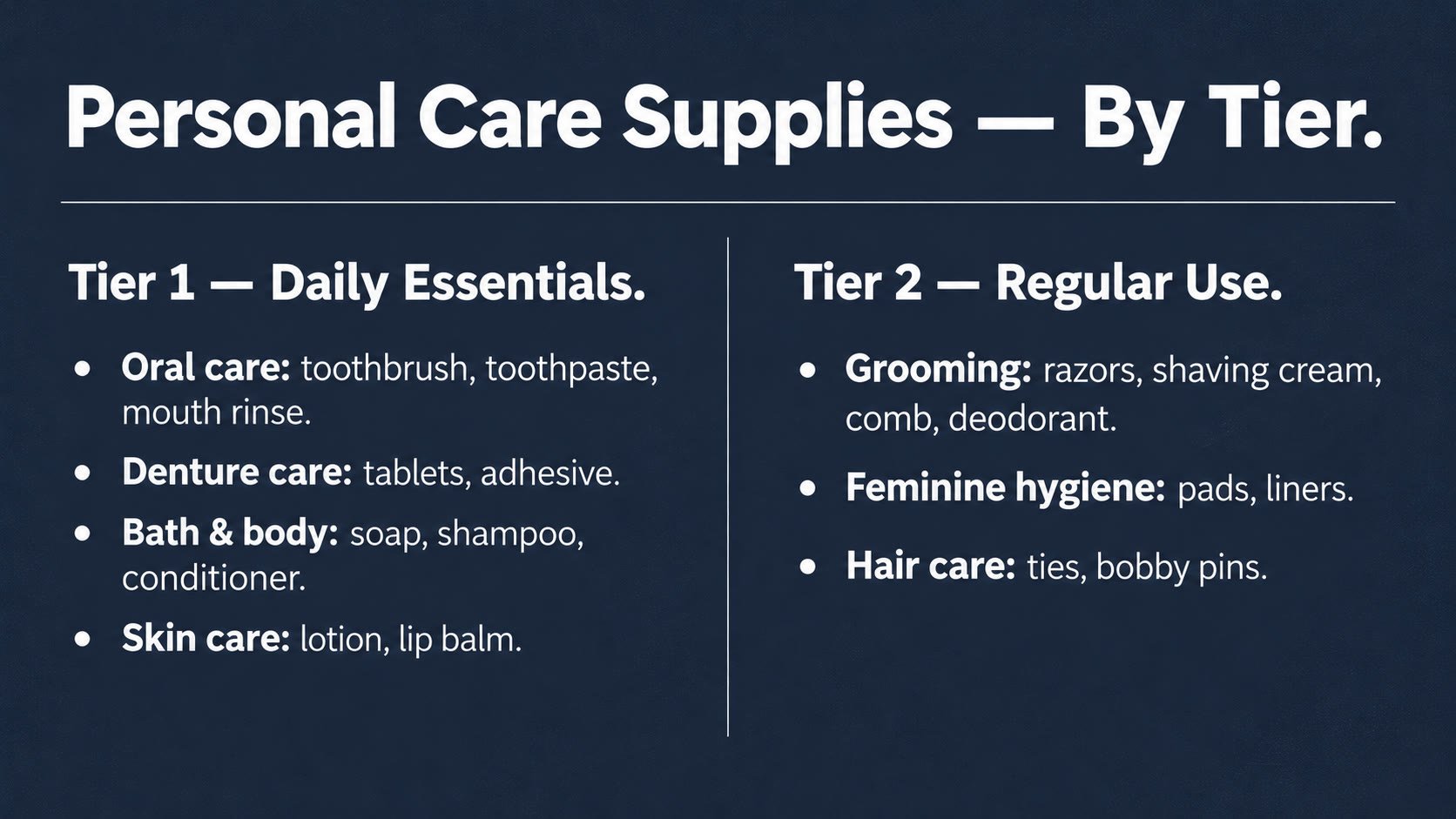
Tier 1: Daily-Use Essentials
| Category | Product | Format to Consider |
|---|---|---|
| Oral care | Toothbrush (soft-bristle) | Individually wrapped |
| Oral care | Toothpaste (fluoride) | Unit-dose or standard tube |
| Oral care | Mouth rinse | Unit-dose packets or pump bottles |
| Denture care | Denture cleaning tablets | Individually wrapped |
| Denture care | Denture adhesive | Individual tubes |
| Bath/body | Bar soap or liquid body wash | Individually wrapped bar or pump |
| Bath/body | Shampoo | Individual packets or pump |
| Bath/body | Conditioner | Individual packets or pump |
| Skin care | Lotion/moisturizer | Pump bottles per room |
| Skin care | Lip balm | Individual sticks |
Tier 2: Regular but Less Frequent
| Category | Product | Notes |
|---|---|---|
| Grooming | Disposable razors | Individually wrapped |
| Grooming | Shaving cream | Single-serve packets or shared pump |
| Grooming | Comb/brush | Per-resident, labeled |
| Grooming | Deodorant | Per-resident, not shared |
| Feminine hygiene | Pads, liners | Stocked in resident bathrooms as needed |
| Hair care | Hair ties, bobby pins | Per-resident, as requested |
A note on deodorant and personal grooming items: these should never be shared between residents. Even when not explicitly covered in infection control protocols, residents and families notice when items have clearly been used by others. The dignity standard alone justifies individual stocking here.
Why Individually Wrapped Products Belong in Your Facility
Here's what most bulk-supply guides bury: the format of the product matters as much as the product itself in a care setting. Individually wrapped products are not just a convenience play. They solve three real operational problems.
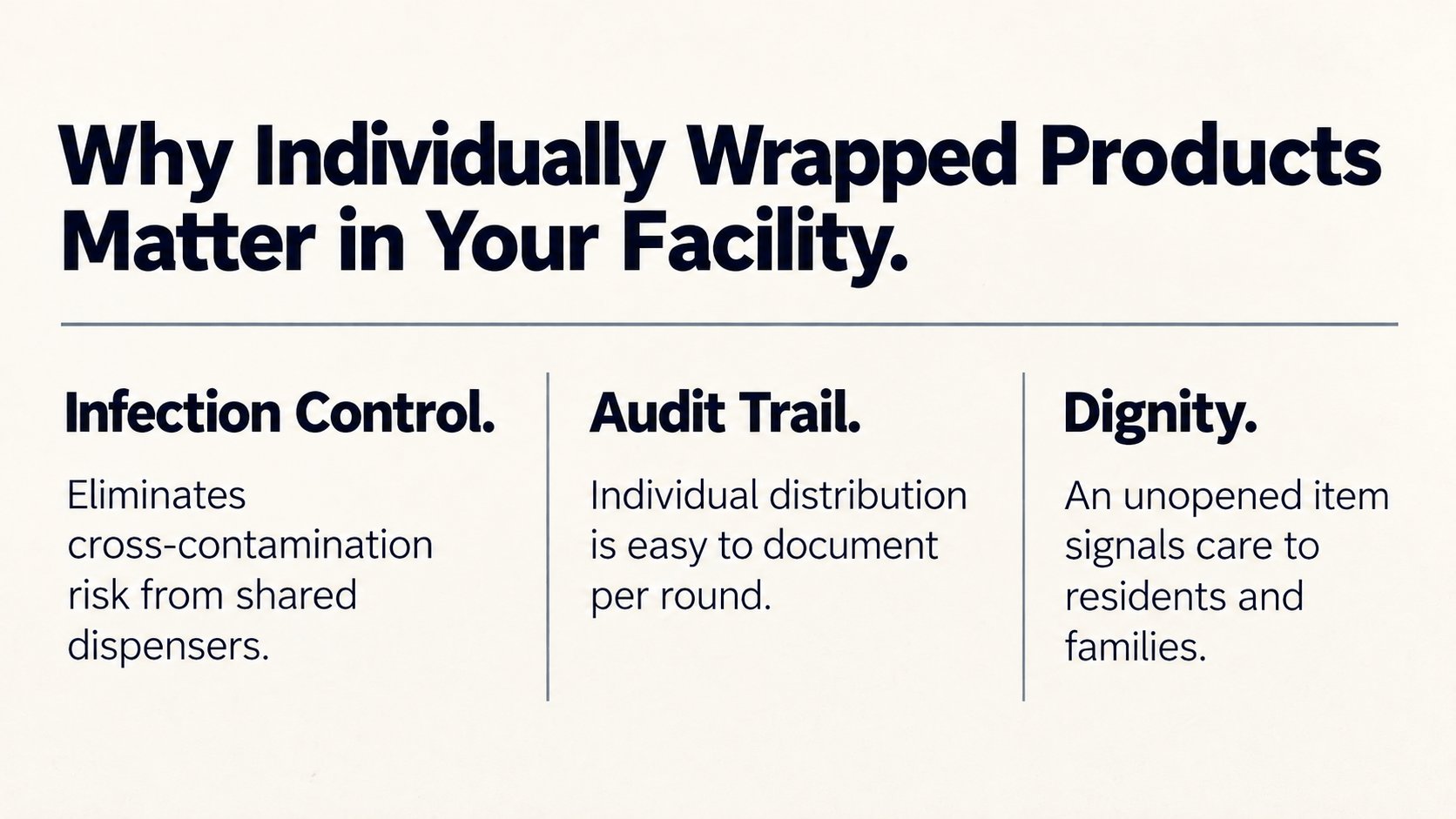
Infection control. CMS infection prevention standards (§483.80) require facilities to maintain an effective infection prevention and control program. An individually wrapped bar of soap that a resident uses once and discards eliminates the cross-contamination risk that a shared pump or dispenser creates if not properly maintained or replaced on schedule. In a skilled nursing facility where residents may be immunocompromised, this is not a minor consideration.
Audit trail and documentation. When a resident or family member asks whether their loved one received their daily hygiene items, an individually wrapped product that gets distributed per round is far easier to document and account for than a shared dispenser that may or may not have been used. Your nursing staff already tracks activities of daily living; individual product distribution integrates naturally into that workflow.
Dignity and resident satisfaction. There's something that matters about handing a resident an unopened, individually wrapped item. It signals care. It signals that no one else used it. For residents who have given up most of the control they once had over their daily lives, that small signal lands. Families notice it too. And family satisfaction is a real factor in your facility's reputation and occupancy.
The format you choose also has direct implications for how your facility holds up under a CMS survey; covered in the next section.
What CMS Surveyors Notice About Your Supply Program
Nursing home surveys cover a lot of ground, but personal care supplies intersect with several areas that surveyors routinely flag. Understanding those intersections helps you structure a supply program that holds up under scrutiny.
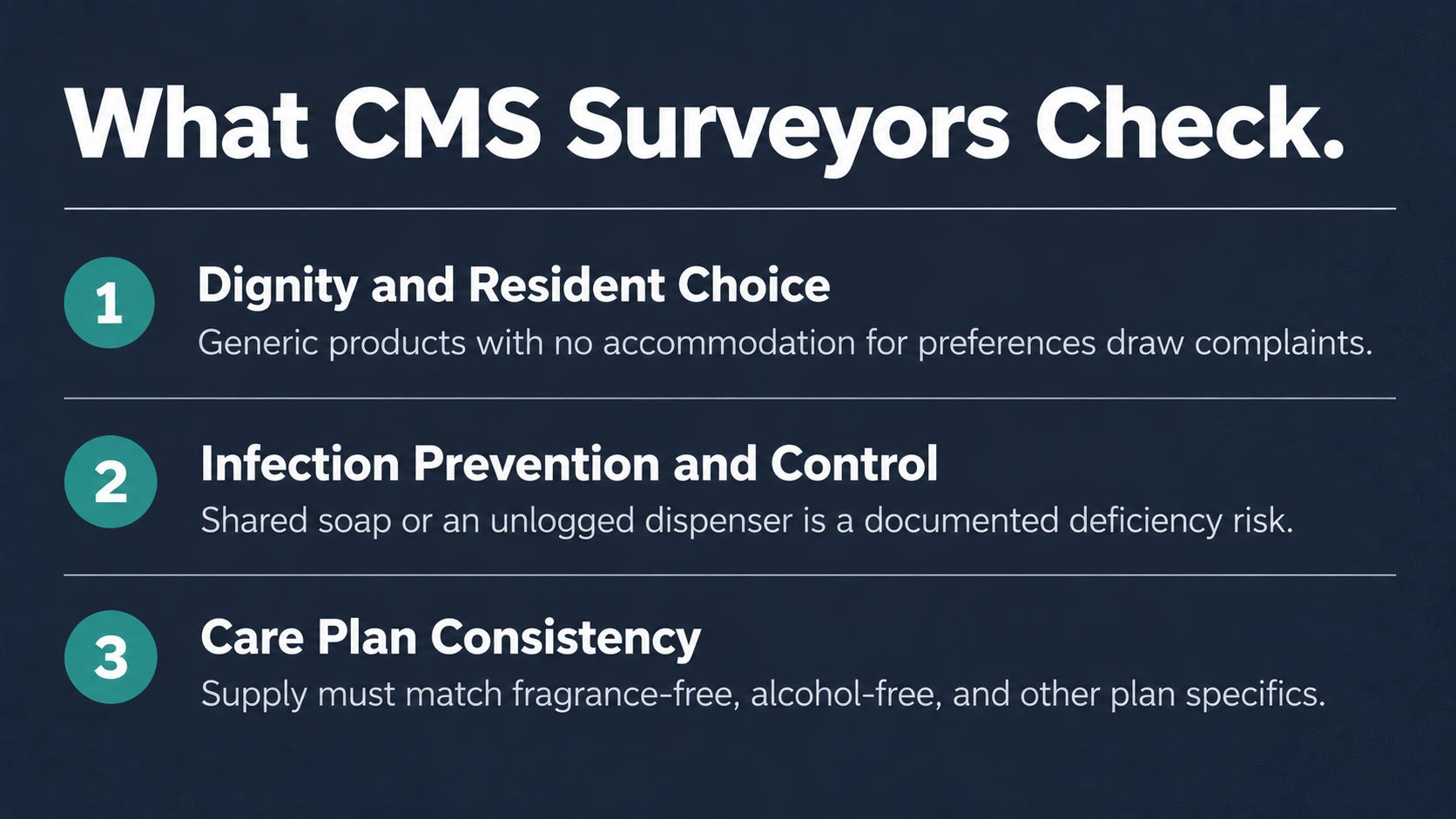
Dignity and resident choice. Surveyors review whether residents receive care that maintains dignity and honors individual preferences. Stocking only one generic product with no accommodation for resident needs is survivable in a survey, but complaints from residents or families about inadequate personal care often trace back to supply program decisions. An individually wrapped product that arrives unopened for each resident supports the dignity standard in a concrete, documentable way.
Infection prevention and control. This is where your supply format has the most direct survey exposure. Shared soap bars, dispensers that aren't cleaned and refilled on a documented schedule, or any item that passes between residents without sanitization between uses can generate a deficiency. Individually wrapped single-use products in resident rooms are defensible on audit; a shared bar of soap in a communal bathroom with no cleaning log is not.
Care plan consistency. Residents' care plans specify personal care routines, including hygiene preferences and product requirements such as fragrance-free formulas, alcohol-free mouth rinse, or specific denture care products. If your supply program cannot accommodate what is written in a care plan, that is a documentation inconsistency surveyors can flag. Build your product range wide enough to cover common care plan variations from the start.
How to Calculate Quantities and Build a Restocking System
Buying in bulk without a usage baseline is how you end up with 900 bars of soap in a storage closet and no toothbrushes in week three. Here's the math to get ahead of that.
Starting point: per-resident, per-day usage.
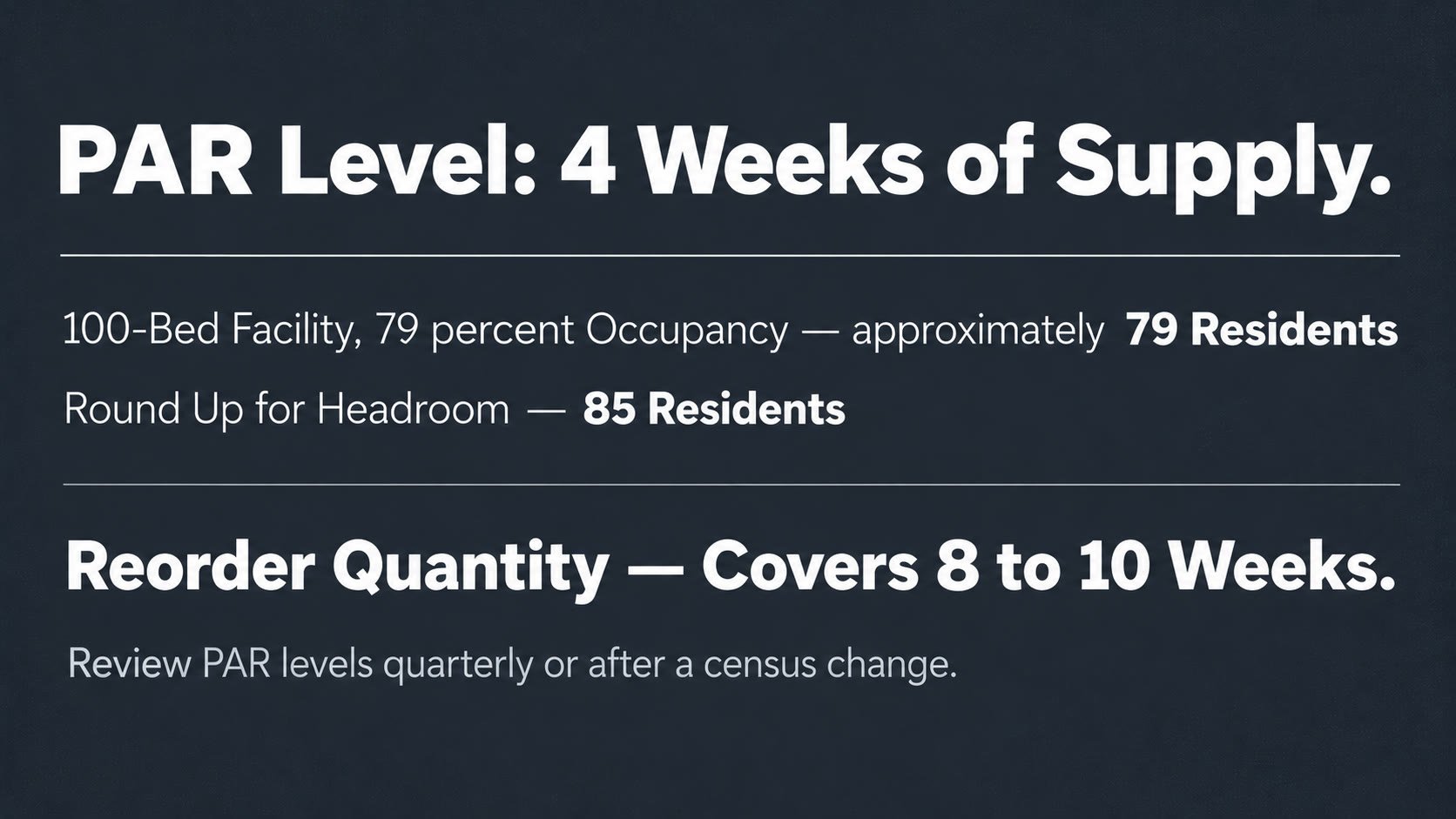
For daily-use oral care (toothbrush, toothpaste) and bath items (soap, shampoo), assume one unit of each per resident per week for items that last multiple uses, and one per use for items like individual soap bars. A 100-bed facility running at approximately 79% average occupancy (the current US national rate per KFF data) needs roughly 79 residents' worth of supply at any given time. Most operators round up to 85 for comfortable headroom.
Build a PAR level. PAR (Periodic Automatic Replenishment) is the minimum stock quantity that triggers a reorder. For a 100-bed facility, a reasonable PAR might be 4 weeks of supply. Order at PAR; reorder quantity covers 8 to 10 weeks. This buffers against supplier delays, seasonal demand shifts, and the occasional unusually fast consumption period.
Don't buy more than you can store properly. Individually wrapped products have longer shelf lives than open-format items, which makes modest overstocking relatively low-risk. But care facility storage space is finite and regulated. Match your order size to your actual storage capacity.
What to Look for in a Supplier When You're Buying for a Care Facility
Not every supplier is set up for the care facility context. Here's the checklist that actually matters:
- Minimum order quantities that match your scale. A 50-bed nursing home does not need to buy 10,000 units to get a reasonable price. Look for suppliers offering tiered pricing that starts at quantities you can actually move.
- Consistent product quality across orders. The worst outcome in a care setting is receiving a product that looks different from what you've been using, prompting questions from residents who've grown accustomed to a specific product. Consistency matters more than novelty.
- Reliable lead times. If your supplier regularly misses promised delivery windows, you will eventually run out of something. In a care facility, "we ran out" is not acceptable. Ask for lead time commitments in writing and verify them against their actual track record.
- Product labeling and ingredient transparency. Residents with allergies, sensitivities, or specific care plan requirements need accurately labeled products. Fragranced vs. fragrance-free matters. Alcohol content matters in mouth rinse. Don't buy from a supplier who can't provide full ingredient lists.
- Individually wrapped options in your product categories. Not all hospitality suppliers stock individually wrapped formats. If infection control and resident dignity are priorities (they should be), confirm your supplier actually carries the format you need before you're three months into a relationship and trying to switch.
About This Guide
This guide was produced by the team at Avistar. We supply individually wrapped guest amenities to hotels, short-term rental operators, and care facilities across the United States, including nursing homes and assisted living communities.
The perspective in this article comes from working directly with facility administrators who manage supply programs at scale. The regulatory context reflects publicly available CMS guidance and should be verified with your compliance team before implementation.
We don't have a commercial interest in steering you toward a format that doesn't fit your facility. Our interest is in giving you an accurate framework so you buy what actually works for your residents and your operations.
Stock Smarter with Avistar
Avistar's oral care collection and bath and body collection are designed for facility-scale purchasing, individually wrapped, consistent across orders, and available in quantities that work for care settings. Our denture and retainer care collection covers cleaning tablets and adhesive products in individual-wrap format, which is particularly useful for memory care and skilled nursing wings.
If you're evaluating suppliers or want to talk through quantities for your specific facility size, our wholesale page has the starting point for that conversation.
Frequently Asked Questions
What personal care supplies are nursing homes required to provide to residents?
Nursing homes participating in Medicare or Medicaid are required under federal CMS regulations to ensure residents maintain personal hygiene and dignity. In practice, this means facilities must provide basic personal care items, including soap, shampoo, and oral care products, for residents who cannot provide them independently. Facilities are generally prohibited from charging residents separately for these basic items. What specific products to carry and in what format is left to facility discretion, as long as the resident's hygiene and dignity standards are met.
Should nursing homes use individually wrapped toiletries or dispenser systems?
Both formats are used in nursing homes, and the right answer depends on the wing and resident population. Individually wrapped products are the stronger choice for skilled nursing wings, memory care units, and any area with residents who are immunocompromised or at higher infection risk, because each item is single-use and eliminates shared-surface contamination. Dispenser systems can work well in extended-stay or independent-living wings where residents have more self-care capability and consistent cleaning protocols are in place. Most facilities benefit from a hybrid approach.
How much should a nursing home budget per resident per month for personal care supplies?
Costs vary significantly based on facility type, product tier, and purchasing volume. Individually wrapped products run slightly higher per unit than bulk dispensed formats, but that gap narrows when you factor in dispenser maintenance, refill labor, and product waste. Buying in case quantities from a wholesale supplier reduces per-unit costs substantially across every format. The most reliable approach is to calculate actual weekly consumption per resident across your core product categories and build a line-item budget from those figures rather than working from a generic estimate.
What's the infection control argument for individually wrapped soap in a nursing home?
Shared soap bars or dispensers that are not cleaned and refilled on a strict schedule can harbor bacteria between uses. For a resident population that may include people with compromised immune systems, post-surgical recoveries, or chronic conditions, that risk is material. Individually wrapped single-use bars eliminate the shared-surface issue entirely. CMS infection prevention standards under §483.80 require facilities to maintain active infection control programs; using individually wrapped products in resident rooms is one practical way to support compliance.
Can family members bring their own toiletries for nursing home residents?
Yes, in most cases. Facilities typically allow residents to keep and use their own preferred products. However, facilities should maintain their own supply for residents whose families are not providing items, or for situations where preferred items run out. Facilities should also have clear policies about product storage in resident rooms, especially in memory care wings where ingestion of non-food items is a safety concern.
How do I build a restocking system for nursing home personal care supplies?
Start with a per-resident usage estimate for each product category. Multiply by your average census to get weekly consumption. Set a PAR level at 4 weeks of supply and a reorder point that gives you 8 to 10 weeks on hand after the order arrives. For individually wrapped products, this means relatively modest storage needs and long shelf life. Review your PAR levels quarterly, particularly after any significant change in census or care acuity. The goal is never running out without over-purchasing to the point where products expire before use.