Bulk body wash is one of those purchases that looks simple from the outside. You need soap. You buy a lot of it. Done.
Except it's not done. For hotels, Airbnb hosts, property managers, and care facility administrators, the format you choose, not just the brand or the scent, directly shapes how guests experience your bathrooms. And bathroom experience is the kind of thing that shows up in a review three hours after checkout.
Here's what you need to know before you place your next order.
TL;DR: Bulk Body Wash Format at a Glance
| Format | Best For | Approx. Cost Per Unit | Guest Perception | Restock Effort |
|---|---|---|---|---|
| Individually wrapped single-use | Airbnbs, boutique hotels, care facilities | $0.25–$0.70 | High trust, hygienic | Low |
| Mini travel-size bottles (bulk case) | Budget to mid-scale hotels | $0.20–$0.50 | Familiar, standard | Medium |
| Gallon refill dispensers | Full-service hotels with daily housekeeping | $0.05–$0.15 per use | Varies widely | High |
| Pump-top room bottles (8–16 oz) | Extended stay, vacation rentals | $0.30–$0.80 | Premium if branded | Medium |
The Question That Actually Matters: Format First, Brand Second
Most buyers skip straight to "which brand" before they've answered the more important question: which format actually fits how my property operates?
Dispensers make genuine sense for the right operation. A full-service hotel with daily housekeeping can keep a wall dispenser filled, clean, and properly maintained without adding meaningful complexity. Extended-stay properties benefit from the lower per-use cost and reduced packaging volume. If your property has the housekeeping infrastructure to back it up, a quality dispenser is a legitimate choice.
The key phrase is "infrastructure to back it up." A dispenser works only if someone is checking fill levels and cleaning the nozzle between every guest turn. For a 10-unit Airbnb portfolio where checkout turnovers are tight and housekeeping is lean, that maintenance commitment is harder to hold consistently. A half-empty or grimy dispenser doesn't signal eco-conscious hosting. It signals the bathroom wasn't fully prepped.
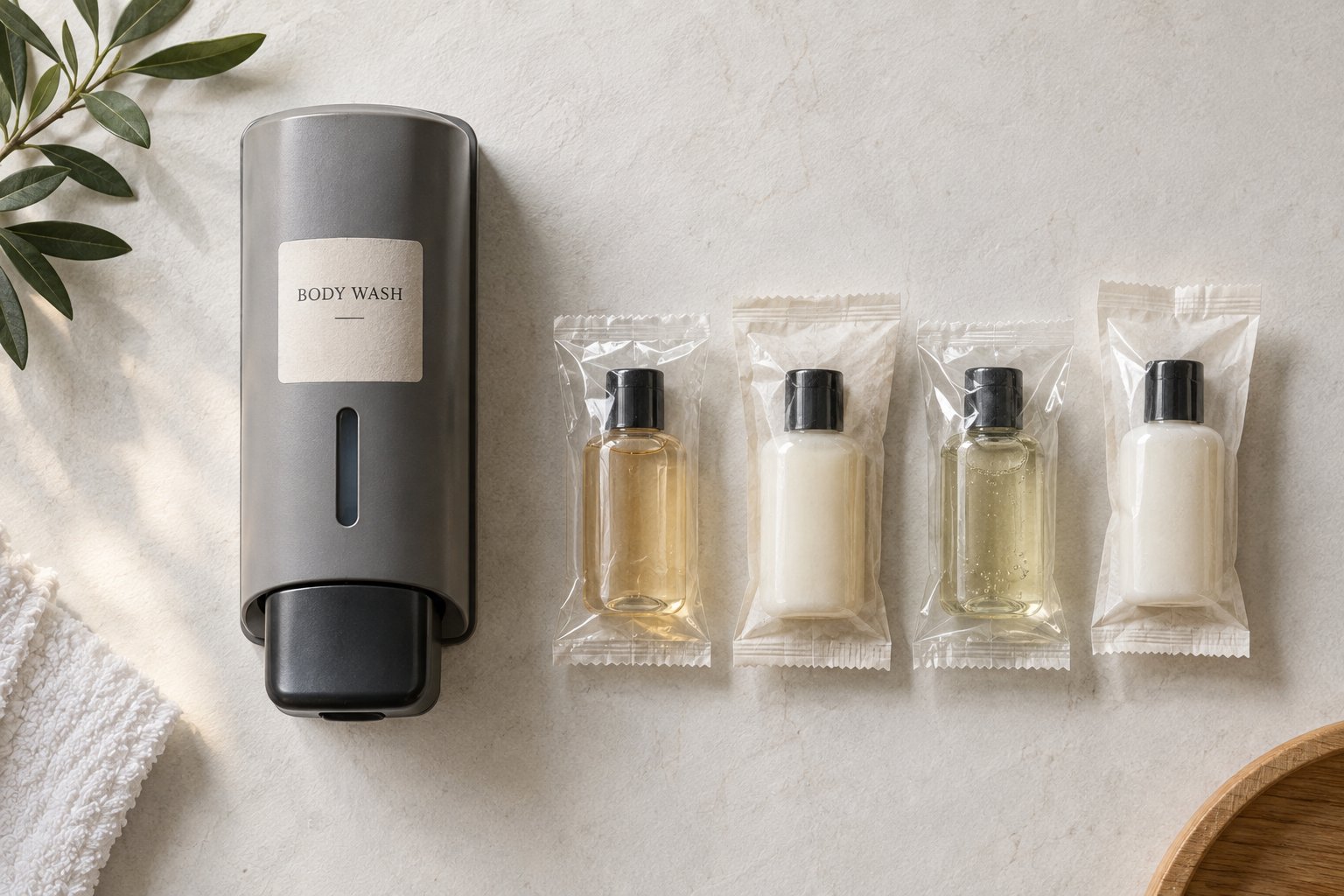
Guests in short-term rentals are doing a silent walkthrough the moment they open the bathroom door. An individually wrapped body wash, sealed and clean on the counter, communicates preparation without any interpretation required. The right format for your property is the one your operation can actually maintain to standard, every turn.
What "Bulk Body Wash" Actually Means
Suppliers use the term loosely, so let's define it precisely. In a hospitality context, "bulk body wash" can refer to any of the following:
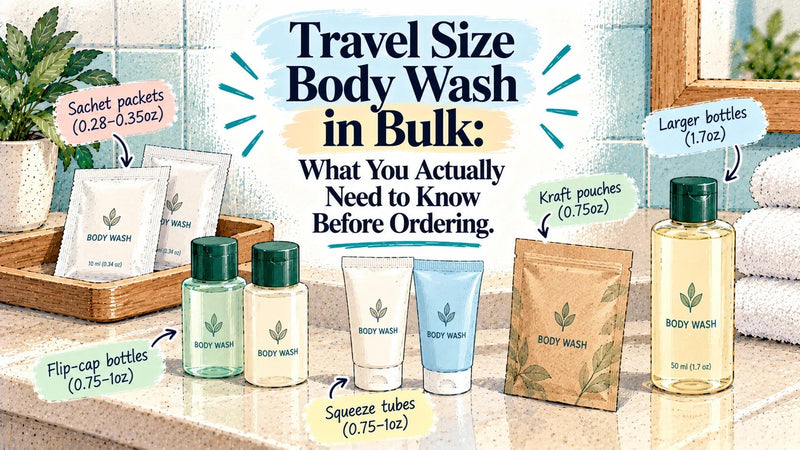
- Individually wrapped single-use sachets or flip-cap bottles (0.75 oz to 1.5 oz), ordered in cases of 100 to 500 units
- Mini travel-size bottles in wholesale cases, the classic hotel amenity format
- Gallon jugs (128 oz) for refilling wall-mounted dispensers
- Pump-top bottles (8–16 oz) left in guest rooms for extended-stay or vacation rental properties

All of these count as "bulk" in the sense that you're buying in volume. But they serve completely different operations. Choosing the wrong format for your property type costs you in either operational friction or guest experience, sometimes both.
For most Airbnb hosts and vacation rental operators sourcing amenities, individually wrapped single-use bottles in cases of 100–500 units are the right answer. They eliminate cross-contamination concerns, simplify housekeeping, and photograph cleanly for your listing.
For care facilities and senior living environments, the same format applies, but the formula matters as much as the packaging. More on that below.
Six Things to Check Before Choosing a Bulk Body Wash Supplier
Once you've settled on a format, the supplier evaluation comes down to these criteria.
1. Minimum order quantity
A single Airbnb host might need 50–100 units per month. A hotel GM sourcing for 80 rooms needs 2,000 or more. Know your monthly usage before you commit to a case size. Most reputable hospitality suppliers offer individually wrapped cases starting at 100 units, with better pricing at 500 and 1,000+.
2. Price per unit, not price per case
Always do the unit math. A case of 200 units at $80 ($0.40 per unit) is a better deal than a case of 100 at $45 ($0.45 per unit), if your turnover supports the larger order. Do not let the headline case price guide your decision.
3. Formula and skin safety
Your guests are not a homogeneous group. A care facility serving elderly residents has different needs than a downtown boutique hotel. Look for formulas that are gentle, fragrance-appropriate, and ideally free from harsh sulfates. Hypoallergenic and dermatologist-tested options are worth the small premium when your guest mix includes sensitive skin or allergy concerns.
4. Packaging integrity
For individually wrapped formats, the seal matters as much as the product inside. A sachet that leaks in storage or arrives dented signals a supplier quality problem before you've even placed it in a room. For dispenser formats, verify that gallon jug viscosity is compatible with your specific dispenser model.
5. Lead time and restock reliability
Running out of body wash two days before a fully booked weekend costs you reviews. Work with suppliers who can commit to lead times and accommodate standing orders or auto-restock. Hospitality supply chains are not the place to experiment with the cheapest, newest vendor.
6. Brand and packaging presentation
A generic white-label bottle is fine for budget properties. But a recognizable brand, or a well-designed private-label option with clean typography and a premium feel, signals investment to the guest. For boutique hotels and higher-tier Airbnbs, a 20–30% premium on per-unit cost often returns more in perceived value than it costs in procurement. See also our [Internal link: Wholesale Soap Supplies Buying Guide] for a deeper look at this decision.
How to Calculate How Much You Actually Need

The formula:
Monthly units needed = (average stays per month) x (units placed per stay) x (number of rooms or units)
An example: you run 8 Airbnb units averaging 15 guest stays per month per unit, with roughly 1.5 guests per stay and one body wash unit per guest.
8 x 15 x 1.5 = 180 units per month
Order a 2–3 month supply at a time for storage efficiency without over-committing. Revisit every quarter as occupancy patterns shift.
For hotels, housekeeping managers typically track amenity consumption per occupied room night (OCC). Build a par level (the quantity needed to cover your longest realistic resupply window) and don't let inventory dip below it. Seasonal occupancy spikes are predictable. Your supplier lead time is not always.
Note: body wash has a typical shelf life of 2–3 years unopened and 6–12 months once opened. Over-ordering creates waste. Trim your buffer if storage conditions are warm or humid.
What Guests Actually Notice

Three things appear consistently in hospitality feedback when guest amenities come up in reviews:
Scent. This is disproportionately memorable. A fresh, clean scent that isn't chemically heavy makes the shower feel like a moment rather than a formality. A smell that reads as "budget motel" goes into the review even when the guest can't quite articulate why.
Packaging condition. A dented, wrinkled, or smudged bottle is worse than no bottle. Guests read packaging condition as a proxy for the property's overall cleanliness standards. This applies especially to individually wrapped formats where the seal is visible. If it looks used, it gets noted.
Format. As covered above, the format your bathroom uses makes a quiet statement about how your property operates. A well-maintained dispenser signals scale and consistency; an individually wrapped product signals that this was placed fresh for this specific guest's stay. Which one lands better depends on your property type and how reliably you can maintain each format to standard.
You do not need a $5-per-unit product to pass this test. You need a product that's fresh, complete, and clearly placed for this specific guest's stay. Our [Internal link: Guest Amenities That Actually Earn Five-Star Reviews] guide goes deeper on this if you want the full picture.
Why Trust This Article
Avistar was built to solve a problem we saw firsthand: operators and hosts couldn't find guest amenities designed for the realities of hosting, not for hotel chains with dedicated procurement teams. The brand started with a specific gap in oral care for people on the move, and grew into a full guest amenity line covering bath and body, oral care, and denture and retainer care because the same problem kept showing up across product categories.
We supply guest amenities wholesale to hotels, Airbnb hosts, property managers, and care facilities, from individual hosts placing their first case order to property managers sourcing across dozens of units. Our catalog includes both individually wrapped formats and dispenser options, sized for operator restocking rather than retail shopping. The tagline is "Made for hosts. Loved by guests." That's not a marketing line; it's the actual design brief.
The evaluation criteria in this guide come directly from what we hear from operators: the format questions, the MOQ frustrations, the dispenser maintenance realities, the review feedback on amenities. We've sourced and supplied across enough property types to know what works operationally and what gets glossed over in generic product descriptions.
How Avistar Fits In
Most guest amenity suppliers are set up for hotel procurement departments with dedicated buyers, storage infrastructure, and housekeeping teams to manage what arrives. Avistar was built for everyone else: the Airbnb host restocking between checkouts, the property manager sourcing across 30 units, the care facility administrator who needs hypoallergenic formulas in individually wrapped packaging because residents share bathrooms and have sensitive skin.
Our catalog covers both individually wrapped amenities and dispenser formats, sized for operational restocking rather than retail shopping. Individually wrapped options work for high-turnover properties where prep simplicity and hygiene signaling matter most. Dispenser formats suit properties with the housekeeping infrastructure to maintain them consistently and the volume to justify the per-use economics.
Our bath and body range includes body wash and soap in bulk case formats built for hotel rooms, Airbnb bathrooms, and care facility distribution. For guests who are in transit and carrying amenities with them, our travel and on-the-go collection covers that use case specifically. For senior living and assisted care settings where formula gentleness and packaging ease matter as much as the product itself, our senior and denture care section has options designed with that resident profile in mind.
We don't include a product in the catalog just because it's available. Every SKU earns its place based on whether it actually works for the operator using it, which is a different bar than whether it looks good in a product photo. If you're sourcing bulk body wash for a property, that's the standard we'd ask you to hold us to.
Frequently Asked Questions
What is the best bulk body wash for hotels?
The best bulk body wash for hotels depends on your property tier and housekeeping setup. For mid-scale to upscale properties, individually wrapped single-use bottles in the 0.75 oz to 1.5 oz range, ordered in cases of 100 to 500, strike the right balance between cost, hygiene signal, and guest experience. Look for gentle, fragrance-appropriate formulas in clean packaging. Wall dispensers are appropriate for full-service hotels with daily housekeeping but add operational overhead that many properties underestimate.
How much does bulk body wash cost for Airbnbs?
Individually wrapped bulk body wash for Airbnbs typically runs $0.25 to $0.70 per unit when ordered in cases. Mini travel bottles come in slightly cheaper at $0.20 to $0.50 per unit. For a host running 5 units with 15 stays per month per unit (roughly 113 units using the 1.5-guests-per-stay assumption above), expect to budget $30 to $80 monthly on body wash alone, depending on format and supplier. Scaling up your case size is the fastest lever on unit cost if you have the storage and occupancy to justify it.
What size body wash do hotels typically use?
Most hotels use 1 oz (30ml) to 1.5 oz (44ml) single-use bottles for individual guest amenities. Budget properties sometimes use 0.75 oz sachets. Full-service hotels and resorts often place 2 to 3 oz bottles or branded pump-top bottles in suites. Properties with higher sustainability targets or daily housekeeping capacity increasingly use refillable wall dispensers with gallon-format refills, which reduce packaging volume and lower per-use cost at scale.
Is individually wrapped body wash better than a dispenser for Airbnbs?
It depends on your housekeeping setup. Dispensers work well for properties with reliable, consistent housekeeping between every guest turn: a full-service hotel with daily housekeeping, or an extended-stay property where turnover is infrequent. For high-turnover short-term rentals where checkout windows are tight and housekeeping is lean, individually wrapped units are often the simpler operational choice: no fill checks, no nozzle cleaning, no maintenance risk between stays. The sealed packaging also communicates directly to the guest that the product was placed fresh for their arrival. If your operation can maintain dispensers to standard on every turn, they're a legitimate option. If it can't, individually wrapped is more reliable.
Can I buy body wash in bulk for a care facility?
Yes, and the recommendation for care facilities leans strongly toward individually wrapped, hypoallergenic options. Elderly residents often have sensitive skin, making fragrance-free or dermatologist-tested formulas worth the small premium. Individual packaging also simplifies distribution and reduces contamination risk in shared environments. Take a look at our senior and care amenity options for products designed with this guest profile in mind.
What is the minimum order quantity for wholesale body wash?
Most wholesale hospitality suppliers offer individually wrapped formats in cases starting at 100 units, with pricing that improves at 500 and 1,000+. Gallon-jug dispenser formats often carry lower MOQs but require dispenser compatibility checks and more storage space. For operators with predictable monthly usage, a standing order or auto-restock arrangement typically beats one-time bulk purchases on both price and reliability.
How do I calculate how much bulk body wash I need per month?
Multiply your average monthly occupied stays by the units placed per stay, then multiply by the number of rooms or units. A 10-room hotel at 70% occupancy over 30 days: 10 rooms x 21 occupied nights x 1 unit per stay = 210 units per month. Order a 2 to 3 month buffer to account for supply lead times and seasonal occupancy peaks. After 2 to 3 months of tracking, adjust your standing order to match your actual consumption rate.