Denture adhesive cream is a paste applied to the fitting surface of a denture to improve stability, reduce movement, and seal out food particles. Most formulations hold for six to twelve hours, though real-world results depend heavily on how well the denture fits in the first place.
Here's what most guides skip: denture adhesive cream is not a substitute for a properly fitting denture. It enhances a good fit. It masks a bad one, and that distinction matters both for individual wearers and for care facilities responsible for resident oral health.
Why People Actually Reach for Denture Adhesive Cream
Dentures shift. That's just physics.
Even a well-made denture sits on soft tissue that changes over time as the jaw ridge resorbs. Talking, chewing, laughing: each creates movement. Adhesive cream forms a thin, water-activated film between the denture base and the gum tissue that reduces that movement and, in the process, gives the wearer more confidence.
That confidence part is worth pausing on. For someone who wears dentures, the constant awareness of potential slippage during a conversation can be genuinely distressing. Adhesive isn't vanity; it's function.
Cream vs. Powder vs. Strips vs. Cushions
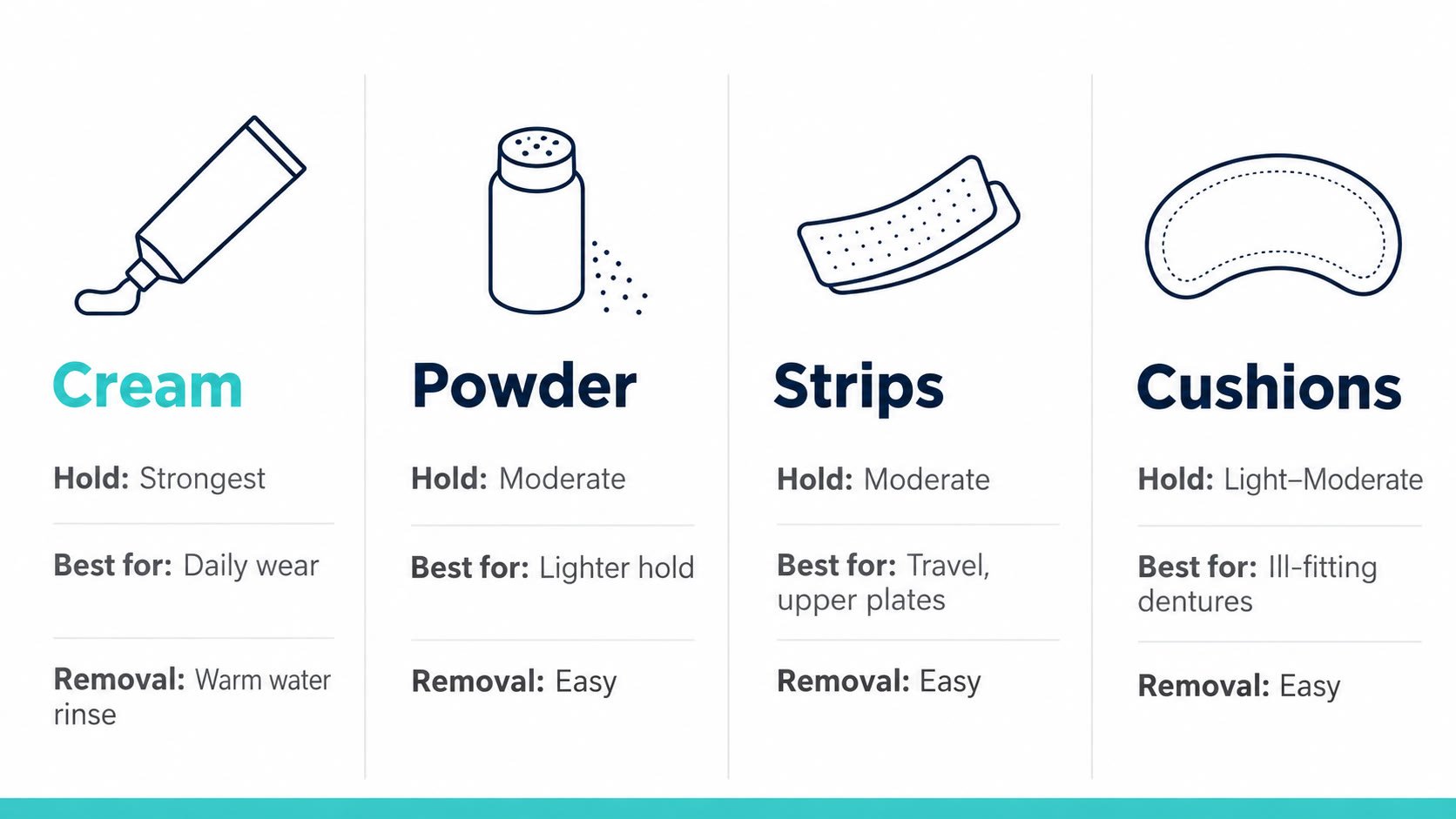
There are four common formats of denture adhesive, and they're not interchangeable.
| Format | Hold Strength | Best For | Ease of Removal |
|---|---|---|---|
| Cream | Strongest | Full and partial plates, daily wear | Moderate (warm water rinse needed) |
| Powder | Moderate | Lighter hold, lower mess preference | Easy |
| Strips/wafers | Moderate | Upper plates, travel convenience | Easy |
| Cushions/pads | Light to moderate | Temporarily ill-fitting dentures | Easy |
Cream is the most widely used format for good reason: it delivers the strongest hold, conforms to irregular gum contours, and works for both full and partial dentures. Powder suits people who find cream too thick or don't need maximum hold. Strips are tidy and convenient for travel, but they don't seal as well around the edges. Cushions are a short-term fix for loose-fitting dentures, not a daily solution.
For care facility settings where staff may assist residents with oral care, cream is the easiest format to control in terms of dosage, provided the tube has a precision nozzle. More on that below.
The Zinc Question
If you've read anything about denture adhesive, you've seen the zinc warnings. Here's a straight take.
Older formulations of popular adhesive creams used zinc oxide as the active binding agent. Zinc is an essential mineral, but consuming excess amounts over long periods can cause copper deficiency, which has been linked to nerve damage in documented cases. The concern surfaced when people applying abnormally large quantities of adhesive multiple times daily, over months and years, were found to have elevated zinc levels.
The critical detail: the problems arose from severe overuse, not from normal daily application. One or two thin applications per day, as directed, is considered safe by dental health authorities.
That said, many people prefer to avoid the question entirely, and the market has responded. Several formulations now skip zinc entirely. These zinc-free options deliver comparable hold and are worth defaulting to, particularly in care settings where staff are applying adhesive for residents and dosage isn't always consistent from shift to shift.
If you want to go a step further, there are also fluoride-free options, which matter for wearers who have concerns about unnecessary additives or who combine their routine with other fluoride-containing dental products.
How to Use Denture Adhesive Cream Correctly
Most people use too much. That's the most common mistake, and it creates the very problems: oozing, sticky residue, difficult removal, that turn people off the product.
The correct approach:
- Clean and dry the denture before applying. Adhesive bonds poorly to a wet or dirty surface.
- Apply two small dots per plate as a starting point. Not a continuous smear. For a full upper plate, three dots across the center is the upper end of what you should need.
- Stay away from the edges. Adhesive applied near the rim will ooze out when the denture is seated.
- Press firmly and hold for about 30 seconds to let the adhesive distribute evenly.
- Avoid very hot food or drink for 15 minutes after seating. Heat softens the adhesive and reduces holding time.
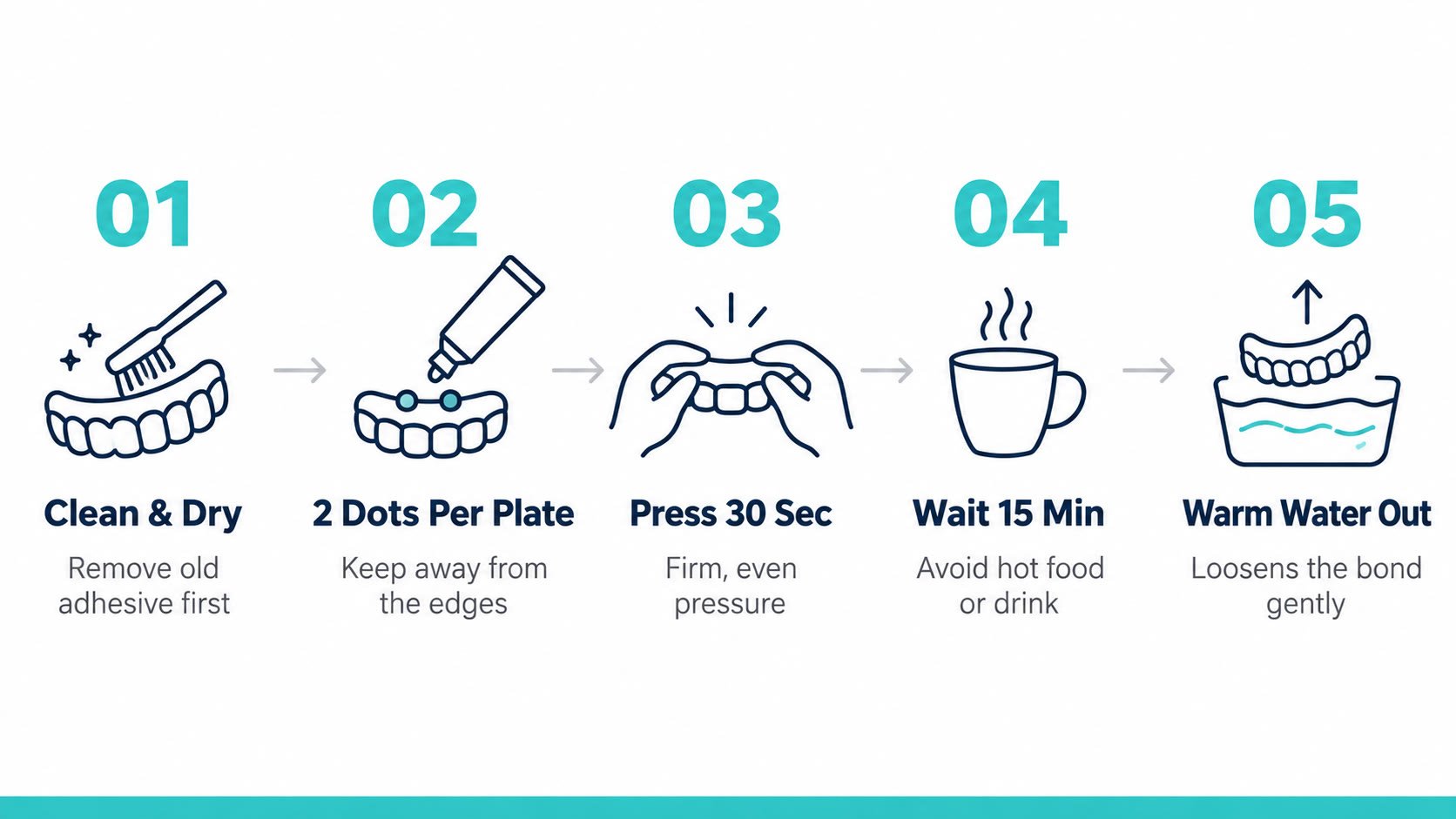
To remove the denture, warm water loosens the bond enough to ease the plate out without discomfort. Remaining adhesive in the mouth rinses away. On the denture itself, a soft brush removes residue before the evening clean. For a deeper clean after removal, Retainer & Denture Cleaner Tablets lift stains, plaque, and odor from dentures, retainers, and aligners in a 15-minute soak.
If adhesive is visible at the plate edges after seating, you've used too much. Start with less than you think you need and adjust from there.
The Brands Worth Knowing
The US market has a few dominant options, and one important differentiator to watch for across all of them: whether the formula contains zinc, fluoride, both, or neither.
Fixodent Complete Original: A zinc-containing formula with strong all-day hold. One of the best-selling products in the category. Fixodent also produces zinc-free versions, including Fixodent Free.
Super Poligrip Original: Reformulated to be zinc-free, with a waterproof hold. Popular for full upper plates. The Power Max variant is the brand's highest-hold option.
Secure Waterproof Denture Adhesive: A smaller-brand option with a genuinely waterproof formula, preferred by some wearers who swim or live in humid conditions.
Avistar Extra Strong Denture Adhesive Cream: Zinc-free and fluoride-free, with a 12-hour hold and a precision nozzle that applies the cream in a thin, controlled line rather than a thick smear. That nozzle detail is more practical than it sounds: most over-application problems come from tubes with wide openings that encourage too much product in one go. The mint formula keeps things fresh rather than medicinal. Available in 2-pack, 3-pack, and 5-pack sizes, with a subscription option that takes 15% off each delivery. You can browse pack sizes at the Avistar Denture & Retainer page.
On generics: store-brand formulations exist at major pharmacies at a lower per-tube price. Quality varies more than with name brands. For personal daily use, the cost difference is meaningful. For care facility purchasing, consistency of application and product reliability tend to matter more than per-tube savings.
What Care Facilities Should Consider When Stocking Denture Adhesive
Senior living communities, skilled nursing facilities, and memory care units face a purchasing challenge that individual consumers don't: they're buying for a diverse group of residents, application is often staff-assisted, and infection-control protocols shape how products are stored and distributed.
A few considerations that tend to get overlooked:
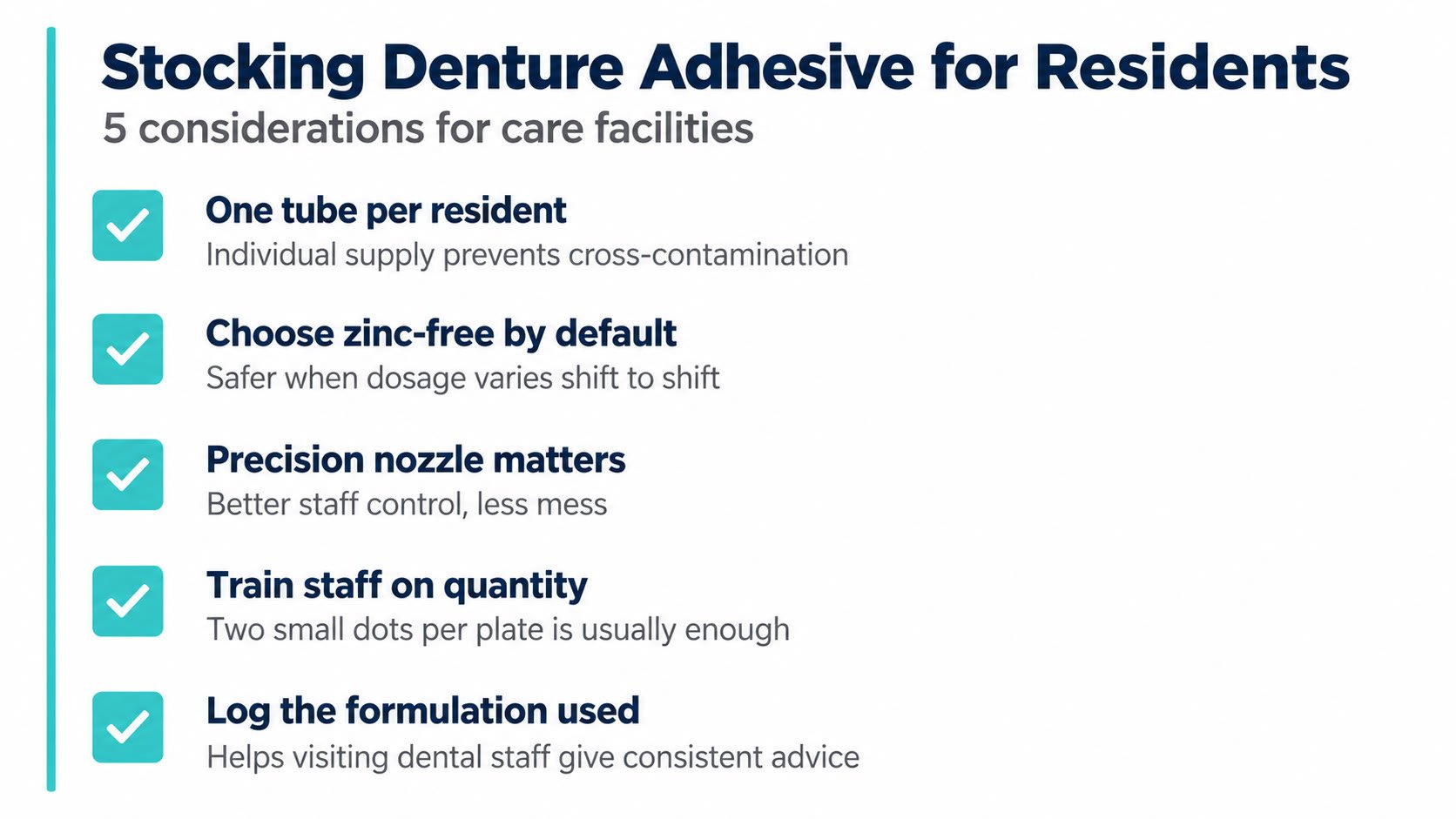
Individual supply per resident, not shared. Each resident should have their own tube. Cross-contamination is a real concern and keeping supplies individually assigned is consistent with the broader principle of personal hygiene product management in care settings.
Zinc-free as the facility default. For the reasons covered above, zinc-free formulations reduce one variable in an environment where monitoring individual product use is inherently difficult. Fluoride-free formulas are an additional consideration for residents with complex dental care routines.
Nozzle design matters for staff-assisted application. Tubes with precision nozzles give care workers more control over placement and quantity, which directly reduces the over-application issue that leads to messy cleanup and resident discomfort. This is one practical reason to compare tube designs, not just formulas, when sourcing for a facility.
Staff training on application. A small amount applied correctly outperforms a large amount applied incorrectly every time. Staff who regularly assist with oral care benefit from a brief protocol covering placement, quantity, and removal.
Coordination with visiting dental services. Many residents with dentures see visiting or mobile dental staff. Keeping a note of which formulation a resident uses makes those handoffs cleaner and reduces the risk of conflicting advice.
Avistar's Extra Strong Denture Adhesive Cream is available in multi-packs, qualifies as an FSA and HSA-eligible expense in the US, and ships the next business day. Pair it with Retainer & Denture Cleaner Tablets for a complete denture-care supply that covers both daily hold and overnight cleaning in one order. The 150-count tablet pack covers roughly five months of daily use per resident.
For the broader oral care setup, including individually wrapped toothbrushes and floss picks for residents, see Avistar's Oral Care collection or the guide to buying toothbrushes in bulk for sourcing context.
Why Trust This Article
We're Avistar, a supplier of guest amenities and oral care products for hospitality properties and care settings. Our product line includes the Extra Strong Denture Adhesive Cream covered in this article, along with toothbrushes, floss picks, retainer cleaner tablets, and other personal care staples sourced in bulk by hotels, short-term rental operators, and care facility administrators.
This article draws on manufacturer product pages and publicly available dental health guidance relevant to US users and facilities. We identified gaps in how adhesive types, zinc safety, application technique, and care facility considerations are typically explained, and aimed to address those gaps with specific, practical information.
For facility-specific purchasing or clinical protocol decisions, verify details with your dental or clinical staff before making changes to resident care procedures.
Frequently Asked Questions
What is denture adhesive cream and how does it work?
Denture adhesive cream is a paste applied to the fitting surface of a denture to improve stability and limit movement during eating and speaking. When the denture is placed in the mouth, saliva activates the adhesive and creates a thin film between the denture base and the gum tissue. This film increases surface contact, reduces shifting, and helps seal out food particles. Most formulations hold for six to twelve hours before needing to be reapplied or replaced.
Is denture adhesive cream safe to use every day?
When used as directed, in a small amount applied once or twice daily, denture adhesive cream is generally considered safe for daily use. The safety concerns historically associated with zinc-containing formulations arose from documented cases of people applying very large quantities over extended periods, not from normal daily use. Anyone preferring to avoid zinc entirely can choose one of the zinc-free formulations available from major US brands, including Avistar's Extra Strong Denture Adhesive Cream, which is both zinc-free and fluoride-free.
How much denture adhesive cream should I use?
Less than most people instinctively apply. Two small dots per plate is a practical starting point. The adhesive distributes when the denture is seated, so start with less than you think you need and adjust up on the next application if you need more hold. If cream is visible at the plate edges after placement, reduce the amount next time.
What is the difference between Fixodent and Poligrip?
Both are well-established denture adhesive creams produced by major consumer health companies. For most users, the practical differences are minor. Super Poligrip has been reformulated to be zinc-free in its standard lineup; Fixodent offers both zinc-containing and zinc-free options. Some users find one brand's texture or flavor more comfortable, which drives product loyalty. For care facility purchasing, consistent availability in quantity and staff familiarity with the product tend to matter more than brand choice.
Should care facilities use zinc-free denture adhesive cream for residents?
Zinc-free formulations are a practical default for care settings where staff assist residents with adhesive application and consistent dosage is harder to monitor. Products formulated without zinc reduce the variable of inconsistent application patterns over time. Some facilities also prefer fluoride-free formulas for residents with more complex dental care routines.
Can denture adhesive cream replace a properly fitting denture?
No. Denture adhesive enhances a good fit and compensates for gradual changes in fit as the jaw ridge changes over time. It is not a substitute for a denture that fits properly. If someone is relying on large amounts of adhesive to hold a very loose denture in place, that's a clear signal to see a dentist for a reline or a new denture. Heavy adhesive use to compensate for a severely ill-fitting plate can cause gum irritation and, with zinc-containing products, raises the risk of excessive zinc intake over time.
Is denture adhesive cream FSA or HSA eligible?
Yes, denture adhesive cream qualifies as an eligible expense under US FSA and HSA plans. This applies to products specifically formulated and marketed as denture adhesive, including Avistar's Extra Strong Denture Adhesive Cream. Check with your specific plan administrator for confirmation, as eligibility rules can vary by provider.