Most operators searching for bulk toiletries don't need another article about how toiletries affect guest reviews. They need to know where to order, what it costs per unit, and whether the supplier can actually keep them stocked through their busiest month of the year.
Bulk toiletries for hospitality use (soap, shampoo, conditioner, body wash, lotion, and oral care basics) are available through four main sourcing channels. Each one suits a different property size, operational model, and risk tolerance. Here's the breakdown.
Quick Buyer's Guide
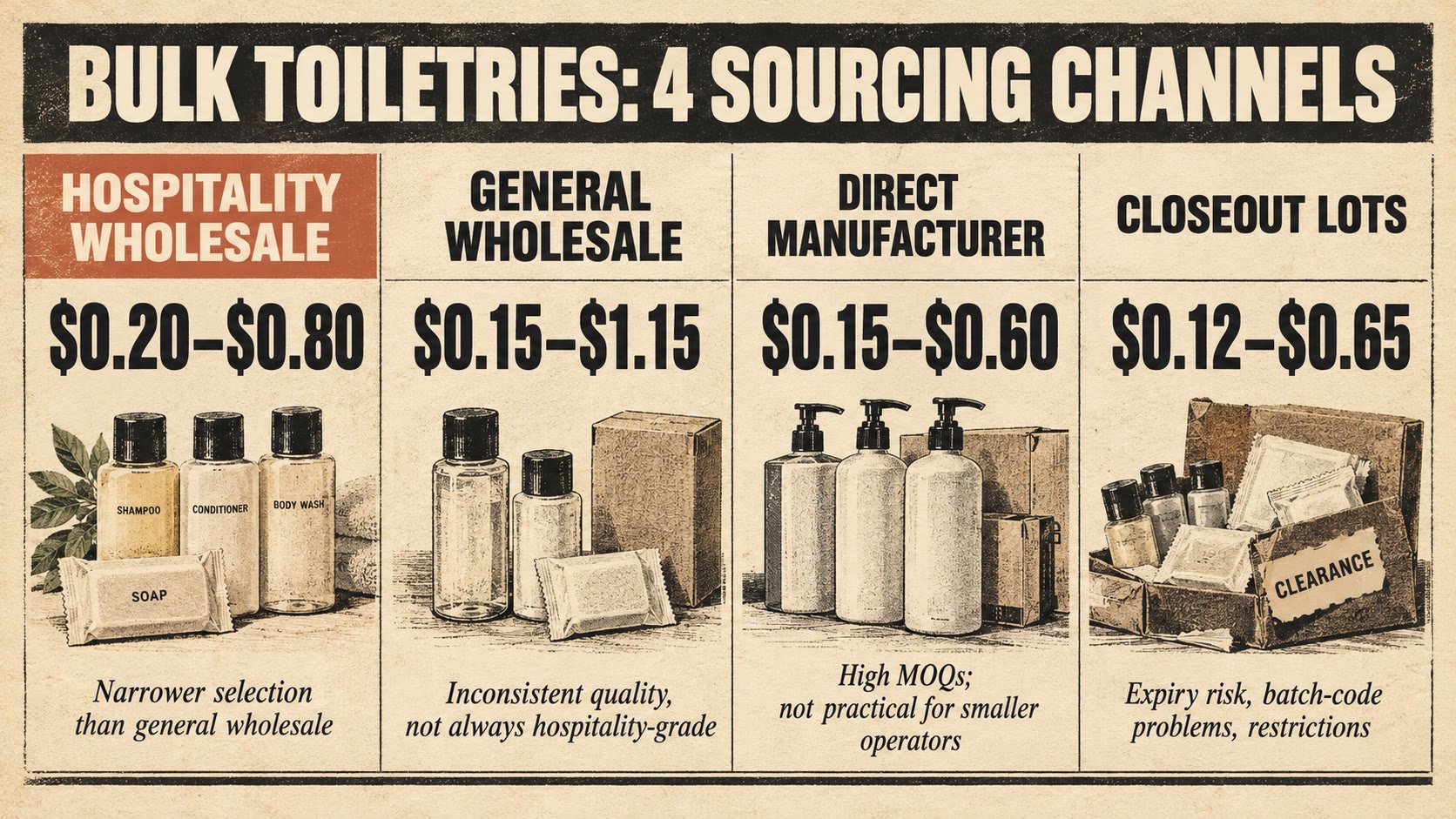
| Sourcing channel | Best for | Typical MOQ | Per-unit cost | Main trade-off |
|---|---|---|---|---|
| Hospitality-specialist wholesale | Hotels, hosts, property managers, care facilities | Low to none | $0.20–$0.80 | Narrower selection than general wholesale |
| General wholesale (Amazon Business, WebstaurantStore) | Mixed-category buyers, one-off needs | Varies | $0.15–$1.15 | Inconsistent quality, not always hospitality-grade |
| Direct manufacturer programs | 100+ room hotels | 500–2,000+ units/SKU | $0.15–$0.60 | High MOQs; not practical for smaller operators |
| Closeout / liquidator lots | Resellers, very high volume | 2,000–5,000 units | $0.12–$0.65 | Expiry risk, batch-code problems, "not for retail sale" restrictions |
What "Bulk Toiletries" Actually Covers
The category breaks into three practical tiers for most operators.
Non-negotiables: soap or body wash, shampoo, conditioner, lotion. Guests don't mention these when they're present. They do mention when one is missing.
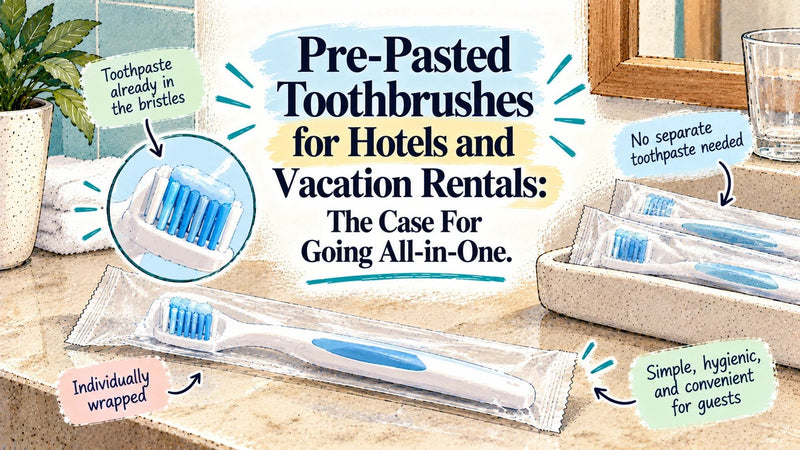
The single highest-impact add: a dental kit: toothbrush and toothpaste. Guests forget their toothbrush more reliably than any other toiletry. The properties that solve this problem generate reviews that say so specifically. The ones that don't generate a different kind of review.
Property-specific extras: shower cap, shaving kit, floss picks, cotton swabs, cotton pads, mouthwash. Right for mid-range and above; the right selection depends on your nightly rate and guest expectations.
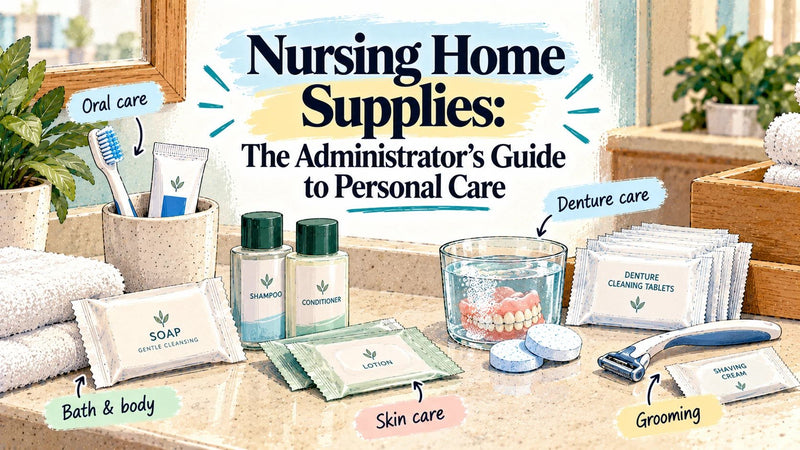
For care facilities, the list extends further: denture care products, softer-bristle oral care, individually wrapped formats designed to meet infection control requirements. That's a distinct product category with different sourcing considerations.
What doesn't belong on a bulk toiletries order: full-size products (not suited to per-stay restocking), unbranded stock without batch codes (shelf-life risk), and fragrance-heavy lines designed for retail shelves rather than guest bathrooms.

The Four Sourcing Channels, Plainly Compared
Hospitality-Specialist Wholesale Suppliers
This is where most independent hotels, short-term rental operators, and care facilities should start. Suppliers like Avistar, Amenities Depot, Direct Textile Store, and Zogics are built specifically for hospitality operations: case pack sizes that work for small-to-mid properties, individually wrapped and kit-format options designed for room turnover, and product lines built for shelf stability rather than retail shelf appeal.
The operational advantage is real. Case packs at these suppliers are sized for a 10-unit Airbnb portfolio or a 60-room independent hotel, not a manufacturing minimum that would take most operators a year to use. Products are designed to arrive guest-ready. And supplier teams understand the operational context when you call.
The honest limitation: selection is narrower than a general wholesale platform. You're sourcing from a curated hospitality catalog, not a warehouse of everything. For most operators, that's a feature. For operators who want to consolidate dozens of categories into one purchase, it's a constraint worth knowing about.
General Wholesale Platforms
Amazon Business, WebstaurantStore, and similar platforms offer enormous variety and competitive unit pricing, and they're genuinely useful for occasional one-off categories or when you're still testing what works for your property. The issue with relying on them for a core toiletries program is consistency: the same product listing may ship from different manufacturers across orders, batch coding is often absent, and the sealed-fresh presentation that hospitality-specific products are designed around isn't always part of the picture.
This sourcing channel works well as a secondary option. It's a rough tool for what is, in practice, a fairly precise job.
Direct Manufacturer Programs
Large hotel chains (typically 100 or more rooms) sometimes qualify for direct pricing from a manufacturer or a branded amenity program. The per-unit economics can be compelling at that scale. The trade-offs are meaningful: minimum orders of 500 to 2,000 units per SKU, lead times that require more inventory planning than most independent operators want to manage, and less flexibility to swap out products without commitment.
For independent hotels under 100 rooms, the per-unit savings rarely justify the cash outlay and operational complexity. For larger operations running a consistent product line across multiple properties, it's worth modeling the math.
Closeout and Liquidator Lots
This is how resellers and high-volume discount operators source. Unit cost can be very low, as little as $0.12 to $0.65 per unit for hotel amenity overstock. The risks aren't abstract: batch codes may show products within 12 to 18 months of expiry, "not for individual retail sale" restrictions apply to many hotel amenity lots, and quality varies significantly across lots.
Unless you have the infrastructure to inspect, batch-code verify, and rotate stock aggressively, closeout sourcing creates problems that the unit cost savings don't cover.
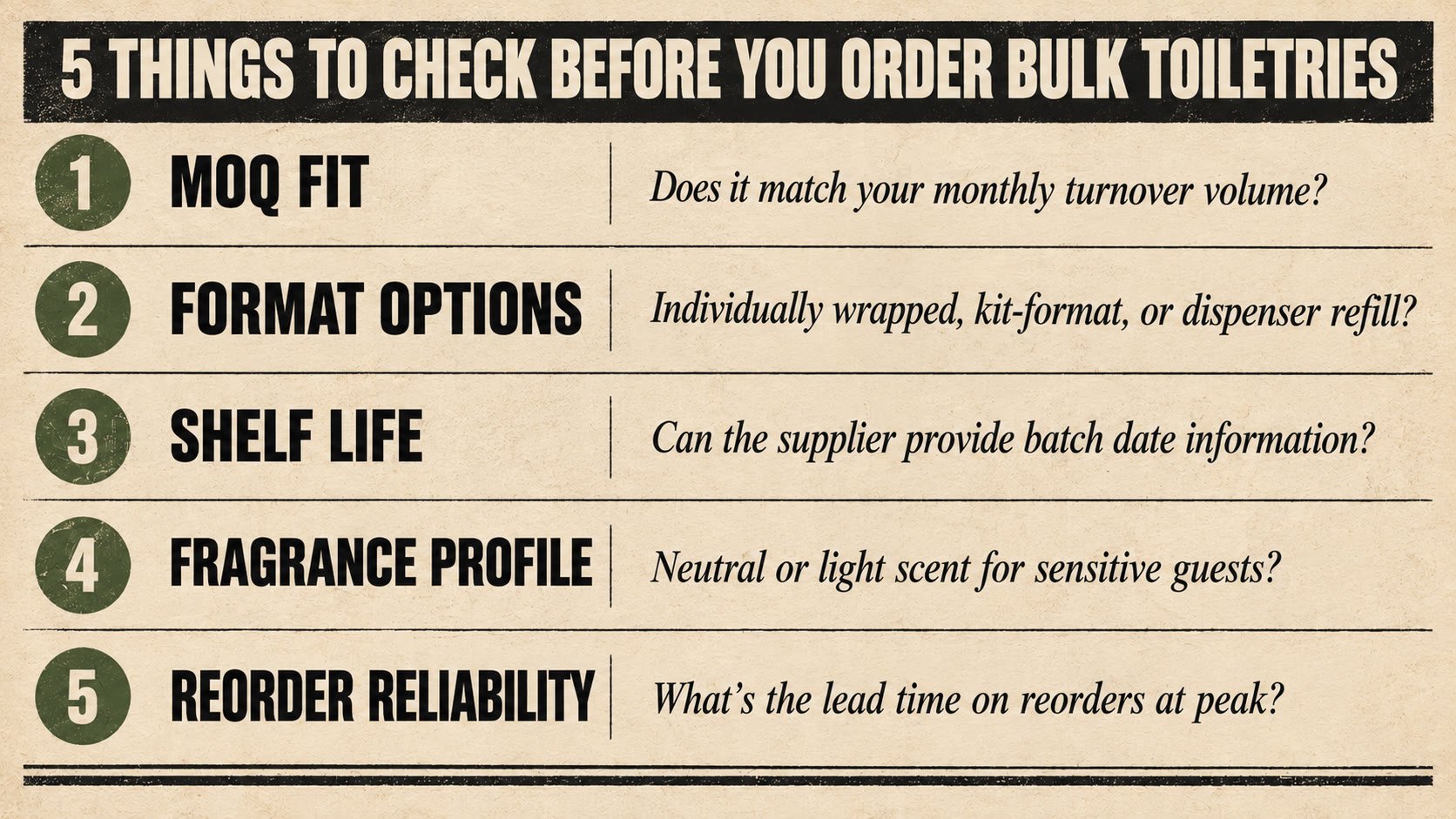
Five Things to Check Before You Commit to a Supplier
Most operators check one or two of these on the first order and discover the rest when something goes wrong mid-peak.
- MOQ relative to your actual turnover rate. Before you commit, run the math: how many room turnovers per month at peak, how many units per turnover, and how long a case at the supplier's minimum order would actually last you. If the answer is "eight months," that's a cash flow problem and a shelf-life risk at once.
- Format options. Does the supplier carry individually wrapped, kit-format, and dispenser refill in the same product family? If your portfolio includes both high-turnover short-term rentals and extended-stay units, you need both formats from one supplier, not two separate sourcing relationships.
- Shelf stability and batch coding. Travel-size individually wrapped products need shelf lives of 18 to 36 months to work within a typical bulk order and storage timeline. Any supplier that can't provide batch date information on an order is a supplier you'll have a problem with eventually.
- Fragrance profile. Neutral or lightly scented is the right default for most hospitality and care settings. Fragrance-heavy products designed to sell off a retail shelf generate complaints from guests with sensitivities. In care facilities, this matters more, not less.
- Reorder reliability. The first order is easy. The sixth one, arriving before you run out mid-peak season, is the test. Ask suppliers directly: what's your typical lead time on reorders, what's your in-stock rate on core SKUs, and what's the process when a product goes out of stock on a standing order? Vague answers to specific questions are specific answers.
Property Type: Quick-Reference Sourcing Fit
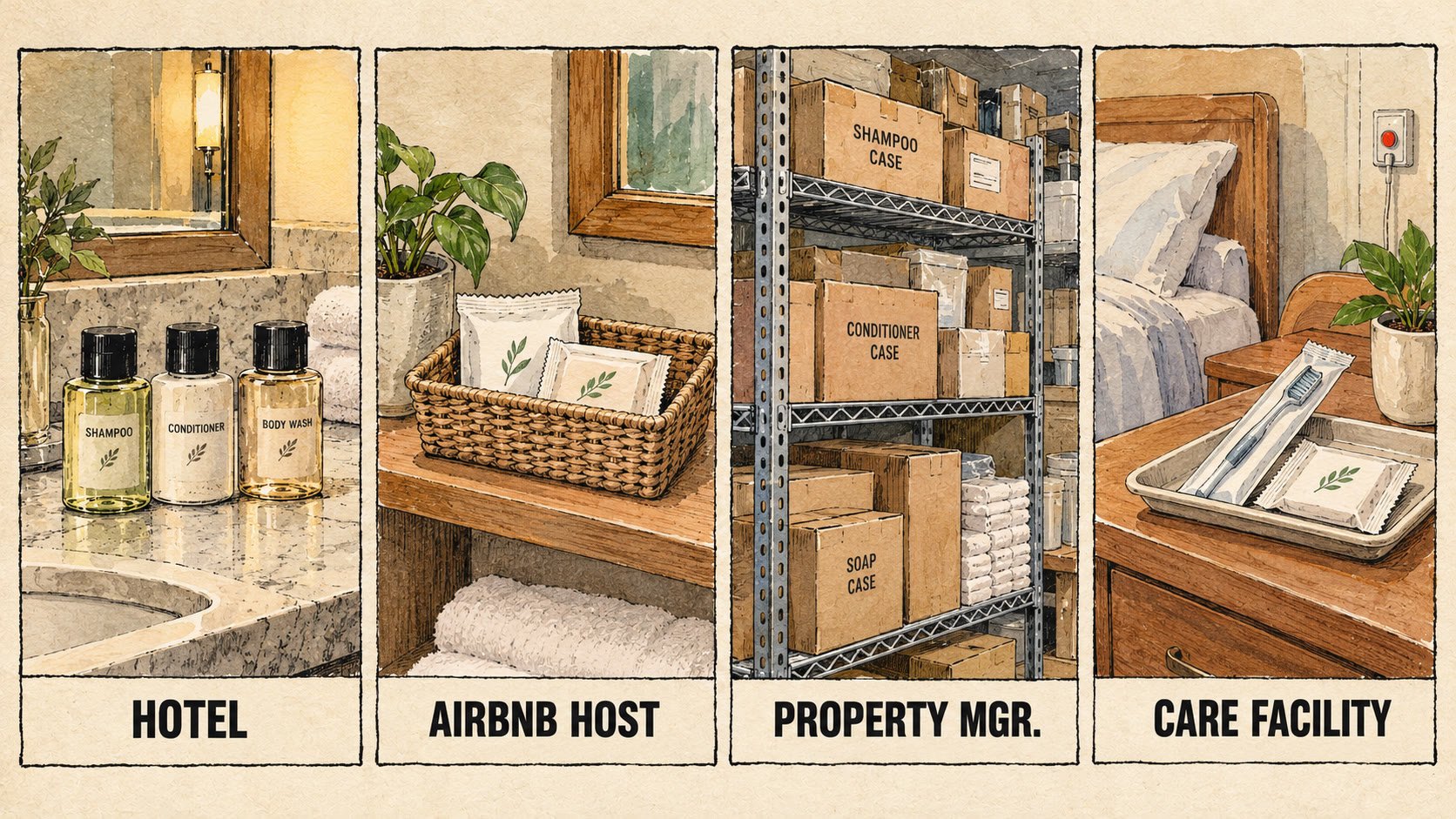
| Property type | Recommended channel | Format | Key consideration |
|---|---|---|---|
| Independent hotel (under 100 rooms) | Hospitality-specialist wholesale | Individually wrapped or dispenser | MOQ fit and reorder reliability |
| Airbnb / short-term rental host | Hospitality-specialist wholesale | Individually wrapped | Sealed presentation, no housekeeping team for dispensers |
| Property manager (20+ units) | Hospitality-specialist wholesale | Individually wrapped | Consistent product across all units; par level planning |
| Senior living / care facility | Hospitality-specialist wholesale | Individually wrapped (required) | Infection control, gentle formulas, expanded oral care |
| Large hotel chain (100+ rooms) | Direct manufacturer or hospitality wholesale | Dispenser or individually wrapped | MOQ economics; brand program consideration |
Where This Comes From
We're Avistar, and we sell wholesale guest amenities to hotels, Airbnb hosts, property managers, and care facilities across the United States. One of the sourcing channels described in this article is us, so that context belongs upfront.
The reason the guidance above is worth reading anyway: we see sourcing decisions go wrong. The property that bought a year's supply and found batch codes showing 14 months to expiry. The host who switched to dispensers mid-season without a housekeeping protocol in place to support them. The property manager who optimized for lowest unit cost and spent the next six months managing a reorder problem.
The evaluation criteria in this article come from those patterns. That's a more useful starting point than the generic hospitality research most buying guides are built from.
Shop Bulk Toiletries Through Avistar
Our catalog covers the full range of bulk toiletries for hospitality and care settings. That includes individually wrapped soap bars and moist towelettes, complete guest amenity sets bundling shampoo, conditioner, body wash, and lotion into a single reorder, and oral care kits covering toothbrushes, pre-pasted brushes, and floss picks.
All products are available at wholesale pricing through the wholesale page. No 500-unit minimums designed for manufacturing economics. No retail product lines repurposed for hospitality.
For more on the full category, our bulk hygiene products guide covers par level calculations, per-unit cost math across the full range, and format decisions by property type. If you're evaluating the full amenities program by property tier, the hotel toiletries guide covers product selection from budget to luxury in detail.
Frequently Asked Questions
What are bulk toiletries?
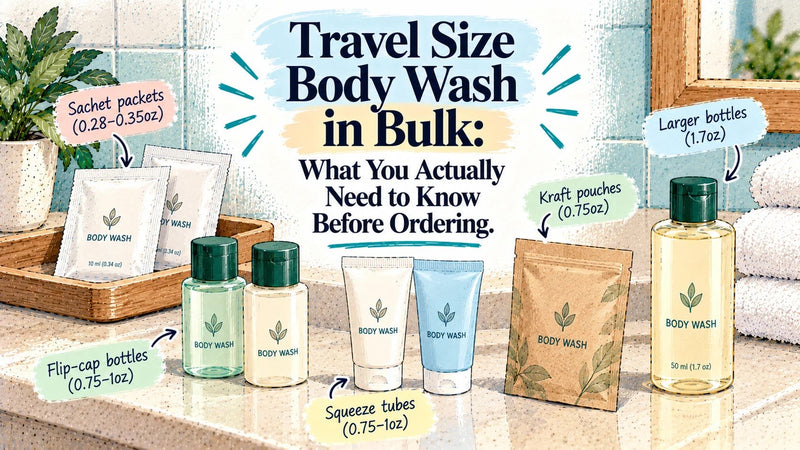
Bulk toiletries are personal care consumables purchased in large quantities for commercial use: soap, shampoo, conditioner, body wash, lotion, and oral care products like toothbrushes and toothpaste. In hospitality, they're bought by the case or pallet from wholesale suppliers and used to stock guest bathrooms at hotels, vacation rentals, and care facilities. The category covers both individually wrapped travel-size formats and larger refill containers used with dispenser systems.
How much do bulk toiletries cost per unit?
At hospitality-specialist wholesale pricing, individual travel-size units typically cost between $0.20 and $0.80 per unit depending on product type, packaging, and order volume. A complete per-guest bathroom restocking (soap, shampoo, conditioner, body wash, lotion, toothbrush, and toothpaste) runs between $1.50 and $4.00 at mid-tier bulk pricing. Direct manufacturer programs can reduce per-unit cost below these ranges, but usually require minimum orders of 500 to 2,000 units or more per SKU.
Where do hotels buy toiletries in bulk?
Most independent hotels and mid-size properties source from hospitality-specialist wholesale suppliers (Avistar, Amenities Depot, Direct Textile Store, Zogics), general wholesale platforms (Amazon Business, WebstaurantStore), or direct manufacturer programs for larger-chain properties. Hospitality-specialist suppliers are the most common choice for independent hotels because case pack sizes and product formats are designed for per-stay restocking rather than retail distribution.
What is the minimum order for bulk toiletries?
It depends on the supplier. Hospitality-specialist wholesale suppliers typically have low or no minimums on reorders, with case packs available from around 24 units on some products to several hundred units for larger bulk orders. General wholesale platforms vary by seller. Direct manufacturer programs typically require 500 to 2,000 units per SKU as a first-order minimum. For small-to-mid portfolio operators, hospitality-specialist suppliers are the practical choice because their order sizes are built around property operations rather than manufacturing economics.
What is the difference between individually wrapped toiletries and dispensers for bulk buying?
Both formats are available from most hospitality wholesale suppliers. Individually wrapped products suit high-turnover short-term rentals and care facilities where sealed presentation matters and housekeeping capacity is limited. Dispensers suit full-service hotels with daily housekeeping, extended-stay properties, and anywhere sustainability is a clear guest-facing priority. Many operators use both: dispensers for bath products and individually wrapped for dental kits and specialty items. Neither format is categorically better; the operational model determines the fit.
What bulk toiletries do care facilities need?
Care facilities need individually wrapped formats (often required by infection control protocols), formulations that are gentle on sensitive skin and low in fragrance, and an extended oral care range: toothbrushes with softer bristles, toothpaste, floss picks, and, for residents with dental appliances, denture care products including cleaner tablets and retainer cases. The restocking model also differs from hospitality: staff place products room by room during rounds rather than leaving a full set in the bathroom between guest turnovers. Sourcing from a supplier familiar with care facility requirements is worth the specificity.