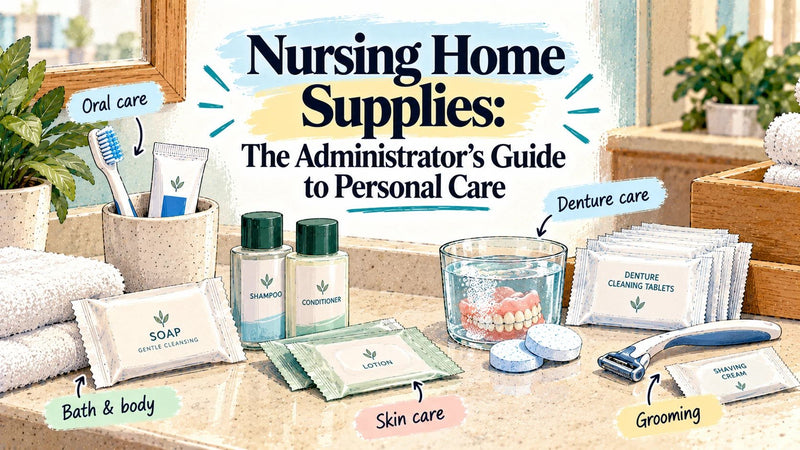
Denture cleaning tablets are effervescent tablets dissolved in water to create a soaking solution for removable dental appliances, including full dentures, partial dentures, retainers, and night guards. For care facilities where a significant portion of residents wear dentures, they are a recurring daily supply need that rarely gets the same systematic attention as medications, linens, or meal service.
That gap is worth fixing.
Here is a scenario that plays out in care facilities across the country every day. A resident's dentures sit in a cup overnight. By morning, nobody has tracked whether a cleaning tablet was used, whether the facility stocks them in the right location, or whether this particular resident can manage the process independently. Nobody documented it. Nobody ordered enough to last the month. And the resident is wearing dentures that have not been properly cleaned in days.
This is not a negligence story. It is a systems story. Denture cleaning tablets get treated as a purchase-once, think-never supply item, right up until they surface as a care quality issue in an audit or a family complaint.
The fix is not complicated. But it does require treating denture care supplies the same way you treat every other clinical supply: with a clear protocol, a stocking calculation, and the right format for your setting.
The Scale of the Problem Most Facilities Underestimate
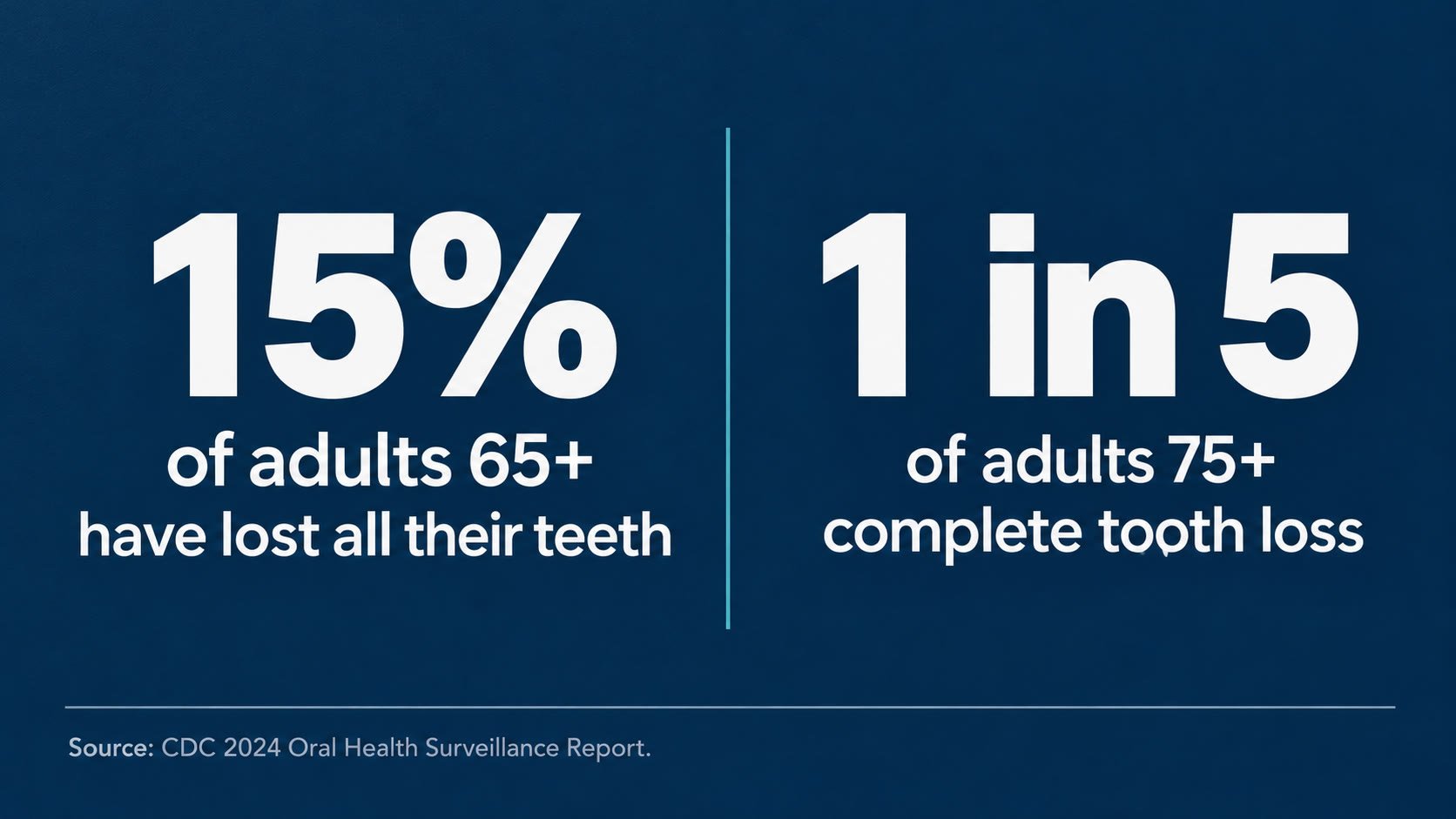
According to the CDC's 2024 Oral Health Surveillance Report, approximately 15% of adults aged 65 and older have lost all their natural teeth. Among adults 75 and older, that figure rises to nearly 1 in 5. In assisted living and skilled nursing settings, where residents skew older and carry more complex health histories, those rates are typically higher than community averages. And complete edentulism only captures part of the picture: many more residents wear partial dentures, which also require daily tablet cleaning.
In a 40-resident memory care unit, you are likely looking at 8 to 12 residents who need daily denture care support. In a 120-bed skilled nursing facility, that could be 25 to 35 people.
What most facilities actually have in place:
- A bottle of generic denture tablets in a shared supply closet
- No per-resident tracking or documentation
- No written restocking schedule
- No staff protocol for assisted denture cleaning
What those residents actually need: a consistent daily process using a clinically sound cleaning agent, administered reliably, tracked in their care plan.
The distance between those two things is where resident oral health problems quietly grow.
What Denture Cleaning Tablets Actually Do
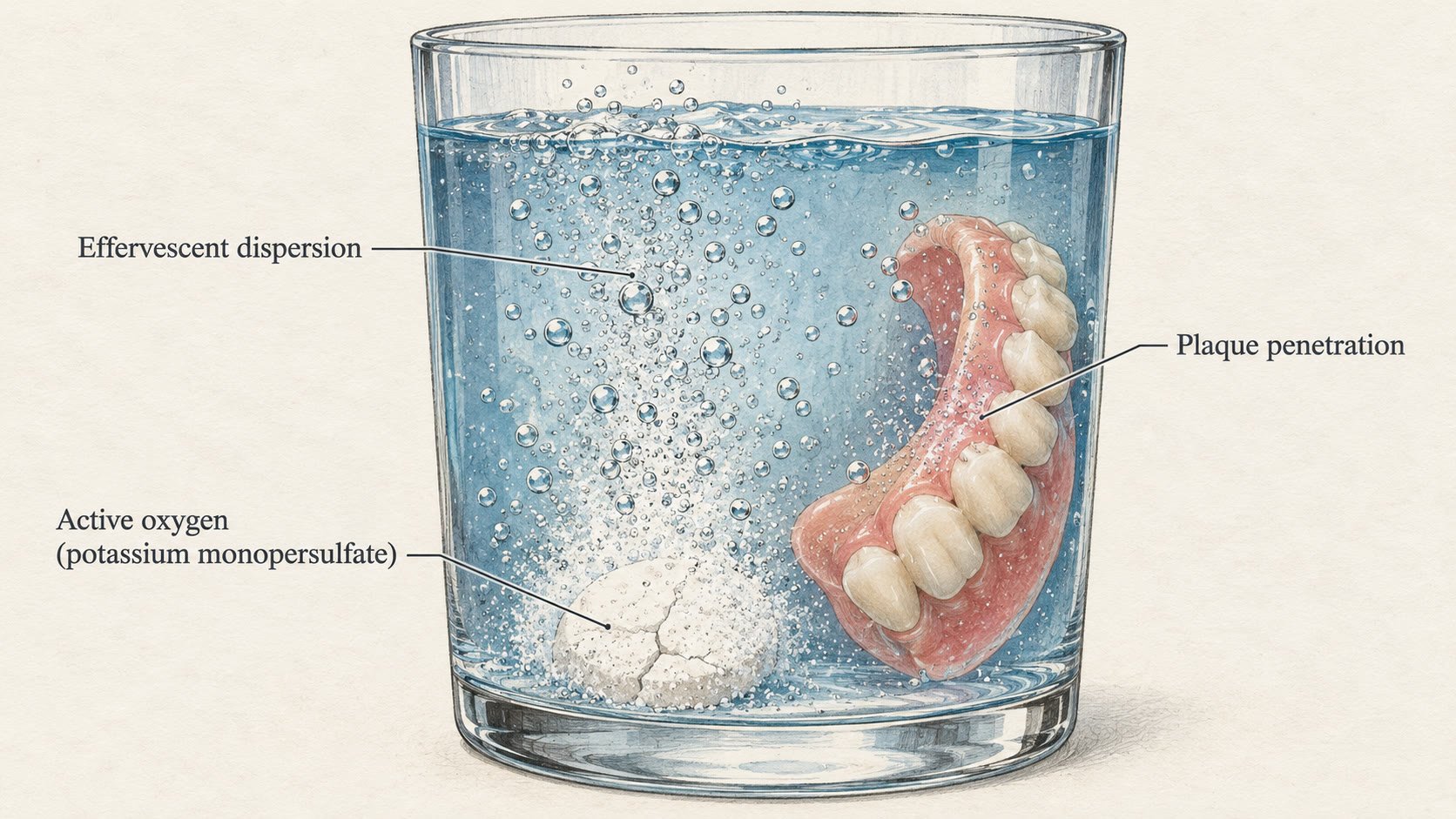
A denture cleaning tablet is an effervescent cleanser. Drop it into warm water and it releases active oxygen from oxidizing agents such as potassium monopersulfate or sodium percarbonate. Sodium bicarbonate and citric acid drive the effervescent fizzing action that disperses these compounds through the solution. Together, the chemistry penetrates the porous surface of acrylic and metal denture components.
That chemical action does three things:
- Breaks down organic material, including food debris and plaque
- Kills odor-causing bacteria
- Lifts surface stains from the denture material over time
The key difference from brushing alone: a brush cannot reach the interior contours of a denture the way a full soak can. Using a tablet is not a luxury step. It is the part of the cleaning process that handles what mechanical brushing misses. For residents wearing dentures all day, that matters for both comfort and oral health.
Most tablets work in 3 to 15 minutes depending on the formulation. Some overnight-formula products require a longer soak for heavy buildup, making them better suited to the end-of-day routine.
Tablets, Powder, Paste: Which Format Makes Sense in a Care Setting?
| Format | Soak time | Per-use cost | Care facility fit |
|---|---|---|---|
| Effervescent tablet | 3–15 min (or overnight) | Low | Strong, especially individually wrapped |
| Powder cleanser | 5–15 min | Low | Moderate: staff must measure each use |
| Paste or gel | Manual brush only | Moderate | Supplemental use, not a standalone soak |
Tablets are the default format in care settings for a reason: they are pre-measured, easy to administer without any staff judgment on dosing, and require nothing other than water and a cup.
A powder requires scooping, which introduces inconsistency between staff members and shifts. A paste requires direct brushing on the denture, which either takes additional staff time or assumes a level of resident dexterity that may not be there.
When your goal is a repeatable, documentable process across multiple staff and multiple residents, tablets are the right answer.
Why Individually Wrapped Tablets Matter More Than You Think
Most consumer-facing denture tablet products come in a shared bottle: 40, 60, or 90 tablets, one opening, used repeatedly. That format makes sense in a household of one or two people. It does not make sense in a care facility with 15 residents who each need a daily tablet.
Here is why the individual wrapping question matters operationally.
Cross-contamination risk. Every time a staff member reaches into a shared container for multiple residents, there is a potential contamination vector. Individually wrapped tablets eliminate this entirely and are easier to defend in an infection control review.
Per-resident accountability. An individually wrapped tablet is a discreet, trackable unit. It can be logged per resident, counted against care plan documentation, and audited. A shared bottle is none of those things.
Resident dignity. This point is underrated. A resident who is still managing their own denture care independently is receiving their own sealed, single-use tablet. That is the same experience a hotel guest would have. For a resident in memory care who may not fully understand the context, being handed something sealed communicates cleanliness in a way a shared bottle does not.
Shelf stability. Tablets in a shared bottle absorb ambient moisture every time the cap is opened, especially in bathroom environments. Individually wrapped tablets maintain their integrity until the moment of use, which matters when you are buying months of supply at once.
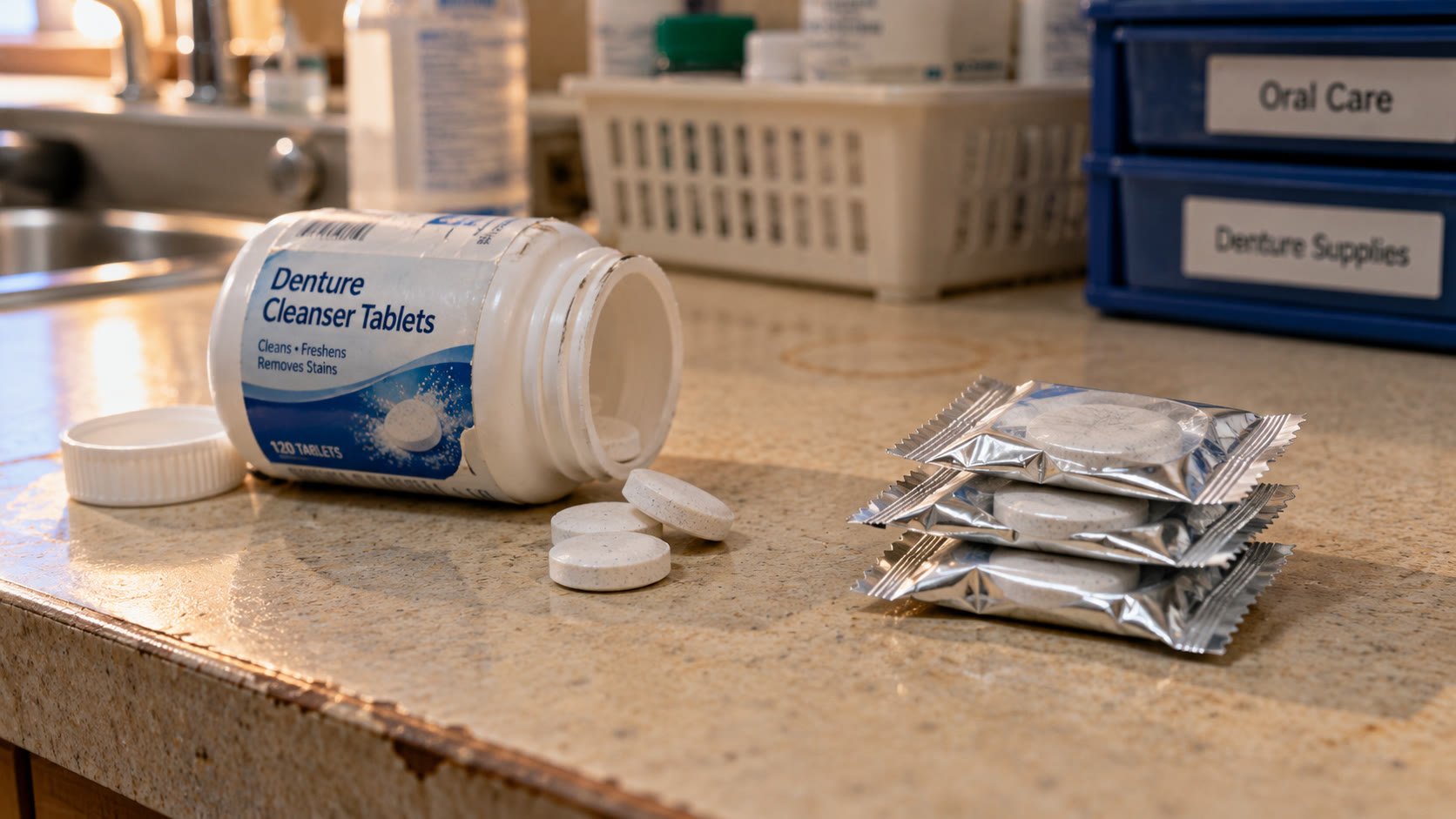
Institutional denture tablet products like those from Dynarex are designed specifically for long-term care settings: individually portioned, case-packed at 960 units (24 boxes of 40), and explicitly labeled for care facility use. That format exists because the operational requirements of a care setting are genuinely different from a bathroom cabinet.
What to Look for When Buying Denture Cleaning Tablets in Bulk
If you are sourcing for a care facility, these are the criteria that actually matter, in order of importance.
1. Active oxygen formula. Look for potassium monopersulfate or sodium percarbonate as active ingredients. These are the compounds doing the antibacterial and stain-lifting work. "Effervescent" alone does not confirm clinical efficacy.
2. Metal-safe formulation. Many residents have partial dentures with cobalt-chromium alloy clasps. Not all tablet formulations are safe for metal components. Confirm this on the product label before standardizing across your population.
3. Soak time that fits your care schedule. If your staff are assisting with denture removal as part of the evening routine, overnight soaks are workable. If the morning schedule requires dentures back in quickly, a 3-to-5-minute formula is the right choice.
4. Individual wrapping. For all the reasons above, individually wrapped is the more defensible format for any multi-resident setting.
5. Case quantity and lead time. Institutional suppliers sell denture tablets in case packs, typically 24 boxes per case. Know your quarterly consumption before ordering so you are not placing monthly emergency orders. Lead time on institutional supplies typically ranges from 2 to 7 business days depending on the distributor.
6. Persulfate allergen consideration. Standard effervescent denture cleaners contain persulfates, which are a documented allergen listed on product labels. Before standardizing to a single product across all residents, check whether any residents have documented persulfate sensitivity. Alternative formulas without persulfates do exist.
The Stocking Math: How Many Tablets Does Your Facility Actually Need?
This is the calculation most facilities skip, then wonder why they run out in week three of the month and end up with ad hoc restocking from a drugstore at retail prices.
The formula is straightforward:
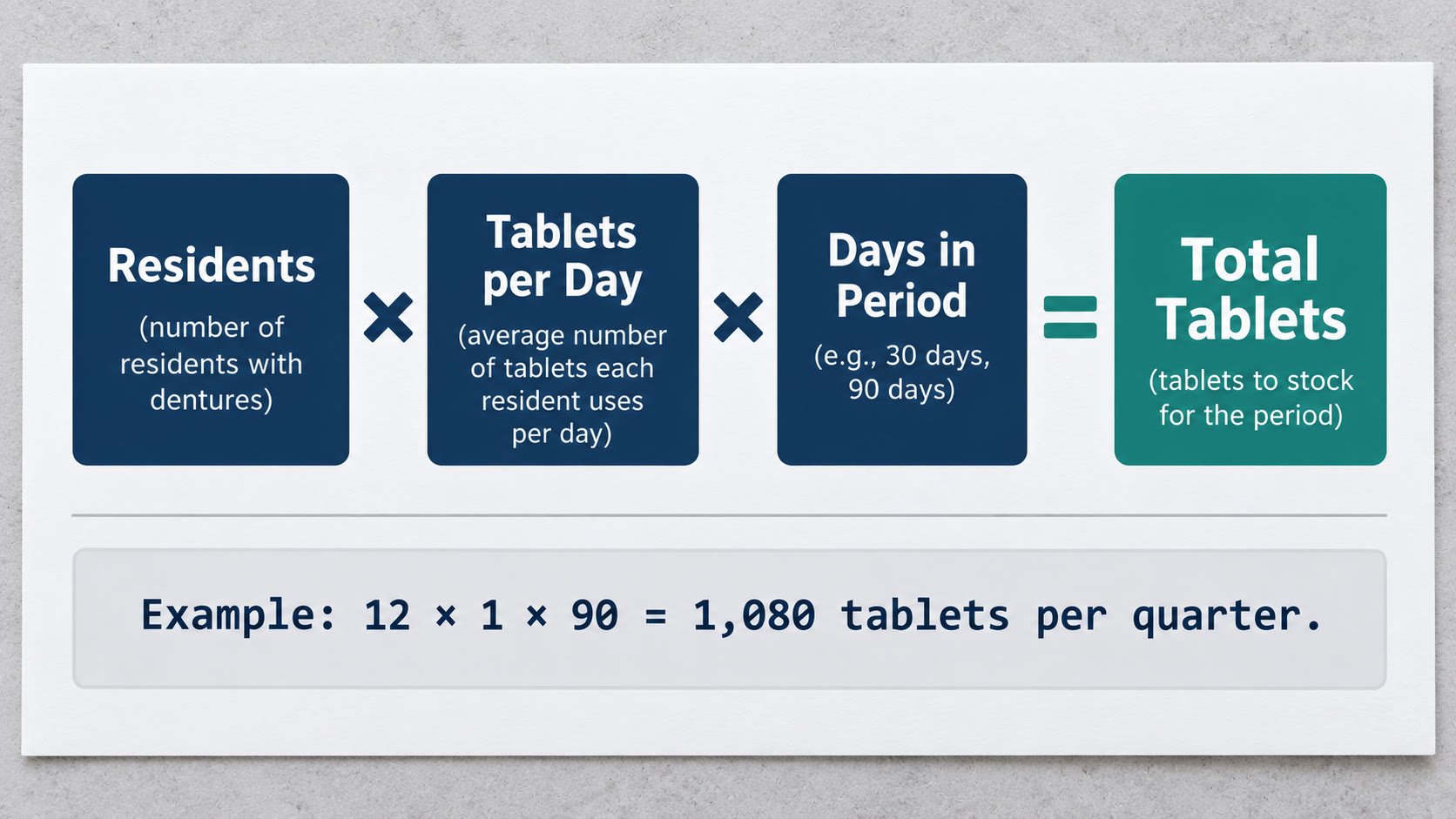
Residents with dentures or partials x tablets per day x days in ordering period = total tablets needed
Example: 12 residents, daily use, 90-day order cycle:
12 x 1 x 90 = 1,080 tablets per quarter
At 960 tablets per case (24 boxes of 40), one case covers most of a quarter. Order a case and a quarter and you have buffer for new admissions, occasional double-soaks for heavy buildup, and the inevitable supply delay.
For memory care or higher-acuity units where staff are more likely to be assisting directly with denture cleaning, add 10 to 15 percent to your estimate. Residents who cannot self-manage denture care are also the residents most likely to have dentures that are cleaned inconsistently, which means heavier buildup and more frequent need for deeper soaks.
About This Guide
At Avistar, we supply oral care and hygiene products to senior living facilities, care homes, and hospitality properties that need reliable bulk solutions rather than retail-scale packaging. Our perspective on denture cleaning comes from that operational context: understanding what works when a care director is managing dental hygiene protocols for dozens of residents, not just one.
We built this guide from the operational reality of institutional buyers, not from a consumer product review framework. The criteria above reflect what actually matters when you are sourcing for 20 residents across two shifts, not what matters for your own bathroom.
Avistar's Denture and Retainer Cleaning Tablets
Our Retainer & Denture Cleaner Tablets are formulated for daily use on dentures, retainers, aligners, and night guards. Each tablet dissolves in a 15-minute soak, works across appliance types, and is individually wrapped for hygiene and per-resident tracking. They come in 60-count and 150-count sizes.
For care facilities sourcing at volume, both sizes are available through our Denture & Retainer collection. We work with senior living and care facilities through our wholesale program, which returns pricing within one business day and accommodates monthly and quarterly reorder schedules.
If you are building out the full oral care picture for your facility, our retainer cleaner guide covers the adjacent category for residents who use orthodontic retainers or night guards alongside, or instead of, dentures. Our oral care collection has the broader range, including toothbrushes, floss picks, and individually wrapped travel-format toiletries for short-term or respite care guests.
Frequently Asked Questions
What are denture cleaning tablets and how do they work?
Denture cleaning tablets are effervescent tablets dissolved in water to create a cleaning soak for removable dental appliances, including full dentures, partial dentures, retainers, and aligners. When dropped into warm water, oxidizing agents such as potassium monopersulfate or sodium percarbonate release active oxygen into the solution, which penetrates denture surfaces to break down plaque, kill bacteria, and lift stains. Sodium bicarbonate and citric acid drive the effervescent fizz that disperses the cleaning agents through the water. Most formulas work in 3 to 15 minutes; overnight formulas address heavier buildup.
How often should denture cleaning tablets be used in a care facility?
At minimum, once per day, typically during the resident's overnight denture removal. For residents with heavier buildup history, a quick morning soak in addition to overnight cleaning is reasonable. The key for care facilities is consistency: denture cleaning should be documented in the resident's care plan so it is tracked across staff and shifts, not left to individual discretion.
Are denture cleaning tablets safe for partial dentures with metal clasps?
Not all formulations are. Standard effervescent tablets are generally safe for full acrylic dentures, but partials with metal clasps, typically cobalt-chromium alloy, require a product explicitly labeled metal-safe. If the label does not confirm metal compatibility, choose a product that does before using it on any resident with a partial.
What is the difference between denture cleaning tablets and retainer cleaners?
The chemistry is similar: both use an effervescent, active-oxygen mechanism. The primary formulation difference is tolerances for material type. Retainer cleaners are optimized for the thinner, more delicate acrylic or polyurethane used in orthodontic appliances. Many products are labeled for both applications. For care facilities where residents may use a mix of dentures and retainers, a dual-use product simplifies purchasing and removes the risk of staff using the wrong product.
How do care facilities avoid running out of denture cleaning tablets?
Calculate demand and order on a quarterly cycle. Multiply residents with dentures or partials by one tablet per day by the number of days in the period, then add 10 to 15 percent buffer. Institutional case packs exist for exactly this kind of volume buying. For facilities with variable census, keeping two weeks of buffer stock on hand prevents shortfalls when admissions increase unexpectedly.
Are individually wrapped denture cleaning tablets worth the higher per-unit cost?
For a care facility, the correct comparison is not per-tablet cost alone. It is total cost accounting for: tablet degradation in shared bottles handled multiple times daily, the compliance value of per-resident documentation, and the infection-control benefit of eliminating shared-container handling. In institutional settings, the marginal premium for individual wrapping is almost always operationally justified.