Soap is the lowest-stakes purchase in hospitality procurement. It's also one of the most mentioned items in negative reviews.
Wholesale soap supplies for hotels and short-term rentals are individually wrapped bar soaps sold in case quantities, typically 200 to 1,000 bars per case depending on bar size and formulation tier, sized between 0.5 and 1.5 oz for single-stay use. The decisions you make here: format, bar size, formulation, and supplier, ripple through every room, every turnover, and every guest's first interaction with your bathroom.
Here's what nobody actually tells you about buying them well.
What "Wholesale" Actually Means When You're Buying Hotel Soap
This is not the same category as buying soap for a retail shelf or for making your own bars. When hospitality operators search for wholesale soap supplies, they're looking for commercially packaged, hotel-grade products in case quantities, with per-unit pricing that reflects volume purchasing.
Most operators move through a few familiar phases:
- Phase 1: Buying multi-packs from a big-box retailer or Amazon. Fast and convenient until you're managing multiple units or properties.
- Phase 2: Switching to a hospitality-specific supplier who sells by the case. Per-unit cost drops, product quality gets consistent, and you stop making emergency runs.
- Phase 3: Setting a recurring order cadence so stock arrives before you run out, not after.
If you're reading a buying guide, you're probably in Phase 2 and wondering whether you're making the right calls. The rest of this article is written for that stage.
Bar Soap vs. Liquid Dispensers: The Honest Take
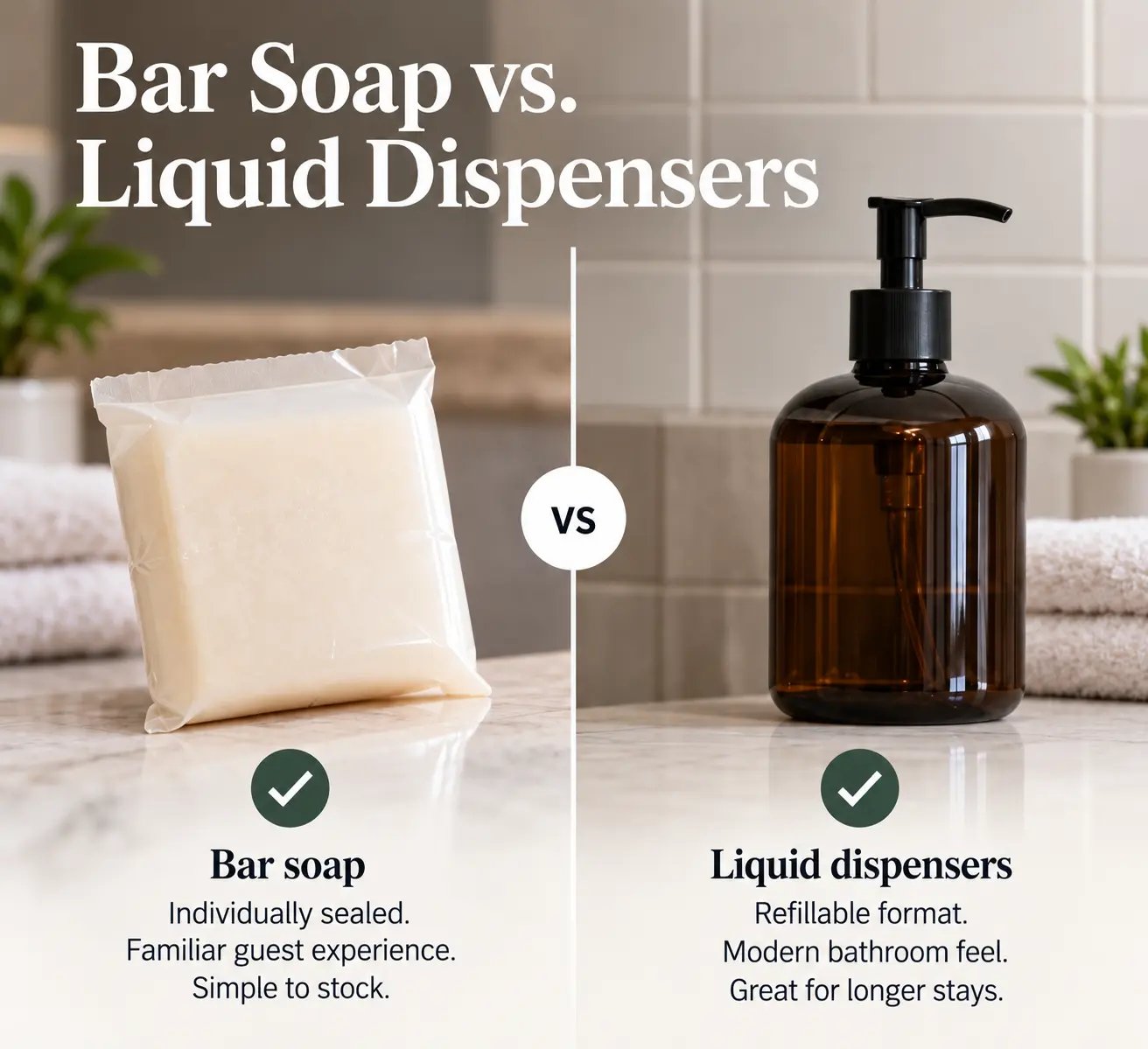
Every few years someone makes the argument that mounted liquid dispensers are better for hotel bathrooms. They cut single-use plastic, the case goes, and they're more sustainable. Both things can be true.
The case for individually wrapped bar soap comes down to one specific signal: a sealed individual bar tells a guest, without any words, that nobody has touched it. A dispenser, however elegant, doesn't give that signal. In a hotel room or an Airbnb where strangers have been sleeping and showering, that visible seal is doing more guest-experience work than most operators give it credit for.
Dispensers have their own strengths: reduced single-use packaging, a cleaner aesthetic for boutique or longer-stay properties, and a consistent product volume that doesn't vary bar to bar. For properties with a sustainability story or shared bathroom areas, a well-maintained dispenser program makes genuine sense.
On the operational side, each format has its own requirements. Bar soap needs per-room restocking at every turnover. Dispensers need refill monitoring, nozzle cleaning, and periodic maintenance, particularly at higher volumes. The right fit depends on your property type and housekeeping setup.
There are legitimate cases for liquid dispensers: shared bathrooms in common areas, long-stay properties where guests expect a residential feel, and operators making a deliberate and clearly communicated sustainability commitment. For short-stay guest rooms, individually wrapped bars remain the most common format because of the hygiene signal they deliver at turnover. Both formats can work together in a well-designed amenity program.
The Decision Framework: Matching Soap Format to Your Property
Before choosing a specific product or supplier, the fastest way to orient your purchase is to match the format to your property type. Most operators either buy based on price alone or copy what they saw somewhere else. This table gives you a cleaner starting point.
| PROPERTY TYPE | RECOMMENDED FORMAT | CASE SIZE | PRIMARY PRIORITY |
|---|---|---|---|
| Hotel / Motel (50+ rooms) | Bar soap, individually wrapped | 500-1,000/case | Cost per unit, supply consistency |
| Boutique Hotel or B&B | Bar soap, premium formulation | 250-500/case | Fragrance, packaging, brand feel |
| Airbnb / VRBO (1-5 units) | Bar soap or complete amenity set | 100-250/case | Margin, compact storage, ease of reorder |
| Multi-unit STR (6+ properties) | Bar soap, bulk case | 500/case | Volume pricing, one-supplier simplicity |
| Care Facility | Mild or fragrance-free bar soap | 500/case | Skin compatibility, no allergen risk |
This won't be a perfect fit for every operation, but it gets you to the right conversation before you spend time browsing supplier catalogs.
Getting the Size Right
This is where most buyers either overthink it or ignore it entirely. Bar size matters because it maps to your average length of stay, and getting the ratio wrong costs you money in one direction or guest satisfaction in the other.
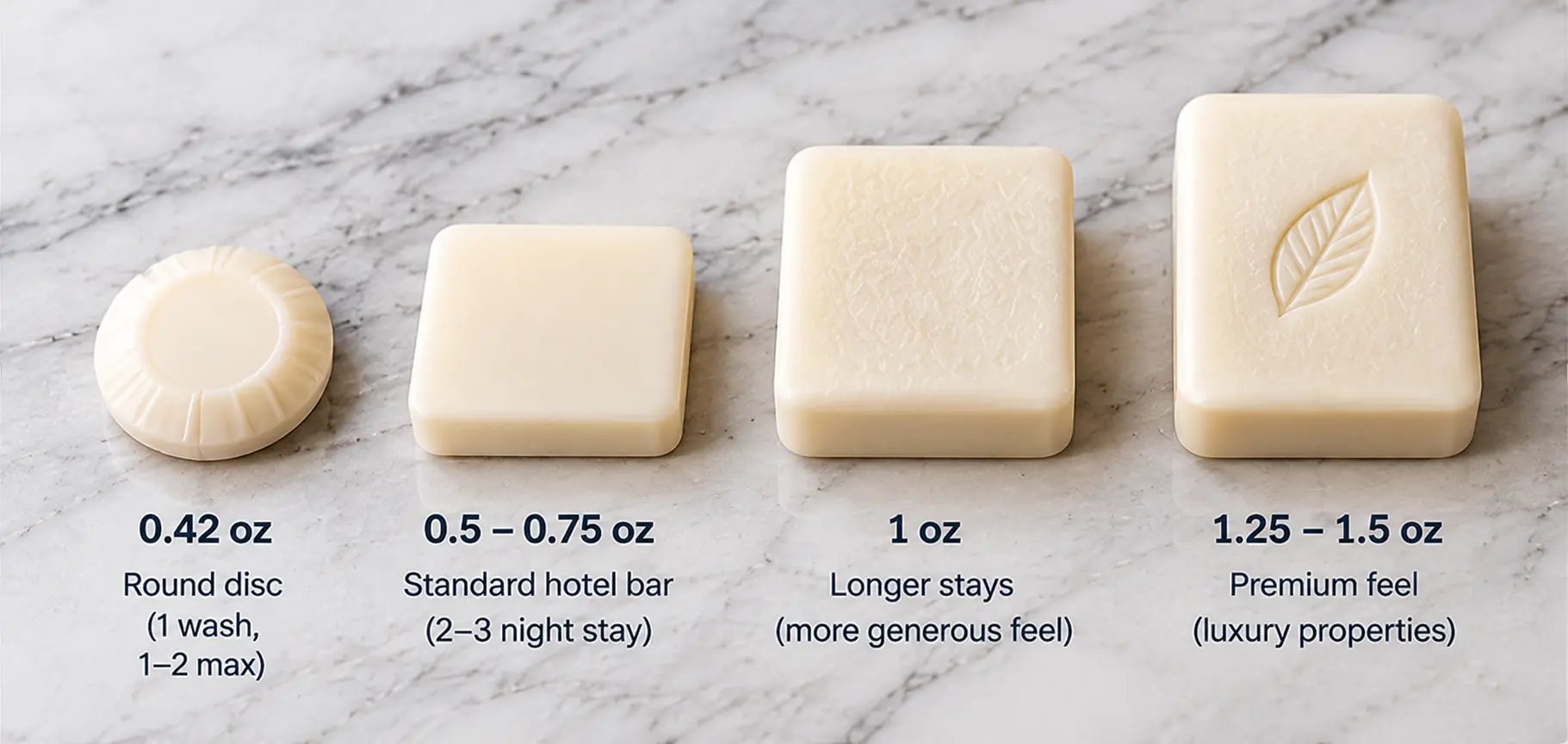
The calculation is simple: if your average stay is one or two nights, a 0.75 oz bar is more than sufficient. If your property gets extended stays, step up to 1 oz. Going larger than the stay length wastes product; going smaller leaves guests searching for more soap mid-stay, which is exactly the kind of friction that shows up in reviews.
For more on how small bathroom decisions affect overall guest perception, see Avistar's article on the five-star bathroom: what guests actually notice.
What Wholesale Hotel Soap Actually Costs
Here's the number most purchasing guides refuse to put in writing. Based on live pricing from major US hospitality suppliers, individually wrapped hotel bar soap breaks down into four rough tiers:
| TIER | FORMAT | BAR SIZE | CASE SIZE | PER-UNIT COST |
|---|---|---|---|---|
| Commodity | Round disc, foil-wrapped | 0.4-0.42 oz | 1,000/case | $0.05-$0.08 |
| Standard hotel bar | Wrapped rectangle | 0.75-0.8 oz | 500-600/case | $0.13-$0.20 |
| Premium / eco formulation | Glycerin bar, kraft wrap | 1-1.4 oz | 250-400/case | $0.23-$0.37 |
| Branded (Dove, Beekman 1802, etc.) | Branded wrapper | 0.88-1.4 oz | 250-300/case | $0.27-$0.50 |
The gap between the bottom and top of that table is real. So is the math behind it.
For a 50-room property running at 70% occupancy, you're placing roughly 35 bars per night. Upgrading from a $0.08 commodity disc to a $0.20 standard bar adds around $4.20 per night to your soap budget, or about $125 per month. For a property charging $150 a night, that's a rounding error. For a property charging $69 a night, it's a number worth thinking about.
For a single-unit Airbnb with four turnovers a week, the math is different again. Going from a $0.08 disc to a $0.35 premium bar costs you about $1.08 a week. At that scale, the upgrade is essentially free, and the guest experience signal is not.
The right question isn't "how cheap can I go?" It's "what does a guest staying here for my nightly rate expect to see on the bathroom shelf?" Buy to that expectation, not to the floor.
What "Quality" Means in Wholesale Soap Supplies
Here's the conversation most supplier websites skip entirely.
At the commodity end of the market, all hotel bar soap is essentially the same: sodium palmate, glycerin, fragrance, titanium dioxide. It works, it lathers, and nobody is going to write a review about it specifically.
Quality differentiation shows up in a few specific ways:
Formulation. Soaps with added glycerin, shea butter, olive oil, or aloe tend to perform better on sensitive skin and create a better impression at higher price points. They cost more per unit. For a mid-scale hotel or budget vacation rental, the commodity formulation does the job fine. For properties charging premium nightly rates, the upgrade is worth it.
Fragrance. Strongly scented soap is a skin sensitivity risk and a guest experience gamble. A guest who reacts badly to a fragrance will remember the property, and not fondly. The hospitality industry has moved toward mild, neutral, or light floral scents for good reason. Avoid anything that smells like it belongs in a candle shop.
Packaging. The outer wrapper is the first thing a guest interacts with in the bathroom, before they've even touched the product. Kraft paper reads as eco-conscious. White gloss sachet wrapping reads as clean and clinical. Custom-branded wrappers read as intentional. At volume pricing, the standard white wrapper does its job. At boutique nightly rates, the packaging is part of the experience.
Individual wrapping (always). There is no situation in a guest-facing bathroom where an unwrapped or shared bar is acceptable. Every bar going into a room should be factory sealed. This is non-negotiable from a hygiene and perception standpoint.
What to Look for in a Wholesale Soap Supplier
This is where most buying guides get vague and tell you to "find a reputable supplier." That's not useful. Here's what actually matters.
Minimum order quantity. Good hospitality soap suppliers work in case increments. If a supplier's entry point is one case of 500 bars, that's a workable starting point for a mid-scale operator. If they require pallet-level minimums to access their best pricing, they're better suited to large-scale hotel chains than to independent operators.
Case pricing tiers. Most wholesale suppliers drop the per-unit price again at three to five cases. Know your monthly consumption before you place your first order so you know whether you're buying at the right tier.
Shipping speed and lead time. For a product you order on a regular cadence, lead time matters more than it seems. A supplier who ships within 48 hours is worth more to a busy property manager than one with a wider catalog and a 10-day lead time.
Formulation transparency. A serious supplier can tell you the approximate ingredient list and any relevant certifications for their bar soaps. If they can't, that's a yellow flag.
Order flexibility. Some operators hit the problem of over-ordering and creating storage issues. Look for a supplier who works with you on order cadence rather than pushing you toward pallet-scale volumes you don't need.
For a more detailed breakdown of how bulk buying mechanics work and when to scale up, Avistar's bulk buying guide for hosts walks through the math.
US Regulations That Affect Hotel Soap Buyers
Most operators don't spend much time thinking about regulatory compliance when they're buying bar soap. They probably should spend at least a few minutes on it, not because the rules are complicated, but because knowing them protects you and changes a few purchasing decisions.
How soap is classified under US law
The FDA draws a line between three categories, and where your soap lands depends almost entirely on the claims made on the label.
True soap (an alkali salt of fatty acids, labeled only for cleansing) falls under the Consumer Product Safety Commission, not the FDA. Most standard hotel bar soaps qualify here. The labeling requirements are minimal: product identity, net weight, and manufacturer information.
Cosmetic soap makes claims beyond basic cleansing: moisturizing, exfoliating, deodorizing, skin-softening. Those claims move the product into FDA territory and trigger cosmetic labeling requirements. Many premium hotel soaps fall here.
Drug soap makes therapeutic claims: "kills 99.9% of germs," "treats acne," "antibacterial." These are regulated as drugs, not cosmetics, and face substantially more scrutiny. Standard hospitality bar soaps should not be making these claims. If a supplier's product does, ask questions.
The rule of thumb for buyers: the words on the wrapper determine the regulatory category. A soap that just cleans is simpler to source and simpler to verify.
The hotel amenity labeling exemption
Here's a detail most operators don't know and most suppliers don't mention. The FDA's requirement that cosmetic products list their full ingredient deck does not apply to products distributed as hotel amenities. Per the FDA's own guidance, ingredient listing requirements are waived for cosmetics "distributed solely for professional use, institutional use (such as in schools or the workplace), or as free samples or hotel amenities."
What this means in practice: the individually wrapped bar soap you place in a guest room doesn't need a full INCI ingredient list on the wrapper to be compliant. You're still responsible for sourcing products from compliant manufacturers, but your operator obligations are lighter than most people assume.
State plastic bottle bans: what they cover and what they don't
This is the regulatory story with the most operational relevance right now, and the part most operators have half-understood.
Since California passed the first ban in 2019, a growing list of states has moved to restrict single-use plastic toiletry containers in hotel rooms:
| STATE | LAW IN EFFECT | HOTELS, 50+ ROOMS | SMALLER PROPERTIES |
|---|---|---|---|
| California | Yes (AB-1162) | Since 2023 | Since 2024 |
| New York | Yes | Since Jan 2024 | Since Jan 2025 |
| Illinois | Yes | Since July 2025 | Since Jan 2026 |
| Oregon | Yes (SB 551) | From 2027 | N/A |
| Washington | Effective Jan 2027 | Jan 2027 | Jan 2028 |
Non-compliance carries fines. New York's law runs $250 for a first offense and $500 for each subsequent violation. Washington sets fines at $500 per day, capped at $2,000 annually.
Here's what these laws actually target: single-use plastic containers for liquid toiletries (shampoo, conditioner, body wash, lotion). They specifically go after the small plastic bottles that end up in landfills by the hundreds of millions each year.
Individually wrapped bar soap in paper or foil packaging is not a plastic container. It is not covered by any of these bans. Operators in California, New York, and Illinois who have switched to paper-wrapped bar soaps for their guest bathrooms are already compliant on the soap side, regardless of how they handle liquid toiletries.
This is the point worth sitting with: the format that's best for guest experience and hygiene perception (an individually wrapped bar) is also the format that keeps you on the right side of state environmental law. The purchasing case and the compliance case point in the same direction.
Some states require you to provide soap
Beyond the plastic bans, a smaller number of states have regulations that actually mandate soap provision in transient lodging. Georgia's tourist accommodation rules, for example, explicitly require individually wrapped soap or liquid soap in toilet facilities. Florida requires soap in public bathrooms of transient establishments. Nevada requires soap and hot and cold running water near toilet facilities.
These rules are primarily enforced through health department inspections, and failing them can affect your operating license, not just your reviews. If you operate in multiple states, it's worth verifying the specific requirements for each jurisdiction through your state health department or lodging association.
Why Trust This Article
We're not a generic purchasing blog. Avistar works directly with hotel operators, Airbnb hosts, property managers, and care facilities supplying individually wrapped guest amenities, including bath and body products, at wholesale scale. That direct experience shapes this guide: the format recommendations, the size guidance, and the supplier evaluation criteria all come from observing what actually works across different property types, not from restating what other hospitality guides say.
What we can say is that the perspective here is grounded in the category we supply, not in surface-level research about it.
Stocking Your Guest Bathrooms with Avistar
If you're looking for wholesale soap supplies for guest rooms, Avistar's bath and body collection covers individually wrapped bar soaps and bath products designed specifically for hospitality use, sized and packaged for turnover efficiency.
For operators who want to build out a complete bathroom program in one order, Avistar's guest amenity sets bundle soap with the rest of the bathroom essentials your guests expect.
For multi-property or high-volume ordering, visit the wholesale page for volume pricing and ordering details.
Frequently Asked Questions
What size soap bars should I buy for hotel rooms?
For most hotels and short-term rentals, a 0.75 oz individually wrapped bar is the practical standard. It covers a two to three-night stay without leaving a large remnant or running short. Properties averaging single-night stays can use a 0.5 oz bar without guests noticing. For longer stays or premium positioning, a 1 oz or 1.25 oz bar reads as a more considered amenity. Size to your average stay, not to the biggest bar you can find at the lowest price.
What is the typical minimum order for wholesale hotel soap?
Most hospitality soap suppliers sell in case quantities, commonly 500 to 1,000 units for standard bar sizes. Some suppliers offer smaller case sizes of 100 to 200 bars for single-unit hosts or lower-volume operators. Volume discounts typically apply at three to five cases or more. Know your approximate monthly room-night count before committing to a case size: over-ordering creates storage problems and ties up cash; under-ordering puts you in emergency restock situations.
Is individually wrapped soap required for hotel rooms?
There is no universal legal requirement mandating individually wrapped soap in guest rooms, but it is the hospitality industry standard for a clear reason: a factory-sealed bar signals to guests that the product is unused. In hotels and short-term rentals where turnover frequency is high, that visible seal directly affects guest perception of cleanliness. Using unwrapped bars or communal soap in guest bathrooms is a meaningful hygiene and reputation risk. Most negative reviews that mention soap reference its absence, not its quality.
What is the difference between hotel soap and regular consumer soap?
Hotel bar soaps are formulated and sized specifically for short-stay use: typically 0.42 oz to 1.5 oz, individually wrapped, with mild fragrance profiles and formulations suitable for a broad range of skin types. They are designed to minimize waste, reduce hygiene concerns, and survive storage and distribution in bulk quantities. Regular consumer soaps are sized for extended personal use and are not packaged for hospitality turnover. Using retail consumer soap in bulk is generally more expensive per guest than buying purpose-made hotel bar soap by the case.
How do I calculate how much soap to order?
A simple baseline: one bar per guest bathroom, per night occupied. A 50-room property running at 70% occupancy uses roughly 35 bars per night, or around 1,050 bars per month. Add a 15 to 20% buffer for housekeeping waste and storage needs. A single 500-bar case covers that property for just under two weeks. Most mid-scale operators settle into a bi-weekly or monthly reorder cadence once they've run the numbers once. The goal is to be ordering before you run out, not after.
Does fragrance in hotel soap matter?
More than most operators factor in at the buying stage. A strongly scented bar raises the risk of reactions in guests with fragrance sensitivities, which creates negative reviews and potential complaints. The industry trend is toward neutral, mild, or lightly scented formulations that are acceptable across the widest range of guests. If your property has a specific scent identity or spa positioning, a coordinated fragrance can reinforce the brand experience. For most mid-scale hotels and vacation rentals, mild and inoffensive is the right call.
How much does wholesale hotel bar soap cost per unit?
At the commodity tier (small disc format, 0.4-0.42 oz), wholesale hotel bar soap runs approximately $0.05-$0.08 per bar at case quantities of 1,000 units. Standard hotel bars (0.75-0.8 oz, 500-600/case) typically run $0.13-$0.20 per unit. Premium formulations with added glycerin, shea butter, or eco packaging (1-1.4 oz, 250-400/case) run $0.23-$0.37 per unit. Branded bars from names like Dove or Beekman 1802 fall in the $0.27-$0.50 range depending on bar size and case quantity. Volume discounts apply across most tiers when purchasing multiple cases.
Do the state single-use plastic bans in California, New York, and Illinois affect hotel bar soap?
No. The state laws banning single-use plastic toiletries in hotel rooms target liquid personal care products in small plastic containers, specifically shampoo, conditioner, body wash, and lotion in plastic bottles under 6-12 ounces depending on the state. Individually wrapped bar soap in paper or foil packaging does not fall under these restrictions. Operators who provide paper-wrapped bar soap in guest bathrooms are compliant with the existing plastic bans in California, New York, Illinois, and Washington state, as well as upcoming legislation in Oregon. The bans apply to plastic bottle format only; they do not affect bar soap in any wrapping format.