Bulk shampoo and conditioner is exactly what hotels, Airbnb hosts, and care facilities use to stock guest bathrooms at scale without paying retail prices per unit. Done right, you're spending less per room, running out of stock less often, and giving guests a bathroom that feels considered. The format you choose: wall-mounted dispensers or individually wrapped units bought in case quantities, matters more than most operators realise before they place their first wholesale order.
Here's what actually matters when you're buying in bulk.
The TL;DR: Which Format Is Right for Your Property?
| Property Type | Format to Consider | Why It Works |
|---|---|---|
| Airbnb / Short-Term Rental | Individually wrapped or dispenser | Wrapped for fast turnover simplicity; dispenser if the property has a consistent cleaning crew |
| Boutique hotel (under 50 rooms) | Either, depending on brand positioning | Dispensers suit a sleek modern aesthetic; wrapped suits a curated, personal feel |
| Large hotel (100+ rooms) | Dispenser (gallon refill) | Volume savings and reduced single-use waste at scale |
| Senior living / care facility | Individually wrapped | Per-resident control, hygiene, and portion management |
| Vacation rental management co. | Both: dispenser for fixed installs, wrapped for top-up | Flexibility across different unit types and cleaning schedules |
Most content on this topic talks about bulk shampoo as if there's one definition. There isn't.
"Bulk" Means Two Very Different Things
When most suppliers say bulk shampoo and conditioner, they mean one of two things:
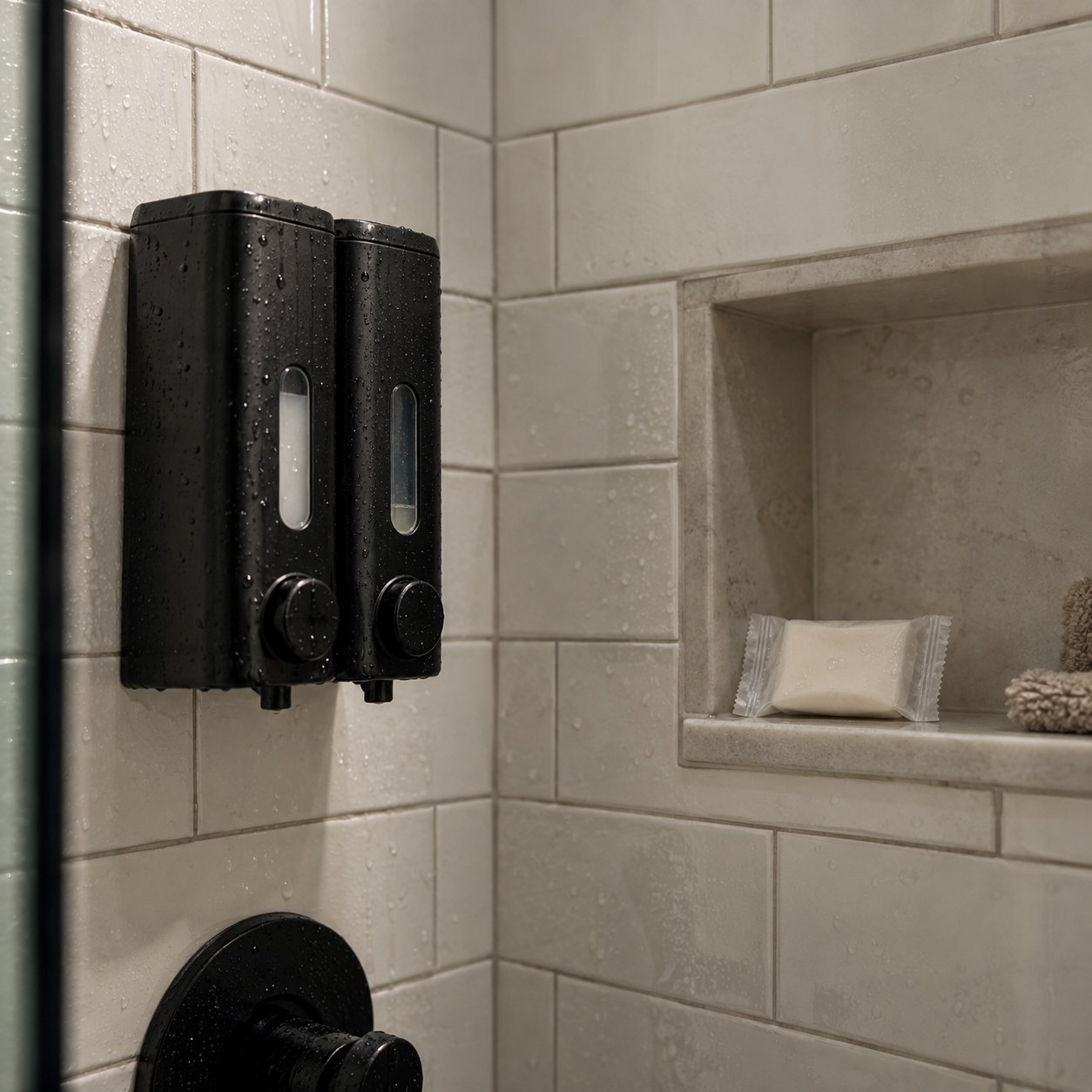
Gallon-size refills. You buy four-gallon cases, fill wall-mounted dispensers, and refill them on a set schedule. Lower cost per fluid ounce. Works well when you have consistent housekeeping covering the same rooms regularly.
Individually wrapped units in case quantities. Single-use sachets or packets, bought by the case of 50, 100, or 500. Higher cost per ounce, but simpler to manage at turnover: swap the product, done.
Both are legitimate bulk formats. The one that makes sense for your operation depends on your property type, your housekeeping setup, and local regulations. If you're new to buying guest supplies at volume, our guide on bulk buying for hosts covers the cadence, storage, and volume logic in detail.
Dispensers vs. Individually Wrapped: The Honest Breakdown
Neither format is universally better. Here's the real picture:
| Factor | Gallon Refill + Dispenser | Individually Wrapped (Case Buy) |
|---|---|---|
| Cost per oz | Lower ($0.05–$0.15/oz) | Higher ($0.20–$0.50/oz) |
| Labor per room turn | Higher (refill + clean dispenser) | Lower (swap product, discard) |
| Guest trust signal | High when dispenser is clean and well-maintained | High (sealed = untouched) |
| Setup cost | Hardware cost per fixture (varies by supplier) | Zero |
| Plastic ban compliance | Fully compliant | Depends on jurisdiction (some ban single-use) |
| Scalability | Best for 50+ rooms at consistent occupancy | Best for variable occupancy, multiple units |
One thing the cost-per-ounce calculation consistently misses: refill labor is real labor. At a vacation rental with 2–3 turnovers a week, someone has to check every dispenser, clean the nozzle, top it off, and notice when the refill is running low. That's a manageable part of the cleaning routine with the right checklist; it just needs to be explicitly accounted for. The turnover checklist approach that keeps reviews five-star works for dispensers and individual bottles alike, as long as the steps are defined and consistent.
Wall dispensers signal a clean, modern bathroom aesthetic when they're maintained well. The key word is maintained: a spotless, full dispenser in a well-designed fixture reads just as premium as an individually wrapped packet. The five-star bathroom isn't about which format you choose; it's about the bathroom feeling like it was prepared for this specific guest, regardless of what's holding the shampoo.
What to Actually Look for in Bulk Shampoo and Conditioner
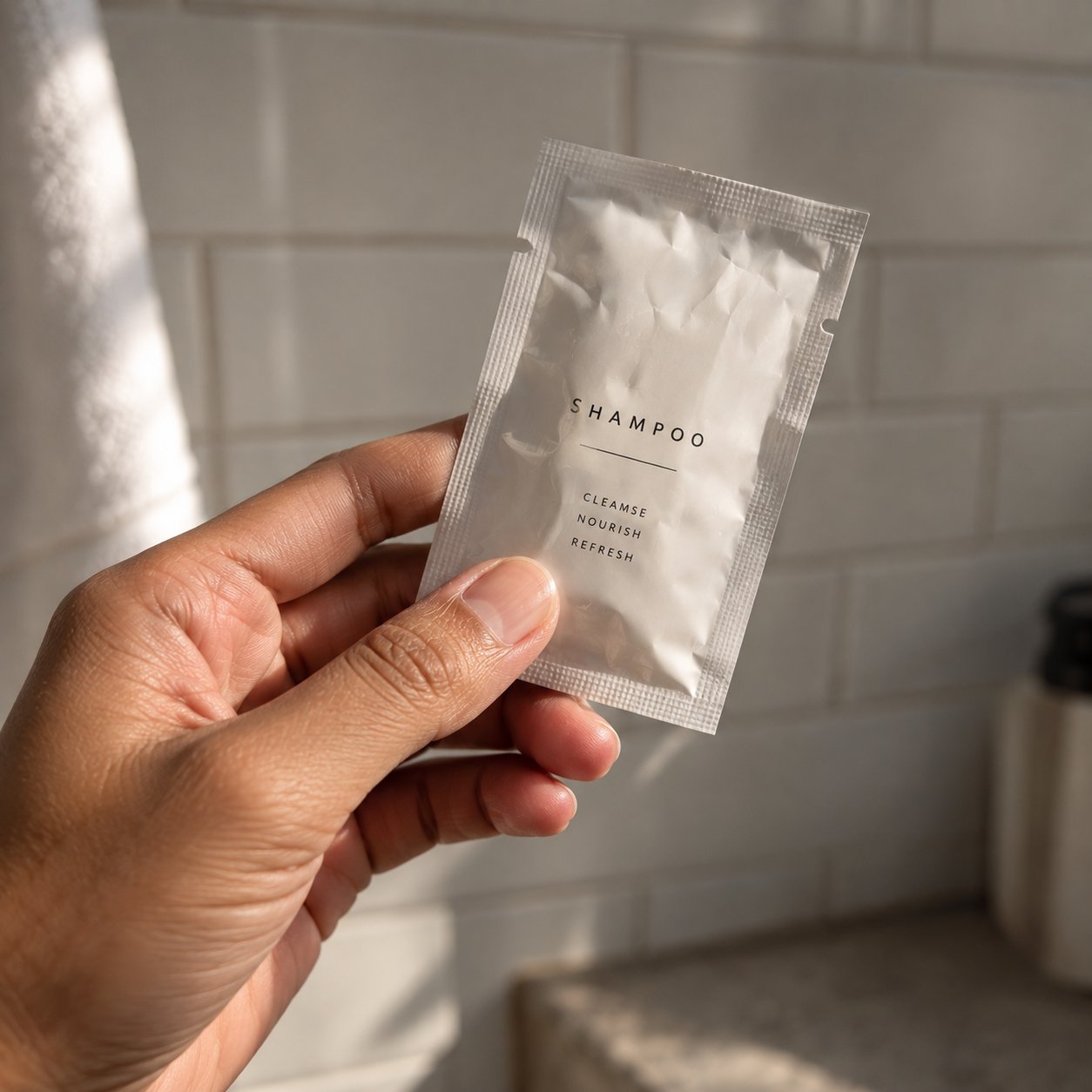
Once you've settled on format, here's what separates a good bulk buy from a regrettable one:
Scent neutrality. Strong fragrances are polarizing. A light, clean scent (think: fresh linen, cucumber, light citrus) works across the widest range of guests. Avoid anything too floral or synthetic-smelling. When in doubt, unscented is underrated. Scent is one of the little touches guests actually remember long after checkout, and a bathroom that smells subtly considered lands better than one that smells like a department store floor.
Formula quality signals. Read the ingredient list. If the first ingredient after water is a cheap sulfate and the second is silicone filler, your guests' hair will feel it. Look for conditioning agents like panthenol or glycerin in the top five ingredients.
Packaging integrity. For individually wrapped packets, the seal matters. A flimsy sachet that leaks in storage means product waste and a bad first impression. For gallon refills, look for tamper-evident seals and sealed bag-in-box packaging.
Per-unit cost at your actual order volume. Don't compare the advertised per-unit price. Compare what you'll actually pay at the quantity you'll realistically order. A supplier with a $0.55 unit price that drops to $0.38 at 200 units is a better deal than one advertising $0.45 with a 500-unit MOQ you can't move fast enough.
Certifications, if they matter to your brand. Cruelty-free, paraben-free, sulfate-free, vegan: these matter to a specific subset of guests and they do appear in reviews. If your Airbnb listing leans eco-conscious or wellness-focused, the right certifications are worth paying for. If you're supplying a 200-room roadside hotel, they probably aren't your first priority.
The Plastic Ban Situation (Read This Before You Order)
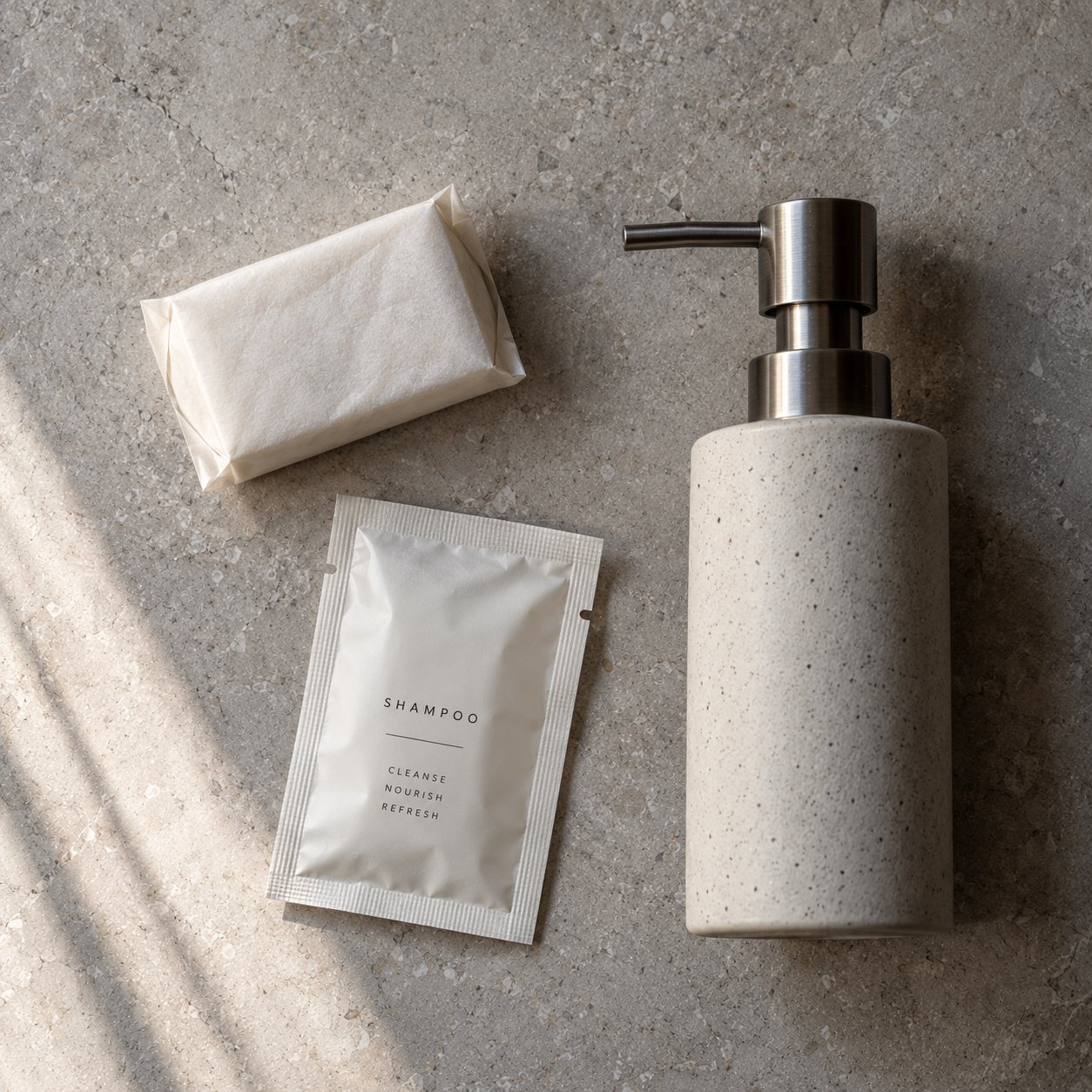
California banned single-use toiletry bottles in hotels effective 2023. Several other states and municipalities are moving in the same direction. The EU has been tightening its single-use plastics rules since 2021.
For most operators, the practical implication is: check your jurisdiction before committing to a large format purchase.
The good news is that this has pushed manufacturers toward better solutions. Paper-wrapped bars are back. Water-soluble sachets exist now. Refillable dispensers have improved significantly. And individually wrapped solid bars, which sidestep the single-use plastic question entirely, are increasingly professional and guest-friendly.
If you're buying shampoo and conditioner for a multi-state or multi-country portfolio, standardize on a format that's compliant everywhere in your portfolio, not just where the strictest rules currently exist. The regulations are moving in one direction.
The Per-Unit Math That Actually Matters
Here's a quick framework for working out what bulk buying actually costs you, not per ounce but per room night:
- Estimate your usage rate. A standard hotel guest uses one shampoo and one conditioner packet per stay. Longer stays or double-occupancy rooms use more; build in a buffer.
- Calculate your annual volume. If you run 10 Airbnb units at an average 70% occupancy (255 nights/year per unit), you need roughly 2,550 shampoo packets and 2,550 conditioner packets per year. Many suppliers offer complete amenity sets (shampoo, conditioner, body wash, lotion, and soap in one pack), which simplifies ordering and storage.
- Price at volume. Avistar's Hotel Toiletries Packets, for example, come in at $0.30 per five-item guest set at 100-count, covering shampoo, conditioner, body wash, lotion, and soap in one order. Buying individual shampoo and conditioner packets separately from commodity suppliers typically runs $0.17–$0.25 per unit, so a two-item set costs more than a complete five-item set at that price point. Either way, you're well below retail equivalent pricing as soon as you hit case minimums.
- Factor in storage and waste. Product sitting in a storeroom for 6+ months past its use-by date is not savings. Order at a cadence where you're turning through inventory within 3–4 months.
For smaller operators: even a 100-count case from a hospitality wholesaler will bring your per-guest cost down substantially versus buying mixed sets at a retail store, and you'll stop making emergency runs before a checkout.
Why Trust This Article
We put this together based on direct experience supplying hotels, Airbnb hosts, and care facilities with guest amenities at wholesale. We've seen what operators actually run into: the bulk shampoo that left hair feeling tacky, the supplier that looked great on paper until the lead time slipped, the format mismatch that added cost instead of removing it. This article covers what we know works, not a surface-level aggregation of spec sheets.
Where Avistar Fits In
Avistar supplies individually wrapped guest amenities wholesale to hotels, Airbnb hosts, property managers, and care facilities. Our Hotel Toiletries Packets include shampoo, conditioner, body wash, lotion, and soap in a single sealed guest set, available in 100, 200, and 300-count cases. We also offer curated amenity sets like the Nature's Essence and Tropical Oasis collections for hosts who want a cohesive, branded feel in the bathroom.
Dispenser formats are on the way for operators who prefer that approach, and we'll have more details on that soon.
Whichever format fits your operation, buying through a supplier who specialises in hospitality means you're getting product sized and packaged for turnover, not repurposed from a retail shelf. The MOQs are built around how hospitality operations actually run, whether you're a solo host restocking monthly or a property management company on weekly delivery.
Frequently Asked Questions
What is the minimum order quantity for bulk shampoo and conditioner?
It depends on the supplier and format. For individually wrapped hotel amenities, most wholesale suppliers have MOQs between 50 and 500 units per SKU. Gallon-size bulk refills are often sold in cases of 4 gallons. If you're a small operator, look for suppliers who allow mixed SKU orders, so you can combine shampoo and conditioner in a single order minimum.
Is it cheaper to use dispensers or individual bottles for hotel rooms?
Gallon-refill dispensers are cheaper per ounce of product, typically $0.05–$0.15 per oz versus $0.20–$0.50 per oz for individually wrapped packets. Dispensers also carry an upfront hardware cost and require regular cleaning and refilling, which adds labor. For high-volume properties with consistent occupancy, dispensers usually win on total cost per oz. For smaller properties or variable occupancy, individually wrapped packets can be more cost-efficient when you factor in the time spent managing refills, and a well-priced amenity set (like Avistar's at $0.30 for a complete five-item guest set) narrows the gap further.
What shampoo and conditioner do most hotels use?
Budget hotels and motels most commonly use individually wrapped sachets or packets from hospitality-specific brands, often purchased as complete amenity sets. Mid-scale and upscale hotels increasingly use wall-mounted dispensers with branded refills. Luxury properties use premium individually wrapped amenities or bespoke branded dispensers. The format signals quality as much as the product itself does.
Are single-use hotel shampoo bottles being banned?
Yes, in some jurisdictions. California banned small single-use plastic toiletry bottles (under 12 oz) in hotel rooms effective January 2023. Other states and the EU are expanding similar restrictions. Hotels in affected areas are required to switch to bulk dispensers or packaging formats that don't involve single-use plastics. Check current rules for your specific location before purchasing.
How much shampoo does a hotel guest use per stay?
The industry standard estimate is roughly one shampoo and one conditioner packet per stay for a single night. For longer stays of 3+ nights, guests typically go through 2–3 packets of each, though housekeeping restocking cadence varies by property policy. Packet formats typically contain enough product for 1–2 washes, which suits the standard short-stay model well.
What's the best bulk shampoo for Airbnb?
It depends on your cleaning setup. Individually wrapped packets bought in case quantities are easy to manage at turnover: no refilling, no maintenance, and guests get a sealed product. Wall-mounted dispensers work well too if you have a consistent cleaning crew on a set schedule. Either way, look for a formula that works across most hair types (mild surfactants, conditioning agents like panthenol or glycerin), clean professional packaging, and a supplier whose case size fits your actual volume so you're not sitting on excess stock.