Good hotel housekeeping is not about cleaning harder. It is about consistency: every room, every turnover, every guest who opens that door and forms an opinion in the first three seconds. The properties that earn repeat bookings and five-star reviews are not necessarily the ones with the biggest budgets. They are the ones with systems.
This guide covers the operational tips that actually move the needle: turnover protocols, bathroom presentation, amenity restocking, and inspection habits that hold up whether you are running 10 rooms or 100.
Quick Reference: Turnover Clean vs. Stay-Over Service
Before the tips, it helps to understand the two modes your housekeeping team operates in. They are not the same job, and treating them as interchangeable is one of the most common sources of inconsistency.
| Task | Turnover Clean | Stay-Over Service |
|---|---|---|
| Strip and replace all linens | ✓ | Only if soiled or requested |
| Replace all toiletries and amenities | ✓ | Replenish depleted items only |
| Full bathroom deep clean | ✓ | Surface wipe and touch-up |
| Check under bed and furniture | ✓ | Spot-check only |
| Full surface inspection | ✓ | High-touch points only |
| Reset to arrival standard | ✓ | Tidy to occupied standard |
| Flag maintenance issues | ✓ | Note and report |
| Approximate time | 25–45 min | 15–25 min |
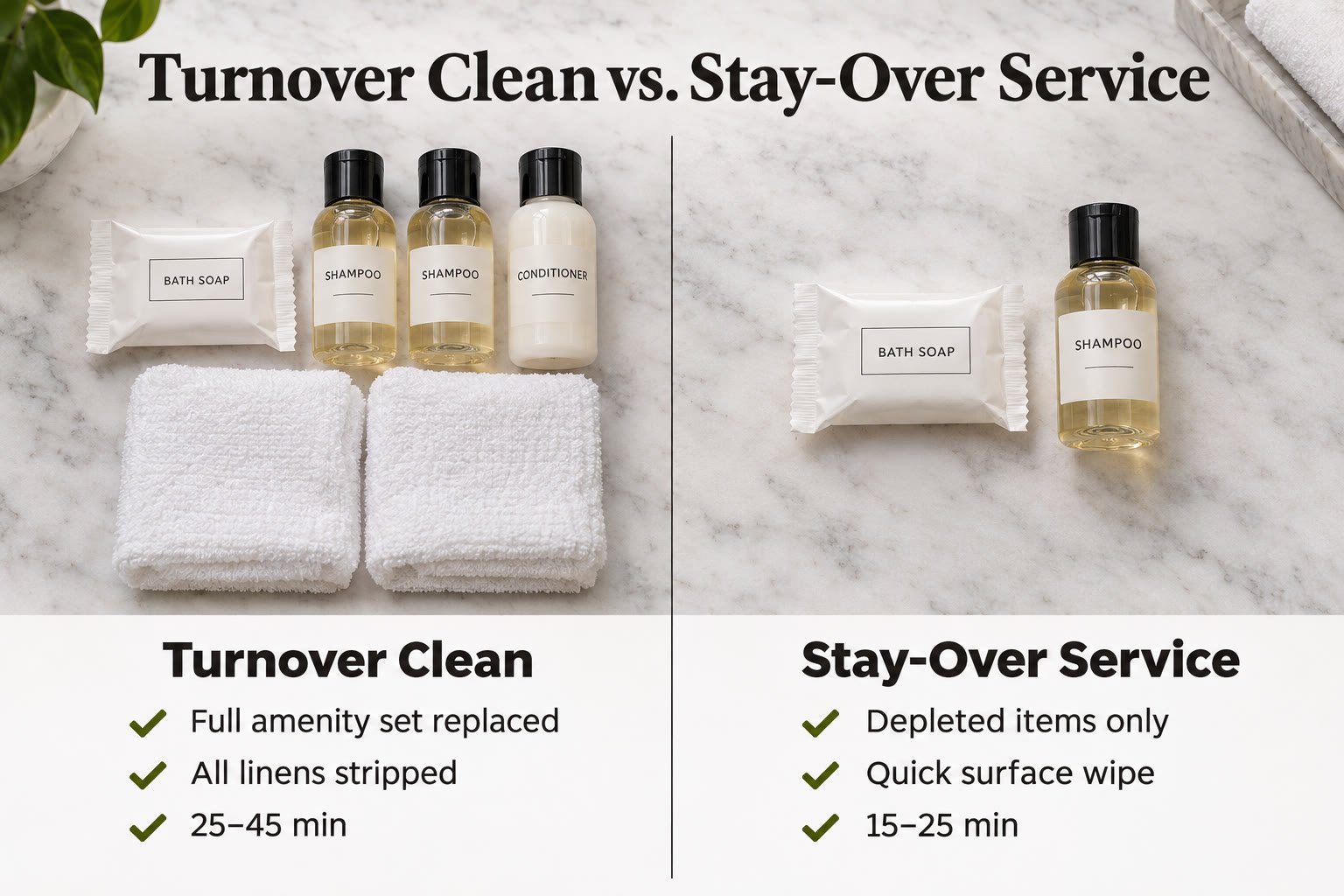
The separation matters for training, for cart stocking, and for scheduling. A turnover clean requires a fully loaded cart. A stay-over service runs leaner. Moving efficiently between occupied rooms demands a different mindset than a full reset between guests.
Housekeeping Is Your Reputation, Not a Background Function
Here is a reframe worth sitting with: housekeeping is not support staff for the guest experience. It is the guest experience, delivered room by room.
A guest can forgive slow WiFi or a noisy street. What they do not forgive is finding evidence of a previous occupant. The first few seconds in a room, the moments between opening the door and setting down their bag, are almost entirely shaped by what housekeeping did or did not do.
This is especially true in the short-term rental market. Airbnb and VRBO guests are comparing your property to other people's homes. The standard is not "clean for a hotel." It is "clean enough that I am not thinking about cleanliness at all."
Getting there requires process, not just effort.
10 Hotel Housekeeping Tips That Actually Work
1. Clean in one direction, every time
Pick a cleaning sequence and standardize it. Most experienced housekeepers work in a U or Z pattern: start at the door, work around the room without crossing your own path, finish where you started. The logic is simple: you are not walking across clean floors, and you are not recontaminating surfaces you have already cleaned.
The specific pattern matters less than the consistency. A new housekeeper following a written sequence will outperform an experienced one improvising, every time.
2. Treat the bathroom as a separate job
The bathroom gets its own checklist, its own supplies, and its own inspection pass. It is the highest-stakes area in any guest room.
Work top to bottom: start with the mirror and vanity, move to the toilet (tank, seat, bowl, base), then shower or tub, then floor. Never clean the toilet with the same cloth used anywhere else. Color-coded microfiber cloths are the simplest system for enforcing this.
The last thing a housekeeper does in the bathroom before closing the door should be a visual scan from the doorway. Standing back gives you the guest's perspective, and it catches things you miss up close.
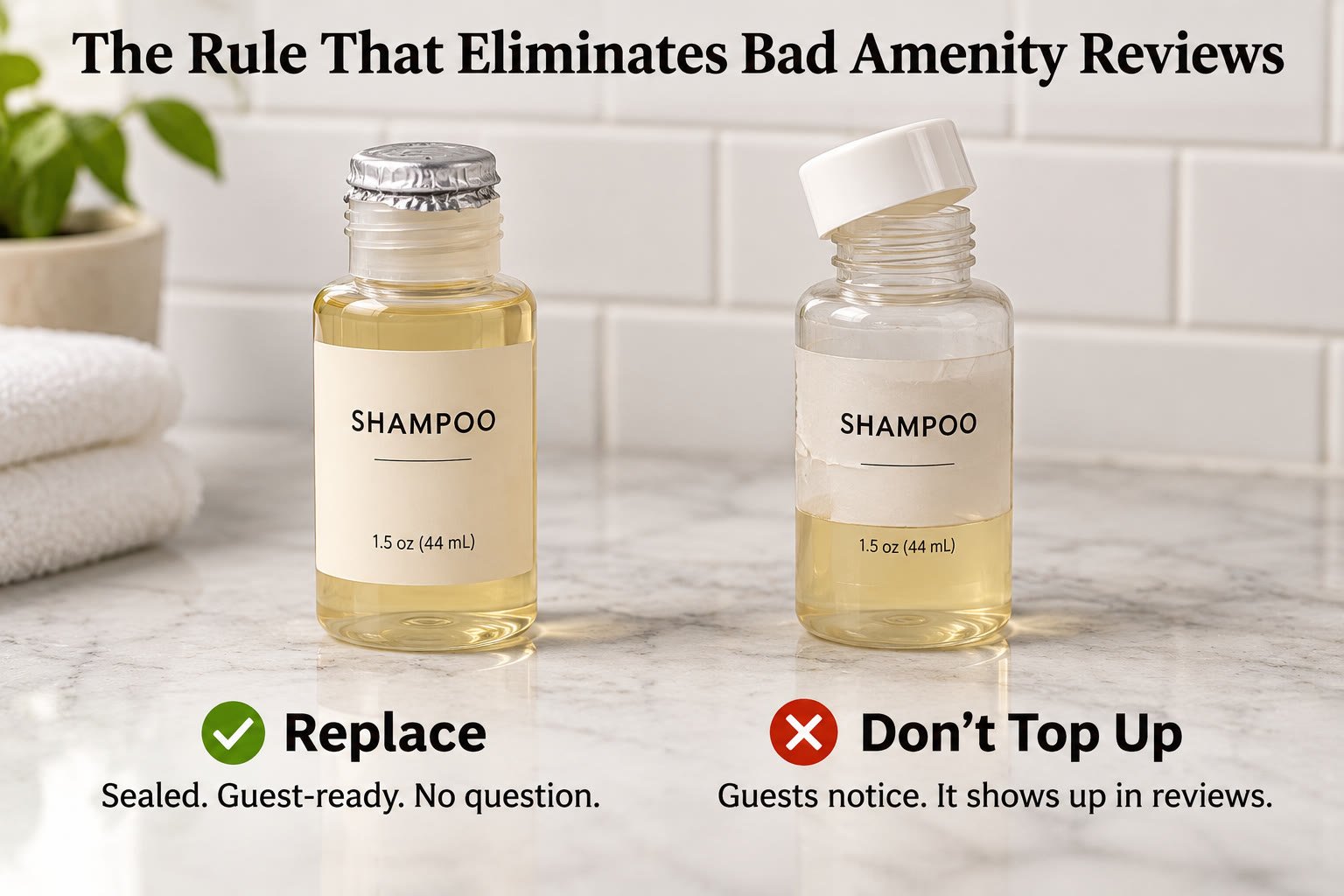
3. Replace amenities. Do not top them up.
This is the one that most properties get wrong, and it is completely avoidable.
A bottle that has been topped up looks like a bottle that has been topped up. Guests notice. The smell is different. The fill level does not match the size of the container. And in a world where hygiene is front of mind, it signals that corners are being cut.
The cleaner operational model: remove all partially used amenities at checkout and replace with fresh, sealed product at every turnover. For properties with longer average stays or extended-occupancy units, wall-mounted dispensers can be the right call, since guests have a full container from day one and do not need daily replacement.
The right format depends on your property type. What it should not depend on is habit. More on this below.
4. Stock your cart before you clean, not during
A housekeeper who runs out of towels on the third room and has to walk back to the linen closet is a housekeeper who is not on schedule. Par levels for carts should be set based on the number of rooms assigned per shift, not on what is left over from yesterday.
A practical baseline for a 10-room turnover shift:
- Bath towels: 20–25 (2–3 per room, plus buffer)
- Hand towels and washcloths: 2–3 each per room
- Amenity sets: one full set per room plus a 15–20% buffer
- Cleaning supplies: fully stocked, color-coded
- Spare trash bags, gloves, fresh linens
Rebuilding the cart at the start of each shift is a 5-minute task. Chasing supplies mid-shift costs that and more in disrupted flow.
5. Set a par level for every amenity and order against it
Housekeeping should never be the department that discovers the property has run out of soap. That is an inventory system problem, not a housekeeping problem.
Each consumable, shampoo, conditioner, body wash, bar soap, dental kits, lotion, needs a minimum par level (the quantity that triggers a reorder) and a reorder quantity. For most mid-sized short-term rental operations or boutique hotels, a 30-day supply based on average occupancy is a reasonable baseline.
Track usage monthly. Properties with high seasonal swing often need a pre-season stock-up 6–8 weeks out, before lead times get tight.
6. Flag maintenance issues. Do not fix them.
Housekeeping sees every room, every turnover. That makes the team the best-positioned to catch problems early: a dripping faucet, a flickering light, a shower door that does not close properly.
The rule is simple: flag it, do not fix it. Build a reporting mechanism into your turnover checklist, even if that is just a notes field in a shared app or a physical log at the front desk. Issues caught early are almost always cheaper than issues caught by guests.
7. Build the inspection into the clean, not after it
Inspections are most effective when they are part of the cleaning process rather than a separate audit tacked on at the end. The goal is a final-pass verification that happens as part of the natural flow.
A practical end-of-room checklist:
- Bed: even, centered, pillows squared
- Surfaces: nothing left behind, all items placed
- Closet: hangers present, iron and board stowed
- Bathroom: clean, dry, amenities set, towels folded
- Windows: closed or cracked per property standard
- Thermostat / AC: set to arrival temperature
- Lights: off, or set to arrival lighting
For new housekeepers, photograph the completed room for the first few weeks. It gives you a shared benchmark for what "done" actually looks like.
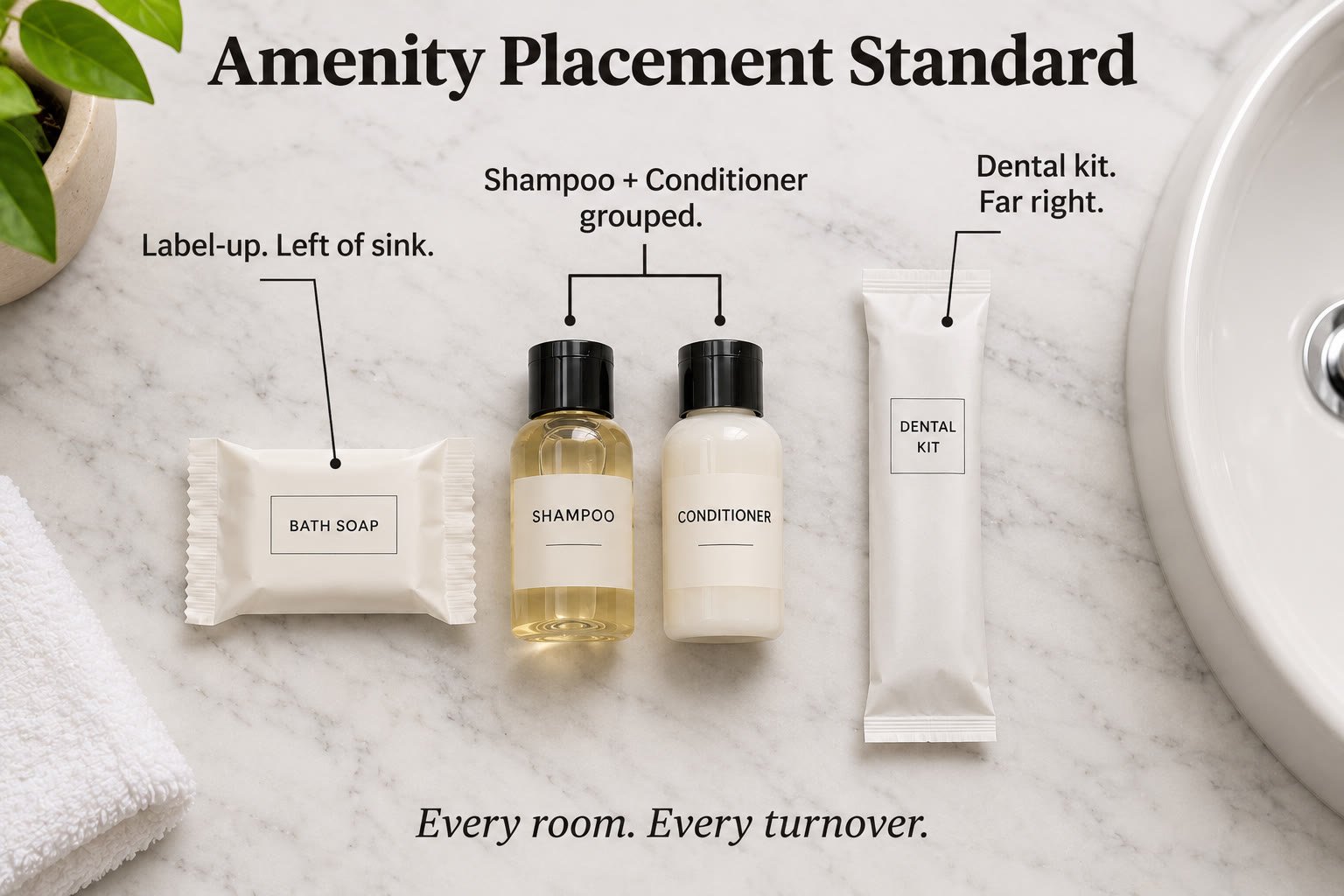
8. Set a standard for amenity presentation, not just availability
Where you place toiletries matters more than most operators realize. Guests do not just notice whether amenities are there. They notice how they look.
A simple, repeatable standard:
- Amenities on the vanity arranged by height: tallest at the back, smallest at the front
- Individually wrapped items placed consistently, not scattered
- Bar soap presented label-up or in a tray, not dropped next to the faucet
- Nothing that looks like it was placed in a hurry
This takes 30 extra seconds and signals care. The alternative signals no one checked.
9. Know the difference between clean and guest-ready
A room can pass a cleanliness check and still not feel guest-ready. The difference is in the finish: towels folded the same way every time, the toilet paper folded at the tip, curtains opened to the same position, the thermostat set.
These are small things. They are also the things that communicate whether a property is managed or just maintained. For short-term rentals in competitive markets, managed earns the reviews. Maintained does not.
10. Train to the standard, not the task
Most housekeeping issues are not performance issues. They are training issues: the person did what they were taught, and what they were taught was not specific enough.
"Clean the bathroom" is a task. "Wipe the vanity with a damp microfiber, clean the mirror from top-left to bottom-right with no streaks, replace the bar soap with a sealed bar placed label-up on the left side of the sink" is a standard.
The more specific your SOPs, the less variance you have between your best housekeeper and your newest one. Document it once, and you stop re-explaining it forever.
The Part of Housekeeping Most Properties Get Wrong
Cleaning gets all the attention. What rarely gets discussed is the other half of what your team does at every turnover: restocking and presenting guest amenities.
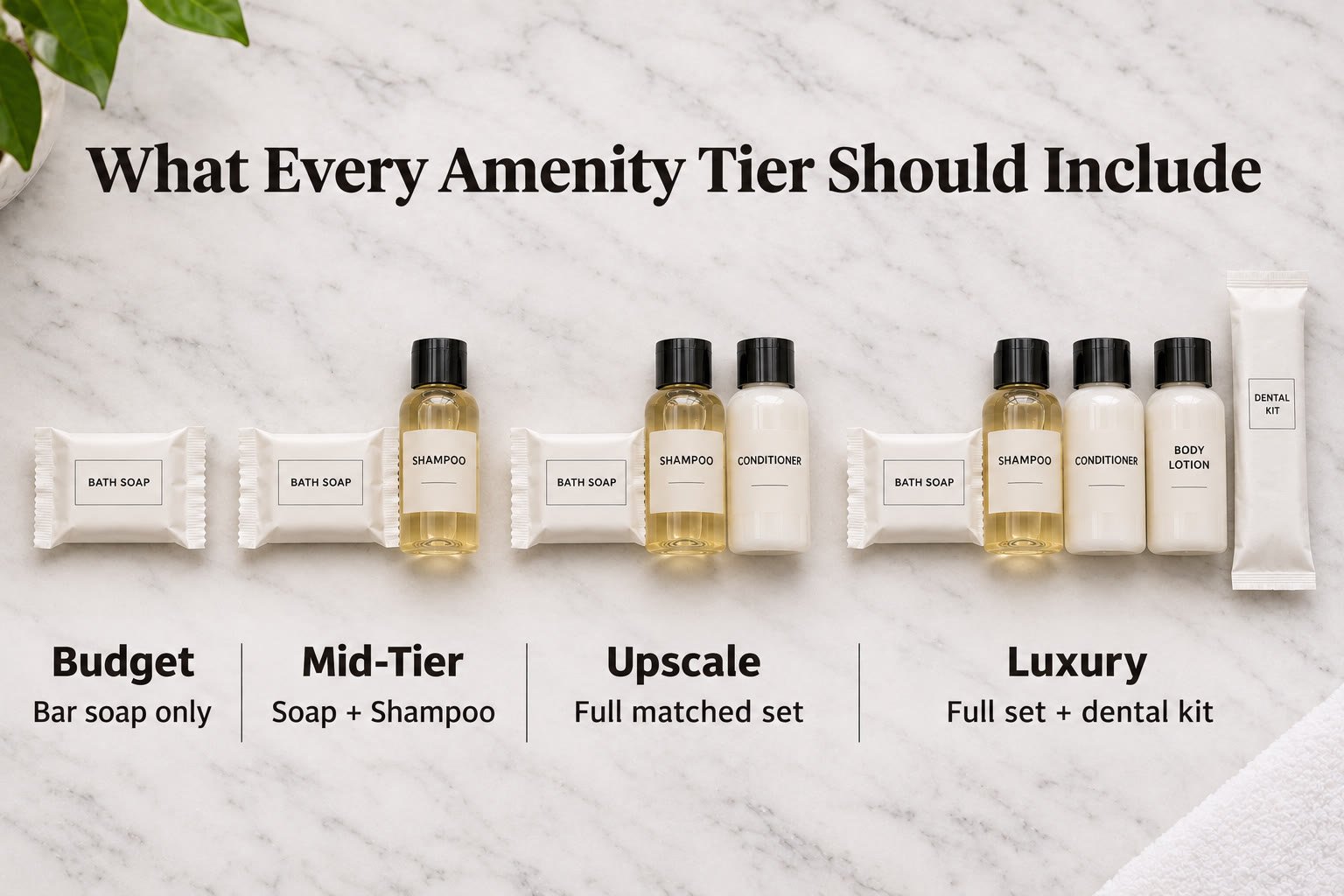
Here is what a fully stocked, well-presented bathroom should include at each check-in:
| Amenity | Budget Tier | Mid-Tier | Upscale |
|---|---|---|---|
| Body soap | Bar soap | Individually wrapped bar | Premium wrapped set |
| Shampoo | 1 oz travel size | Matched set, individually wrapped | Full-size or branded dispenser |
| Conditioner | Optional | Matched set, individually wrapped | Standard |
| Body lotion | Omit | Optional | Standard |
| Dental kit | Omit | Recommended for 2+ night stays | Standard |
| Shower cap | Omit | Optional | Standard |
On format: individually wrapped vs. dispensers. This is not a one-size-fits-all decision, and it does not need to be. Individually wrapped products carry a clear hygiene signal: this has not been touched. For turnover-heavy properties like short-term rentals and boutique hotels, that visual confirmation matters and shows up in reviews. For extended-stay properties or eco-focused operations, refillable wall dispensers are the more practical and sustainable format, since guests have a full container from day one and you are not generating per-amenity waste with every checkout.
Both formats can deliver an excellent guest experience. The wrong call is not about format; it is about mismatched format for the property type.
For sourcing guidance on soap and body care at scale, our Wholesale Soap Supplies Buying Guide covers what to look for in hotel-grade products and how price-per-unit changes with volume. For shampoo and conditioner specifically, see our Bulk Shampoo and Conditioner Guide for Hotels and Hosts.
For oral care kits, our guide to buying toothbrushes in bulk covers hotel-grade dental kits, what to look for at volume, and how to match the product to the guest tier you are serving.
How Avistar Fits Into Your Housekeeping System
The best housekeeping systems depend on products built for the same operational rhythm. Individually wrapped guest amenities are specifically designed for high-turnover properties: each item arrives sealed, each checkout can be fully restocked without guessing what is left, and your housekeeping team has a clear, consistent standard to execute.
Avistar supplies soap, shampoo, conditioner, body wash, and oral care kits to hotels, short-term rental operators, and care facilities across the United States, with wholesale pricing and ordering that works for portfolios of any size.
Why Trust This Article
We supply individually wrapped guest amenities to hotels, Airbnb hosts, vacation rental operators, and care facilities across the United States. That operational context shapes how we think about housekeeping: not purely as a cleaning discipline, but as the system that determines whether the product you sourced actually reaches the guest in the condition and presentation it was meant to.
The tips in this guide draw on that supply-side experience alongside a close look at how hospitality operators of all sizes structure their housekeeping programs. We focused specifically on the angles most guides skip: amenity restocking, presentation standards, and the practical difference between a turnover clean and a stay-over service.
Frequently Asked Questions
What is the difference between a turnover clean and a stay-over service in a hotel?
A turnover clean, also called a checkout clean, is a full reset of the room between guests: all linens stripped and replaced, all amenities refreshed, the bathroom deep-cleaned, and a final inspection against an arrival standard. A stay-over service tidies an occupied room: high-touch surfaces wiped, towels refreshed if needed, depleted amenities replenished. They are different jobs with different time requirements and different cart loads. Training staff to treat them the same way is one of the most common sources of housekeeping inconsistency.
How often should hotel rooms be deep cleaned beyond the standard turnover?
Most full-service hotels schedule a deep clean every 30 days per room, covering behind furniture, under the bed, grout lines, and fixtures beyond the standard turnover protocol. For short-term rentals with high turnover, a thorough monthly or quarterly deep clean is a reasonable baseline, with standard turnover cleans covering daily presentation. The right frequency depends on occupancy rate and room traffic rather than a fixed calendar.
Should hotels top up shampoo and conditioner bottles between guests?
No. Topping up toiletry bottles between guests is a hygiene and perception risk. Guests frequently notice the inconsistency in scent, fill level, or container condition, and it shows up in reviews. The standard that eliminates this problem: remove all partially used amenities at checkout and replace with sealed product at every turnover. For properties where individual bottles are cost-prohibitive at volume, wall-mounted dispensers with a fully refilled cartridge are a better alternative than topped-up single-use bottles.
How many rooms can one housekeeper clean per shift?
Industry norms vary by property type and room size. A commonly cited benchmark for full-service hotel housekeeping is 12–16 rooms per 8-hour shift for a full turnover clean. Short-term rental operations with larger units and more amenities to reset often see 6–10 units per shift. These numbers assume a fully stocked cart, a clear written SOP, and a room layout that does not require significant travel between units. Properties consistently below these benchmarks should audit cart stocking and room sequencing before looking at staffing levels.
What amenities should every hotel bathroom include at a minimum?
At a minimum: body soap (bar or liquid), shampoo, conditioner, and lotion. For mid-tier and above, a dental kit and shower cap are standard expectations among guests. Extended-stay properties or those targeting business travelers often add a razor, a cotton kit, or a vanity set. The exact set should match the nightly rate and guest expectation, with individually wrapped products at turnover-heavy properties and dispensers as a practical option for extended-stay or eco-focused operations.
What housekeeping mistake shows up most often in guest reviews?
Insufficient bathroom attention, specifically: visible residue, hair, or the appearance of non-fresh amenities. The bathroom is disproportionately represented in one-star reviews compared to any other room element. A systematic end-of-clean visual check from the bathroom doorway, combined with a replace-not-top-up policy for toiletries, eliminates the majority of these complaints without requiring more time per room.
How should guest toiletries be arranged in a hotel bathroom?
Consistency matters more than any specific arrangement. A practical standard: arrange items by height on the vanity with tallest at the back, place soap label-up or in a tray, group shampoo and conditioner together, and ensure nothing appears placed in haste. The goal is a bathroom that reads as intentional. Individually wrapped products reinforce this effect because the sealed packaging immediately communicates that the items are unused.