Most people searching for travel size body wash in bulk end up on Amazon, scroll through 40 near-identical listings, and pick whatever has the most reviews.
That's not a bad strategy. But it's also not a purchasing strategy.
If you're stocking a hotel, an Airbnb portfolio, or a care facility, the decision has more layers than a star rating. Format, size, formula, MOQ, reorder reliability. Get a couple of those wrong and you're either over-spending per unit or fielding complaints about empty bottles and weird scents.
Here's what actually matters.
First: What "Travel Size in Bulk" Means for Operators
Travel size in the hospitality context isn't the same as TSA-friendly. It means individually sealed, single-use-ready units in case quantities, typically 100 to 300 per order.
The individually sealed part is the thing that matters most. An opened or refilled dispenser is a shared product. A sealed 1oz bottle is a fresh one. Guests notice the difference, especially in short-term rentals and care settings where the hygiene signal of a brand-new product carries real weight.
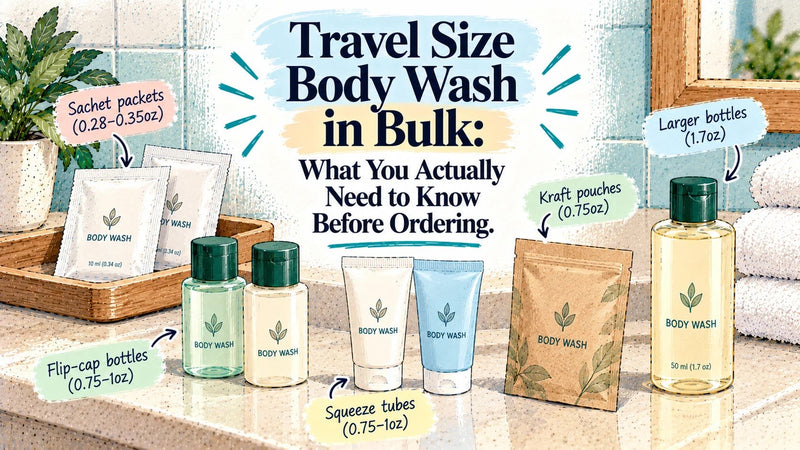
Standard sizes run from 0.35oz (10ml) sachets at the budget end to 1.7oz (50ml) flip-cap bottles for extended-stay properties. The sweet spot for a single overnight stay is 1oz (30ml): enough for a thorough shower, not so much that half is wasted at checkout.
The Format Decision Nobody Talks About
Most search results for this topic are product listings with no explanation of the actual format tradeoffs. Here they are:
| Format | Size | Cost/Unit | Best For |
|---|---|---|---|
| Sachet / foil packet | 0.28–0.35oz | $0.20–$0.35 | High-volume budget properties, care kits |
| Flip-cap bottle | 0.75–1oz | $0.30–$0.55 | Hotels, motels, Airbnbs (1–3 night avg stay) |
| Squeeze tube | 0.75–1oz | $0.35–$0.60 | Properties where guest perception of quality matters |
| Kraft paper pouch | 0.75oz | $0.36–$0.50 | Eco-focused or sustainability-positioned properties |
| Larger flip-cap bottle | 1.7oz | $0.49–$0.75 | Extended-stay, vacation rentals (4+ night avg) |
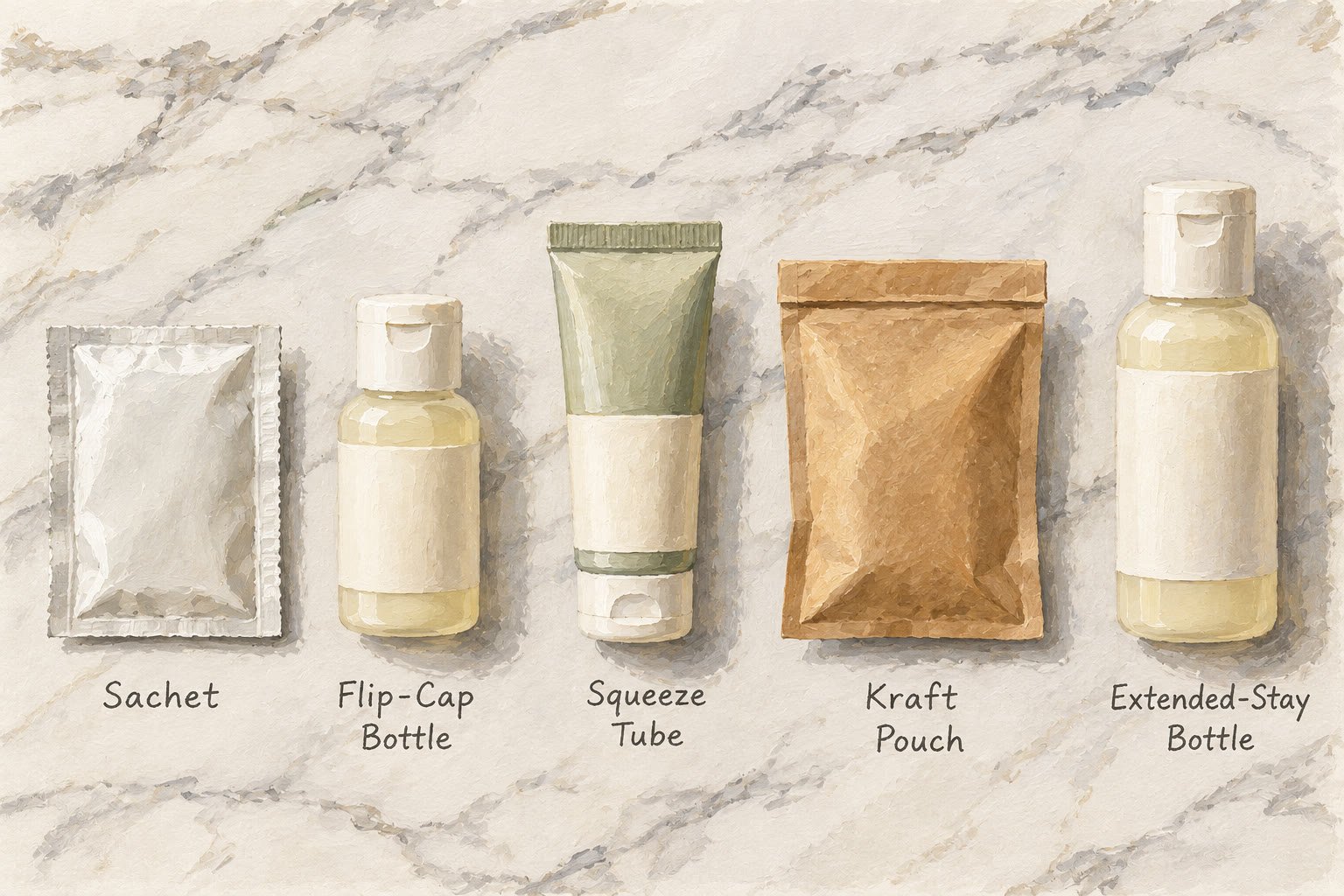
Sachets are the cheapest format, but they read as disposable. They work for care kits and emergency stock, less so for a guest bathroom where you want the experience to feel considered.
Flip-cap bottles are the industry default for a reason: they're sturdy, they seal cleanly between uses on a turnover cart, and guests recognize the format as "hotel." At $0.30–$0.55 per unit in 100-packs, they're also reasonable.
Tubes and kraft pouches cost a little more and signal a little more. If your property leans into a sustainability story or a boutique identity, these formats reinforce that. If your property is a 40-room limited-service hotel and you move 1,500 units a month, the premium probably isn't worth it.
Larger 1.7oz bottles are worth considering if your average stay is three nights or longer. A 1oz bottle disappears on night one. A guest staying four nights shouldn't have to wonder if you're going to replenish it.
What About Dispensers?
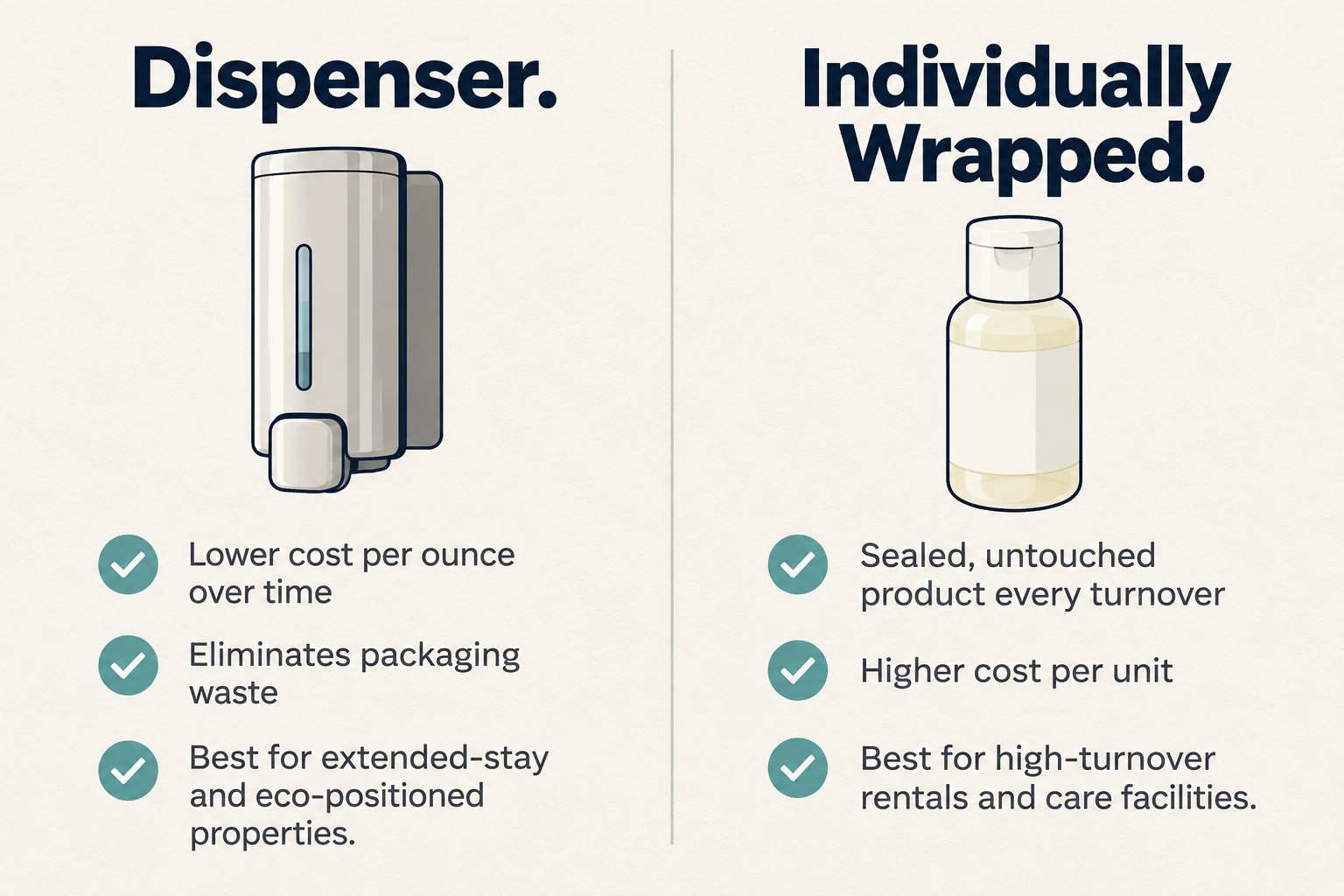
Worth addressing directly: wall-mount refillable dispensers are a legitimate option, especially for extended-stay properties or operators who care a lot about single-use plastic reduction.
The tradeoff is straightforward. Dispensers have lower per-ounce cost over time and eliminate packaging waste. Individually wrapped units have higher per-unit cost but deliver a sealed, untouched product at every turnover. The right answer depends on your property type, your guests, and what your average length of stay looks like.
For high-turnover short-term rentals and care settings, the hygiene signal of a sealed product tends to win. For extended-stay or eco-positioned hotels, dispensers are a reasonable choice. Both formats are valid, and both are available, so this is an operational fit question, not a quality one.
If you want the full picture on bulk body wash formats, including gallon refill dispensers, pump-top room bottles, and per-ounce cost comparisons across all options, the bulk body wash guide covers that broader decision.
The Buying Criteria That Actually Matter
Beyond format, here's what separates a good bulk body wash order from one you'll regret:
Individual seal on every unit. Not loose in a bag. Not bulk-filled from a larger container. Each unit factory-sealed. This is non-negotiable for hospitality use.
Paraben-free formula. Most reputable hospitality suppliers have already moved here. It's worth confirming on the spec sheet before ordering, particularly for care facilities, and worth noting that California Prop 65 labeling requirements have put paraben-containing products under scrutiny for properties operating in that state.
Unisex scent or fragrance-free. White tea, green tea, light citrus, fresh linen: these are broadly inoffensive and work across guest demographics. Avoid heavily gendered fragrances. For care facilities, fragrance-free is the default for a reason: skin sensitivities are more common among older residents, and a strong scent in a clinical setting reads wrong.
SKU stability. This is the underrated one. If you find a product that works and then the listing disappears or the formula changes, you're starting over. Look for brands with a track record of consistent reordering, especially if you're buying from a marketplace. Hospitality-specific suppliers (not general retail wholesalers) tend to be more reliable here.
Lead time. For smaller properties, next-day Amazon delivery is convenient. For larger operations with predictable monthly volume, a supplier relationship with net-30 terms and reliable case delivery is worth more than the convenience of a marketplace.
How to Calculate What You Actually Need
Simple formula:
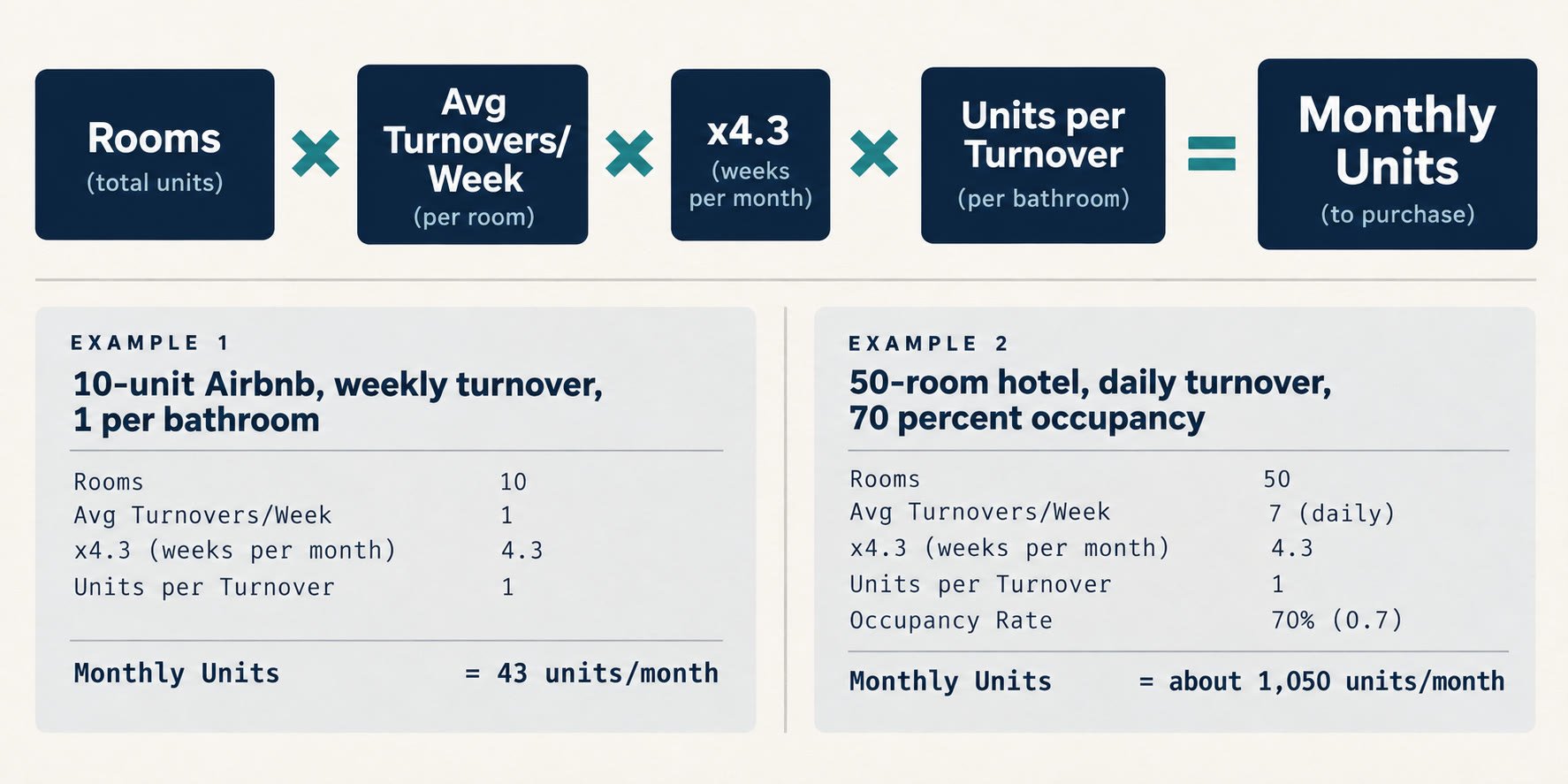
Monthly units = rooms × avg turnovers per week × 4.3 × units placed per turnover
A 10-unit Airbnb portfolio with weekly turnover and one body wash per bathroom needs roughly 43 units a month. A 100-pack is a 2-month supply. A 200-pack gets you to 4 months and usually hits a price break.
A 50-room hotel running at 70% occupancy with daily turnover needs about 1,050 units per month. That's five or six 200-packs monthly. At that volume, a case-price wholesale arrangement almost always makes more financial sense than per-pack marketplace ordering.
The rule of thumb: order enough to cover 2–3 months at a time. It captures volume discounts, reduces reorder frequency, and gives you enough buffer to not scramble when a supplier runs short.
A Quick-Reference Guide by Property Type
| Property Type | Format | Size | Notes |
|---|---|---|---|
| Budget motel | Flip-cap or sachet | 1oz | Cost per unit is the driver |
| Mid-scale hotel | Flip-cap bottle | 1oz | Brand and reorder consistency matter |
| Boutique / upscale hotel | Tube or branded bottle | 1–1.7oz | Presentation earns the premium |
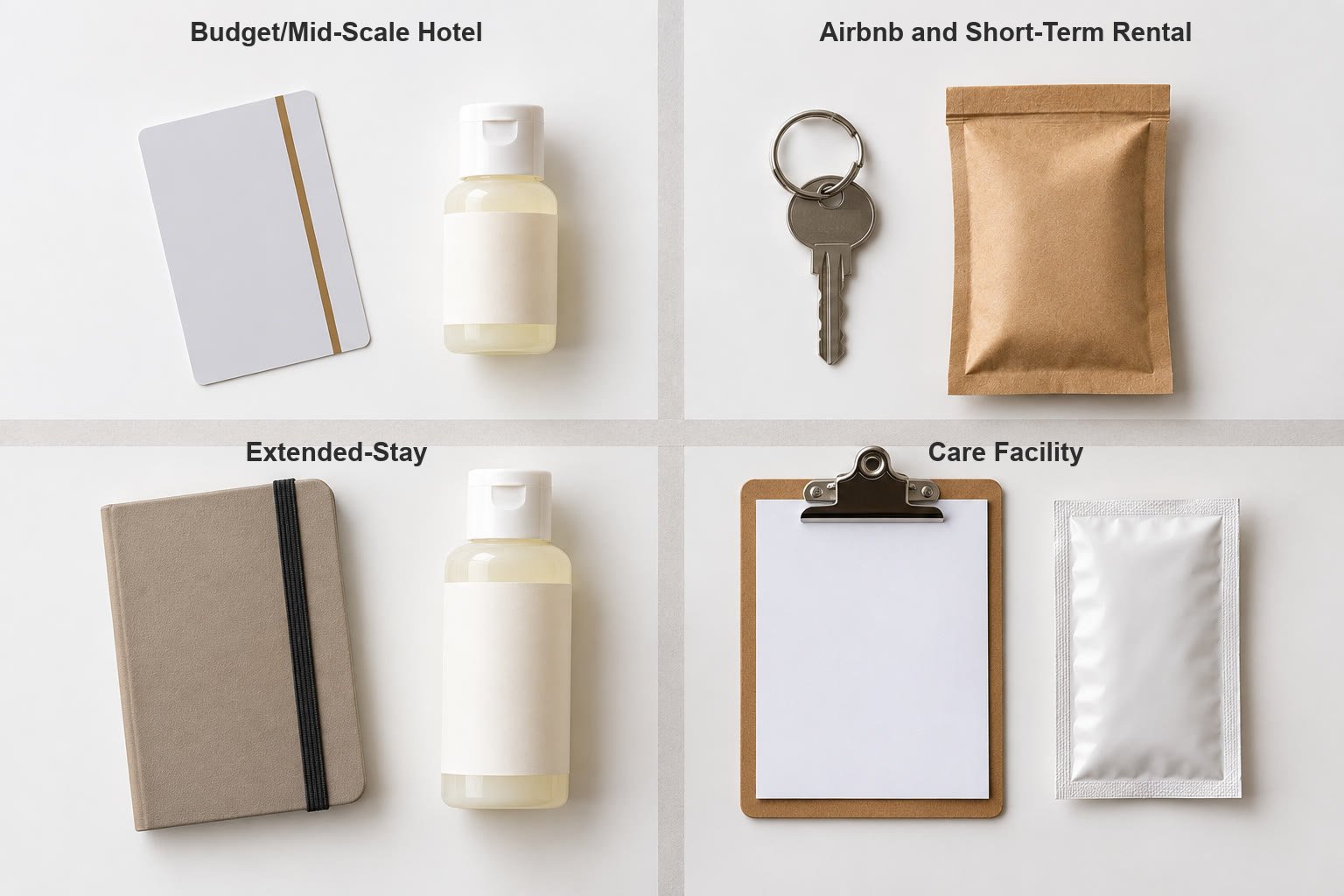
| Airbnb / short-term rental | Flip-cap or kraft pouch | 1–1.7oz | Hygiene signal and guest perception |
| Extended-stay / apart-hotel | Larger bottle or dispenser | 1.7oz+ | Single-use waste is more visible at longer stays |
| Care facility | Sealed, fragrance-free | 0.75–1oz | Allergy risk and hygiene assurance are the priority |
Where Avistar Fits
If the criteria in this article match what you're shopping for, Avistar's bath and body catalog is built around the same spec: individually sealed body wash in hospitality pack sizes, with reorder-stable SKUs for properties that turn rooms on a regular schedule. No marketplace guesswork, no bulk-filled units.
For volume that warrants case pricing or net-30 terms, the wholesale program is the starting point. And if you're still deciding between individually wrapped units and dispenser formats, the bulk body wash guide maps out that decision with per-ounce cost context included.
A Note on Sources
The format guidance and price ranges in this article come from hands-on supplier research: product specs, wholesale pricing tiers, and format comparisons across suppliers actively serving the US hospitality market. Avistar works directly with hotels, Airbnb hosts, property managers, and care facilities; that's the operational lens the buying criteria reflects.
The per-unit numbers are directional benchmarks, not quotes. Pricing moves, MOQs vary by supplier, and a quick conversation with your supplier will give you current figures for your actual volume. Use the ranges here to calibrate, not to finalize.
Frequently Asked Questions
What size is travel size body wash for hotels?
In hospitality, travel size body wash runs from 0.35oz (10ml) sachets at the smallest to 1.7oz (50ml) flip-cap bottles for extended-stay properties. The most common format for a one-night stay is 1oz (30ml). All of these fall well under the TSA's 3.4oz liquid limit, so guests can also pack leftover product if they choose.
How much does travel size body wash in bulk cost?
At standard hospitality wholesale quantities (100-pack), expect to pay roughly $0.25 to $0.70 per unit depending on format, formula quality, and brand. Sachets and basic flip-cap bottles sit at the lower end; premium tubes, kraft paper pouches, and branded amenity lines cost more. Volume pricing typically starts at 200+ units, with further breaks at 500 and 1,000 units for properties ordering at scale.
What's the minimum order quantity for hotel body wash?
Entry packs typically start at 30 units, useful for testing a product before committing to stock. Standard working inventory for most operators starts at 100-packs. Wholesale pricing and volume discounts generally require 200 units or more. For properties going through 200+ units a month, a recurring case-price arrangement beats ad hoc marketplace ordering on cost and reliability.
Are individually wrapped body wash bottles better for Airbnb?
For most Airbnb and short-term rental operators, yes. A factory-sealed bottle communicates to the guest that the product hasn't been opened before them. That's a hygiene signal that matters in short-stay, high-turnover settings. Dispensers are a reasonable option for extended-stay guests or eco-positioned properties, but for 2–4 night rentals with regular turnover, sealed individual units are the standard for a reason.
Is travel size body wash suitable for care facilities?
Yes, and individually wrapped format is generally the preferred choice for senior living and care settings. Sealed packaging removes cross-contamination risk, per-resident dosing is easier to manage for staff, and fragrance-free options are available from most reputable hospitality suppliers. For care procurement, filter specifically for fragrance-free or hypoallergenic formulas to reduce skin reaction risk among residents with sensitivities.
What scent should I choose for guest body wash?
A light unisex scent (white tea, green tea, citrus, fresh linen) is the safest call for most properties. Avoid heavily fragranced products or gendered scents unless your property's branding specifically calls for it. Care facilities should default to fragrance-free. If you're buying for a boutique property and want the scent to reinforce your brand identity, sample before committing to a 200+ unit order.
Can I buy paraben-free travel size body wash in bulk?
Yes. Most hospitality-specific suppliers now offer paraben-free formulas as standard, and it's worth confirming on the product spec before ordering. Brands including Terra Pure, INFUSÉ, and ECO Amenities offer paraben-free options in hospitality pack sizes. It's also worth noting for properties in California: paraben-containing products have been flagged under Prop 65 labeling requirements, making paraben-free the cleaner choice from a compliance standpoint.