Here's what most guides on this topic get wrong: they treat it like a shopping decision. Pick a nice-looking brand, order a case, done. But if you're running more than one unit, or doing more than ten turnovers a month, buying bulk shampoo and conditioner for your Airbnb is actually a supply chain decision. The brand matters less than the format, the minimum order quantity, and whether the product can survive a housekeeper tossing it into a basket forty times a month.
The short answer: individually wrapped single-use packets are the default format for most Airbnb hosts because they're fast to restock, eliminate cross-contamination concerns, and let you count inventory in seconds. Dispensers work well for extended-stay properties or eco-forward listings. What drives that choice isn't your aesthetic preference; it's your turnover rate.
Quick-reference: Format vs. Situation
| Your situation | Best format |
|---|---|
| Nightly or weekend turnovers, multiple units | Individually wrapped singles |
| Stays of 3+ nights, single unit, eco focus | Wall-mounted dispenser |
| Co-hosting or outsourced cleaning | Individually wrapped (easier to track inventory) |
| Premium listing with higher ADR | Full-size bottle placed per guest |
Why Shampoo and Conditioner Is a Bigger Decision Than It Looks
Every checkout leaves the bathroom needing to be reset in under fifteen minutes. That's the real constraint. Your housekeeper isn't reading ingredient labels at the sink; she's refilling, restocking, and out the door. The product you choose gets pulled off a shelf, placed in a shower, and either used once or not at all.
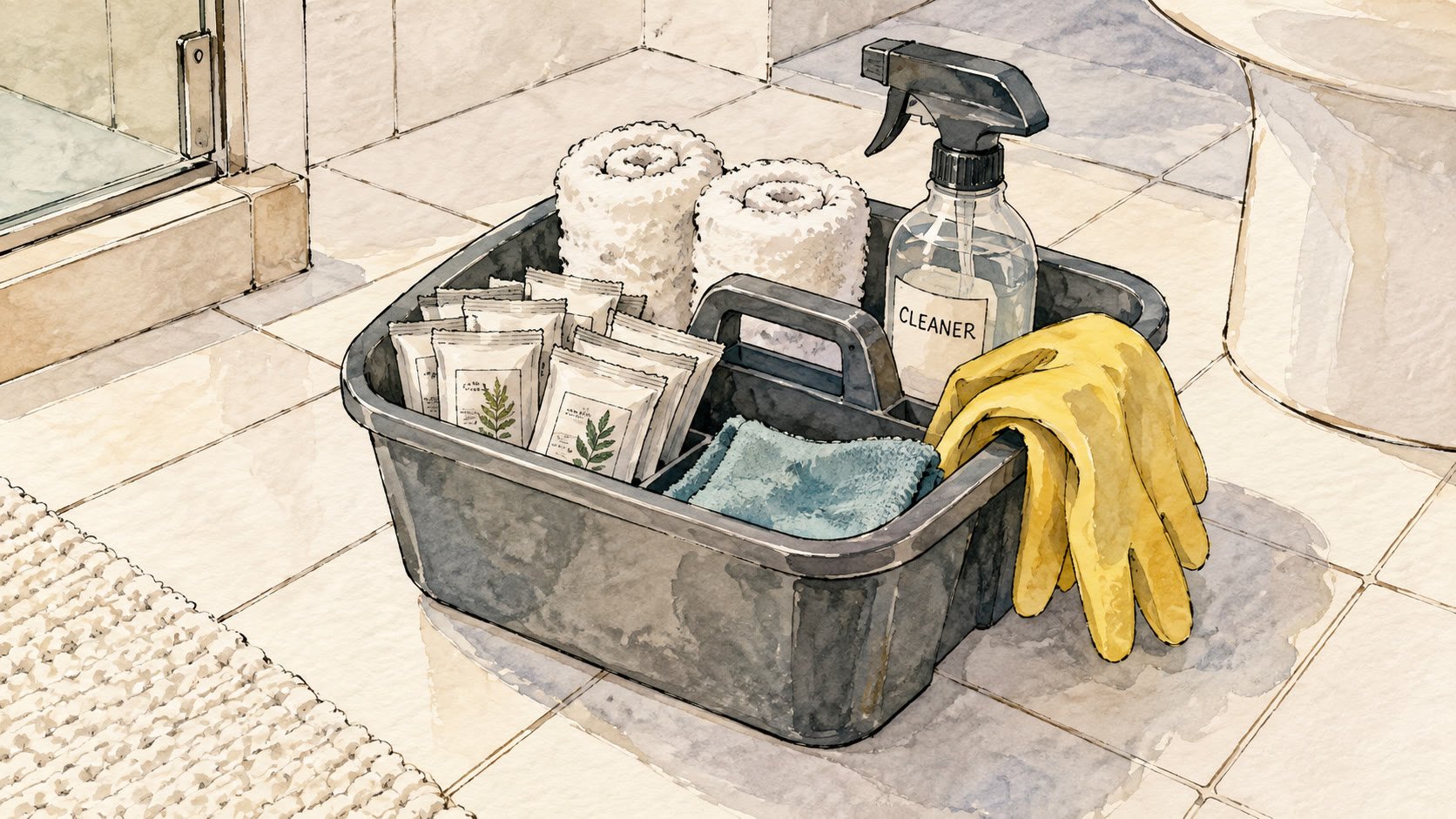
Here's what the math looks like for a single unit running twenty turnovers a month: twenty shampoo units, twenty conditioner units. At $0.30 to $0.60 per individually wrapped packet from a wholesale hospitality supplier, that's $12 to $24 a month per property. A 200-pack order of shampoo covers roughly ten months for that unit, and a separate 200-pack of conditioner does the same. For three units, both 200-packs last three to five months depending on occupancy.
That's the case for buying in bulk. But the format question is separate from the quantity question, and most hosts mix up the two.
The Format Decision for Airbnb Is Really a Turnover Speed Decision
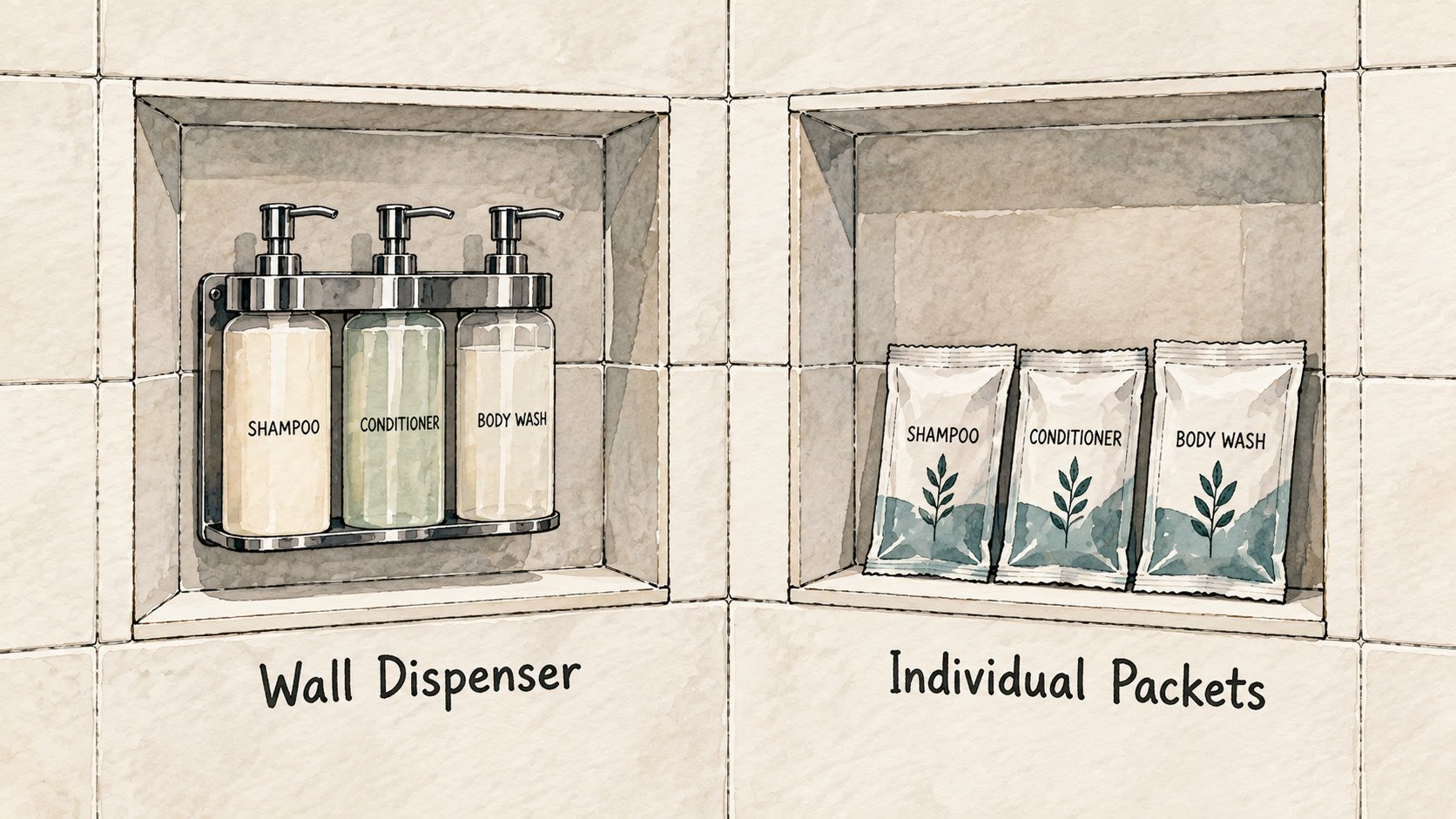
For the full dispenser vs. individually wrapped comparison, including cost-per-ounce, labor math, and sustainability trade-offs, we've covered it in depth in our guide to bulk shampoo and conditioner for hotels and hosts. The short version for Airbnb: the format that works for you is the one your cleaning workflow can actually support, not the one that looks best in product photos.
Individually wrapped packets win for most Airbnb hosts because:
- A co-host cleaning between a 10am checkout and a 2pm check-in does not have time to check a dispenser level and refill it
- There's no opened bottle to smell, assess, or decide what to do with after checkout
- Restocking means: grab two packets, place them in the shower, done
Dispensers work for Airbnb when the listing has genuinely long average stays (seven-plus nights), the host does their own cleaning, or the listing markets sustainability as a feature and guests selected on that basis. Running weekend-to-weekend turnovers with outsourced cleaning is not that profile.
How Your Amenity Choice Shows Up in Your Listing and Your Reviews
This is the angle most hosts miss: toiletry format affects more than your cleaning workflow. It affects how guests describe your property in reviews.
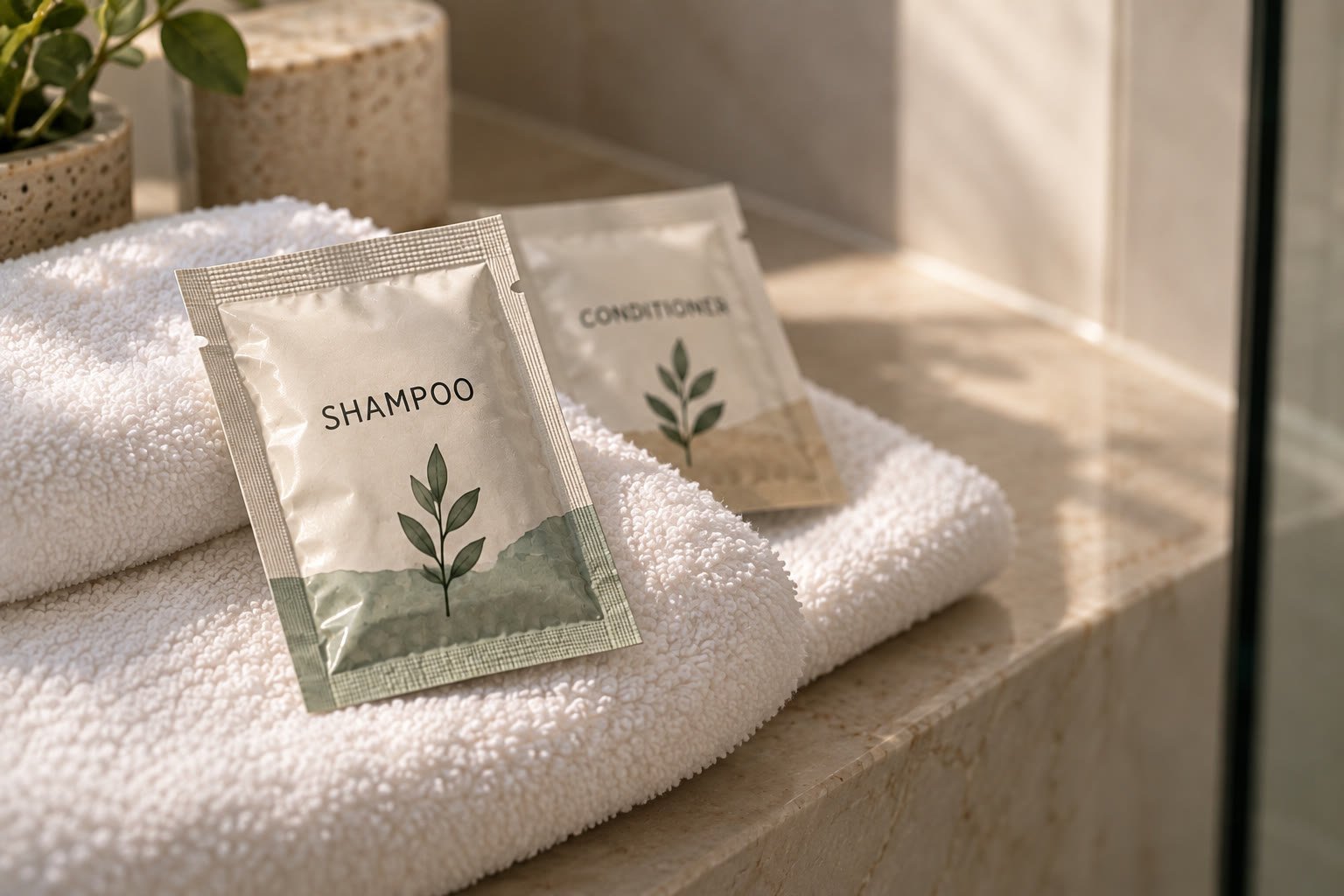
"Hotel-quality toiletries" and "individually wrapped amenities" are phrases that show up in positive Airbnb reviews because they signal freshness and care in a way that refilled dispensers don't, regardless of what's inside them. A guest who opens a sealed packet knows it was placed there for them. A guest who uses a half-full dispenser is never quite sure.
If your listing description currently says nothing about bathroom amenities, consider adding a line. Hosts who mention their toiletry standard consistently in listing descriptions see fewer "forgot to restock" review mentions because guests arrive with calibrated expectations. A line like "individually wrapped hotel amenities provided" takes ten seconds to add and does real work on both the booking and review side.
How Much Shampoo and Conditioner Does an Airbnb Guest Actually Use?
Per guest, per stay: one shampoo, one conditioner. That's the industry baseline for single-night or two-night stays. For stays of three or more nights, plan on approximately one set per two nights: a four-night stay typically means two shampoos and two conditioners per room.
Here's what that looks like across different portfolio sizes:
| Portfolio size | Turnovers/month (est.) | Shampoo units/month | Conditioner units/month | Typical order size |
|---|---|---|---|---|
| 1 unit | 12–20 | 12–20 | 12–20 | 200-unit pack |
| 3 units | 36–60 | 36–60 | 36–60 | 200-unit pack per product (reorder every 3–5 months) |
| 5+ units | 60–100+ | 60–100+ | 60–100+ | 500+ unit pack or standing order |
A few variables shift these numbers:
- Occupancy rate. A unit at 60% occupancy with a 2.3-night average stay uses fewer units per month than one running at 90% doing mostly weekend bookings.
- Guest count. Two guests each use a packet if you place them per person. If you place per room, you use one regardless.
- Listing standard. Some hosts place two shampoos and two conditioners per stay regardless of guest count, as a deliberate signal of generosity. That changes your monthly draw.
The practical rule: never let your on-hand supply drop below a two-week buffer. Running out mid-month means ordering at retail prices, which defeats the point of buying wholesale.
What to Look for in a Bulk Shampoo and Conditioner Supplier
Not every bulk supplier is built for short-term rental operators. Some cater to hotels with 10,000-unit minimums. Others sell "bulk" packs that are really just twelve bottles at retail pricing with a volume label. Here's what to actually evaluate before committing to a supplier:
Minimum order quantity (MOQ). For a single-unit host, a 200-pack MOQ is workable. For a portfolio of five or more units, 500-pack options with lower per-unit pricing make more sense. MOQs below 100 units usually carry retail-grade prices.
Format availability. Confirm that the supplier carries individually wrapped sachets or single-use tubes, not just gallon jugs for decanting. Decanting adds a step to restocking that compounds quickly across multiple units.
Ingredient and scent profile. US guests increasingly read labels. Products with clear ingredient disclosures, no harsh sulfates, and a mild scent profile generate fewer complaints than strong-fragrance budget options. Neutral or lightly scented formulas also work across more hair types, which matters when you don't know your guests before they arrive.
Lead time and reorder reliability. A supplier with a 2–3 week shipping window means you need to carry six weeks of supply at all times, not two. Short lead times, under seven days for standard orders, let you run leaner inventory.
Per-unit cost at your actual order volume. Do the math yourself. Market pricing for wholesale individually wrapped amenity packets typically runs $0.30–$0.45 per packet at 100–200 count, dropping to $0.22–$0.32 at 500–1,000 count depending on the supplier and product tier. Whether the lower per-unit price at higher volume justifies the commitment depends on your monthly usage and storage space, not on what looks like a good deal on the listing page.
Three Things Airbnb Hosts Get Wrong About Stocking Toiletries
Ordering by feel instead of by data. "I ordered a pack a few months ago and we seem fine" is not a supply chain. Know your monthly usage per unit, track it in a simple spreadsheet, and set a reorder trigger: for example, four weeks of supply remaining. This takes about ten minutes to set up and saves the scramble every time you realize you're low.
Buying from retail channels at retail prices. Amazon and Target sell bath products in multi-packs marketed as "bulk" that typically contain 24 to 36 units at $1.00 or more per unit. That's not wholesale pricing. A proper hospitality amenities supplier brings that cost below $0.60 and often below $0.40 at volume.
Ignoring scent compatibility. Strong lavender, heavy coconut, or intense floral fragrances polarize guests in a way that neutral scents don't. One guest who mentions a headache or an allergic reaction in a review is a problem that a slightly better scent choice could have avoided. Mild, clean scents cover more guest profiles and generate fewer off-comments.
Why Trust This Article
This guide was written by the team at Avistar, a wholesale supplier of individually wrapped guest amenities serving hotels, Airbnb hosts, property managers, and care facilities across the United States. Our perspective comes from working directly with hospitality operators of all sizes, from single-unit hosts managing their first rental to property managers running dozens of units. Where we reference quantity estimates or pricing benchmarks, these are based on current wholesale market norms.
How Avistar Fits Into Your Restocking Workflow
Most bulk hospitality amenity suppliers are built around hotel accounts and price accordingly. Avistar's Hotel Toiletries Packets start at 100 count, which works for a single-unit host getting started without committing to a year's supply of a product you haven't tested at your property.
Each pack is a five-item individually wrapped set: shampoo, conditioner, body wash, body lotion, and soap. Packs are available in 100, 200, and 300 count (starting at $29.99 for a 100-count), so you can size your order to your actual monthly draw rather than buying whatever the supplier's minimum happens to be. A 100-count gives you 20 of each item; for a single unit running 15 to 20 turnovers a month, that's roughly a month of shampoo and conditioner covered alongside the rest of the bathroom kit in a single order.
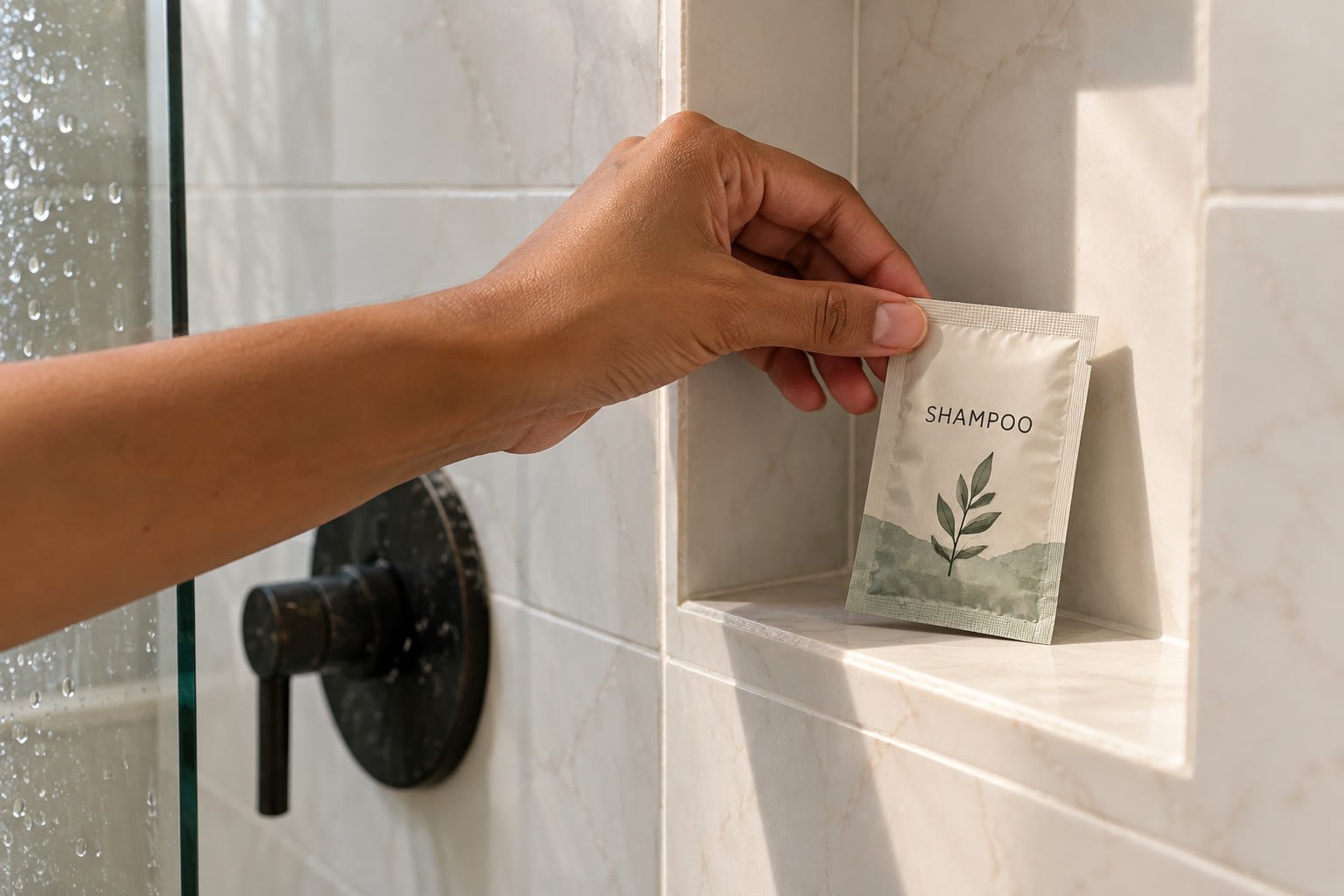
Each packet arrives sealed and ready to place. Your housekeeper picks it up, drops it in the shower, and keeps moving. No decanting, no labeling, no deciding what to do with a half-empty bottle a previous guest left behind.
There's also something hosts don't always anticipate: the individually wrapped format simplifies the post-checkout bathroom check. A sealed packet either hasn't been touched or it's gone. There's no opened bottle of uncertain age to assess, no guessing whether that conditioner is from this stay or three checkouts ago. When you're turning a unit in under two hours, that small certainty saves consistent time at every checkout.
For the full bathroom kit beyond the shower, our room-by-room Airbnb supplies checklist is where to start.
Frequently Asked Questions
How much shampoo and conditioner should I provide per Airbnb guest?
The standard for short-term rentals is one shampoo and one conditioner per guest, per stay, for stays of one to two nights. For longer stays, add one set per additional two nights. A four-night stay for two guests means roughly four shampoos and four conditioners. Rounding up slightly is a better guest experience than running short, and the cost difference at wholesale pricing is minimal.
What's the difference between hotel shampoo and Airbnb shampoo?
There isn't a meaningful product distinction. The same individually wrapped single-use packets sold to hotels are appropriate for Airbnb. The operational difference is in order volume and frequency: hotel housekeeping teams manage centralized supply rooms and place larger, less frequent orders, while Airbnb hosts typically reorder more often in smaller quantities. The product specs that matter are the same for both: mild formula, neutral scent, clear labeling.
Are bulk shampoo and conditioner packets TSA-compliant?
Single-use packets fall well under the TSA's 3.4 oz (100 ml) per-container limit, so they're TSA-compliant for guests who choose to pack them. This is a minor listing benefit worth mentioning if your guests are frequent travelers or business visitors. It adds a small "take what you need" element to the amenity without changing your per-stay cost.
Is it better to use dispensers or individual packets in an Airbnb?
For most Airbnb operations, individually wrapped packets are more practical. They're faster to restock during turnovers, they eliminate contamination questions, and inventory tracking is immediate. Dispensers work better for extended-stay listings or eco-focused properties where sustainability is a featured part of the listing. The format should match your turnover speed and guest profile, not a general preference about what looks nicer.
Where is the best place to buy bulk shampoo and conditioner for Airbnb?
Wholesale hospitality amenity suppliers are the right channel for most hosts, not retail or general e-commerce platforms. Look for suppliers who specialize in guest amenities, offer MOQs suited to your portfolio size (200 to 500 units covers most small to mid-size hosts), and stock individually wrapped formats. Retail "bulk" packs typically price at $0.80–$1.20 per unit; a proper wholesale supplier brings that to $0.30–$0.60 depending on order volume.
How should I store bulk shampoo and conditioner for multiple Airbnb units?
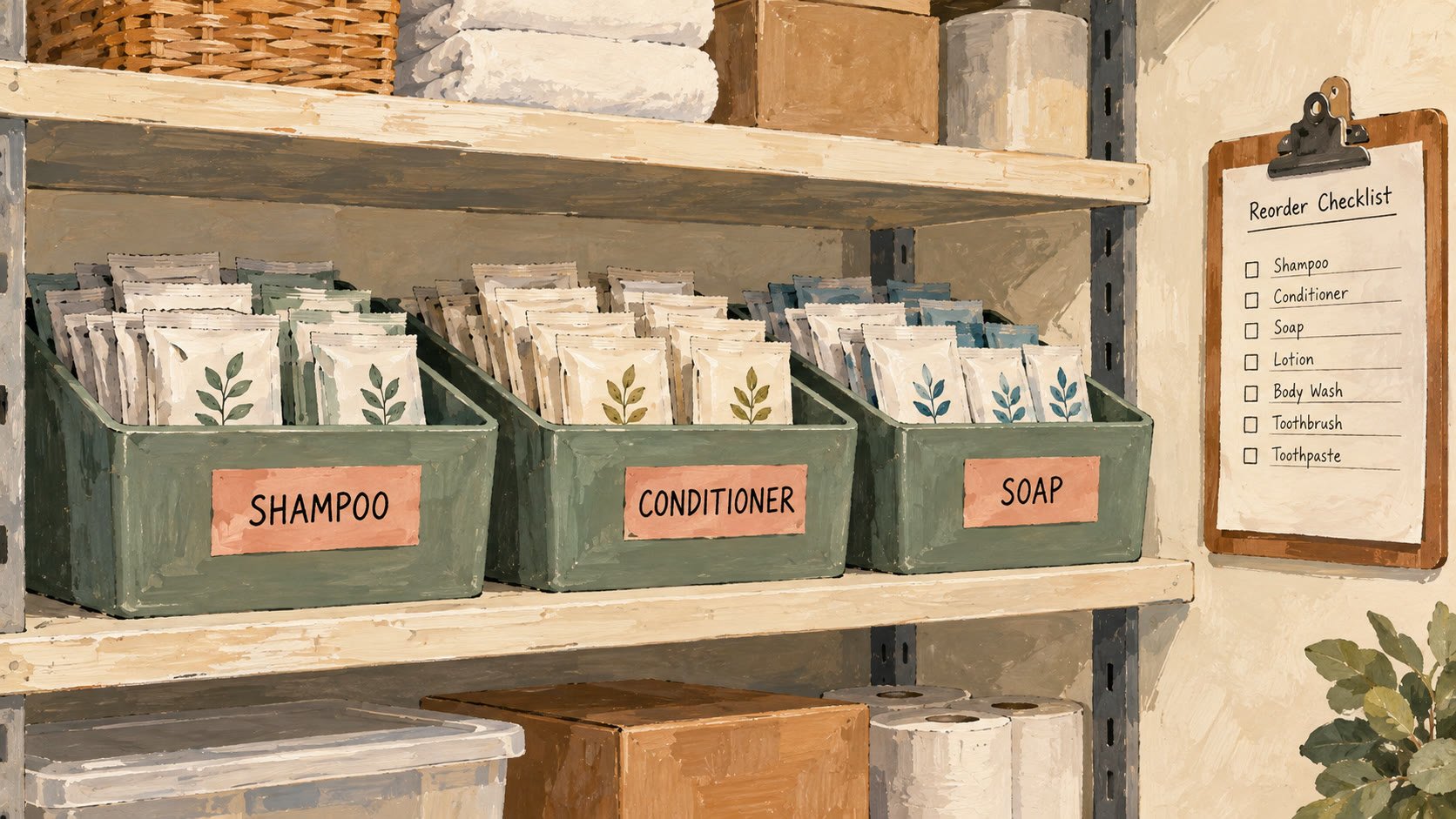
Keep your supply stock in a cool, dry location away from direct sunlight. Individually wrapped packets store flat and stack easily in a labeled storage bin organized by product type. A two-week to four-week buffer is the practical minimum for a single unit; larger portfolios benefit from keeping six to eight weeks on hand to absorb reorder delays. Most hotel-grade amenities carry two to three year shelf lives, so ordering in bulk isn't a freshness risk as long as you're turning through stock steadily.