Buying hotel soap in bulk is deceptively simple on the surface. You need soap, you need a lot of it, and you want the lowest defensible cost per bar. Most buying guides stop right there, hand you a list of suppliers, and call it done.
The operators who actually get this right are making three separate decisions that most buyers collapse into one. Collapse them, and you end up either overpaying for the wrong format, running out at the wrong time, or, in the worst outcome, putting a product in your guest bathroom that quietly signals you don't care.
Here's how to think through it properly.
The Format Decision Is the One That Actually Matters
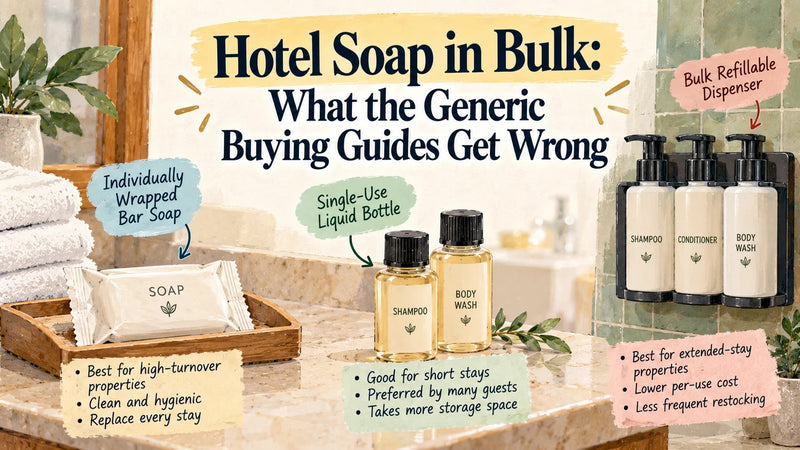
Before you look at a single price-per-unit number, you need a clear answer to this: bar soap, liquid soap, or dispenser?
Most guides treat this as a preference question. It isn't. It's an operational question, and the right answer is almost entirely determined by your turnover rate and your housekeeping workflow.
| Format | Best suited for | The honest tradeoff |
|---|---|---|
| Individually wrapped bar soap | High-turnover properties: short-term rentals, boutique hotels, B&Bs, care facilities | Higher per-use cost than dispensers; needs replacing every turnover |
| Single-use liquid pump bottle | Same use cases as bar soap; guests who prefer liquid | Similar cost to bar soap; takes more storage space per unit |
| Bulk refillable dispenser | Extended-stay hotels, eco-focused properties, consistent room counts | Lower per-use cost and less restocking; harder to signal "placed here for you" |
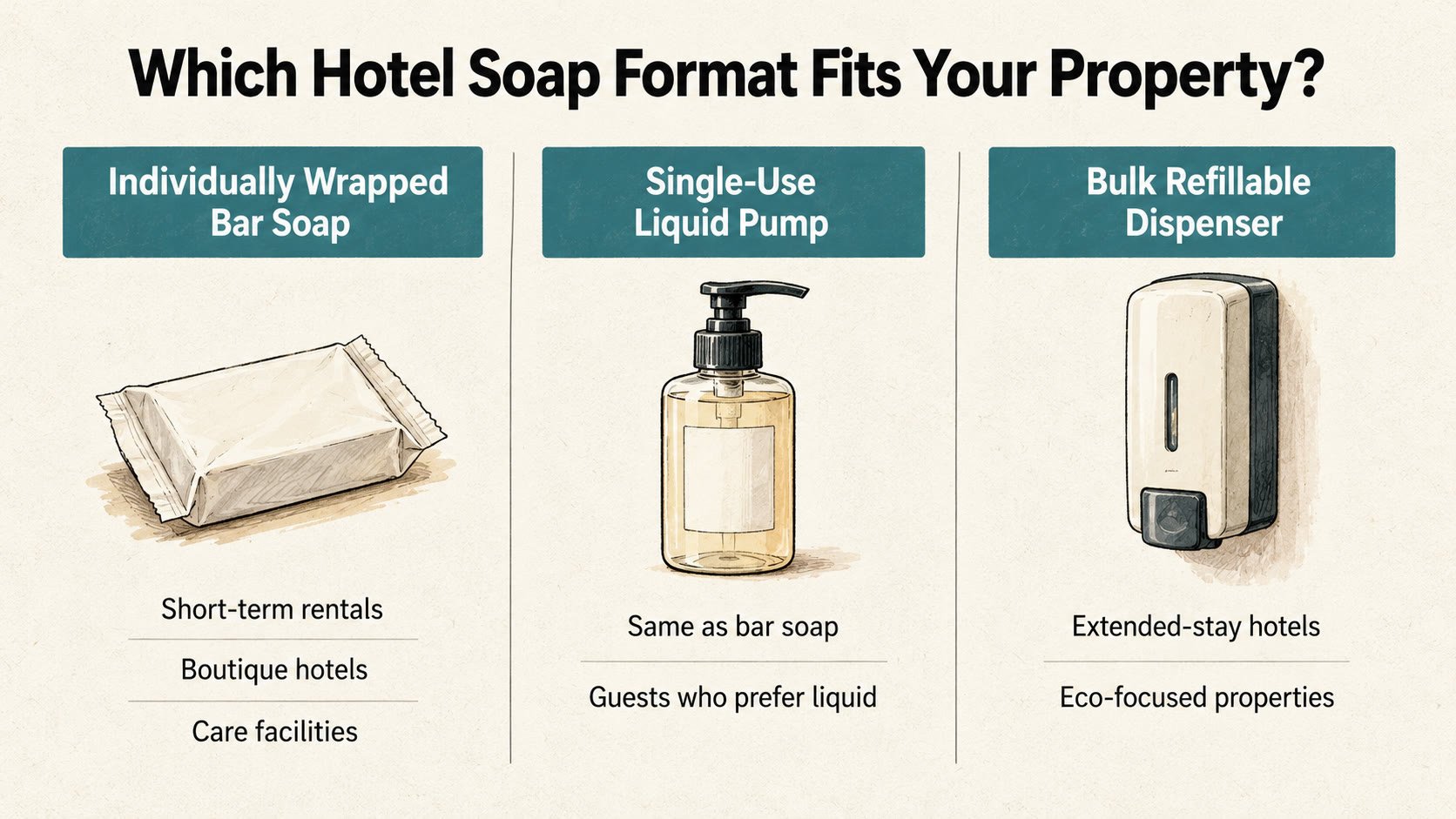
That last point matters more than most buyers give it credit for. A sealed, individually wrapped bar carries a message before a guest even touches it: this is new, it's clean, it was set here for you. A refill dispenser is perfectly hygienic, but it doesn't communicate that. In a short-term rental or care facility context, where the hygiene signal is part of the guest experience, that distinction shows up in reviews.
That said, dispensers are a legitimate choice. If you're running an extended-stay property, operating at scale with a housekeeping staff that refills routinely, or actively positioning around sustainability, a well-designed refill system makes operational and reputational sense. The format should follow your property profile, not a default assumption that one is better than the other.
Size: The Decision Most Buyers Underweight
Once you've settled on format, size is where a lot of operators make an unnecessary mistake.
The standard mini hotel bar soap is 0.5 oz (roughly 14–15g). That comfortably covers a weekend stay for a single guest. A 1 oz bar (28g) gives more runway for longer stays or heavier users. A full-size bar (3+ oz) is a different product category: it's a leave-behind luxury statement, not a per-stay consumable.
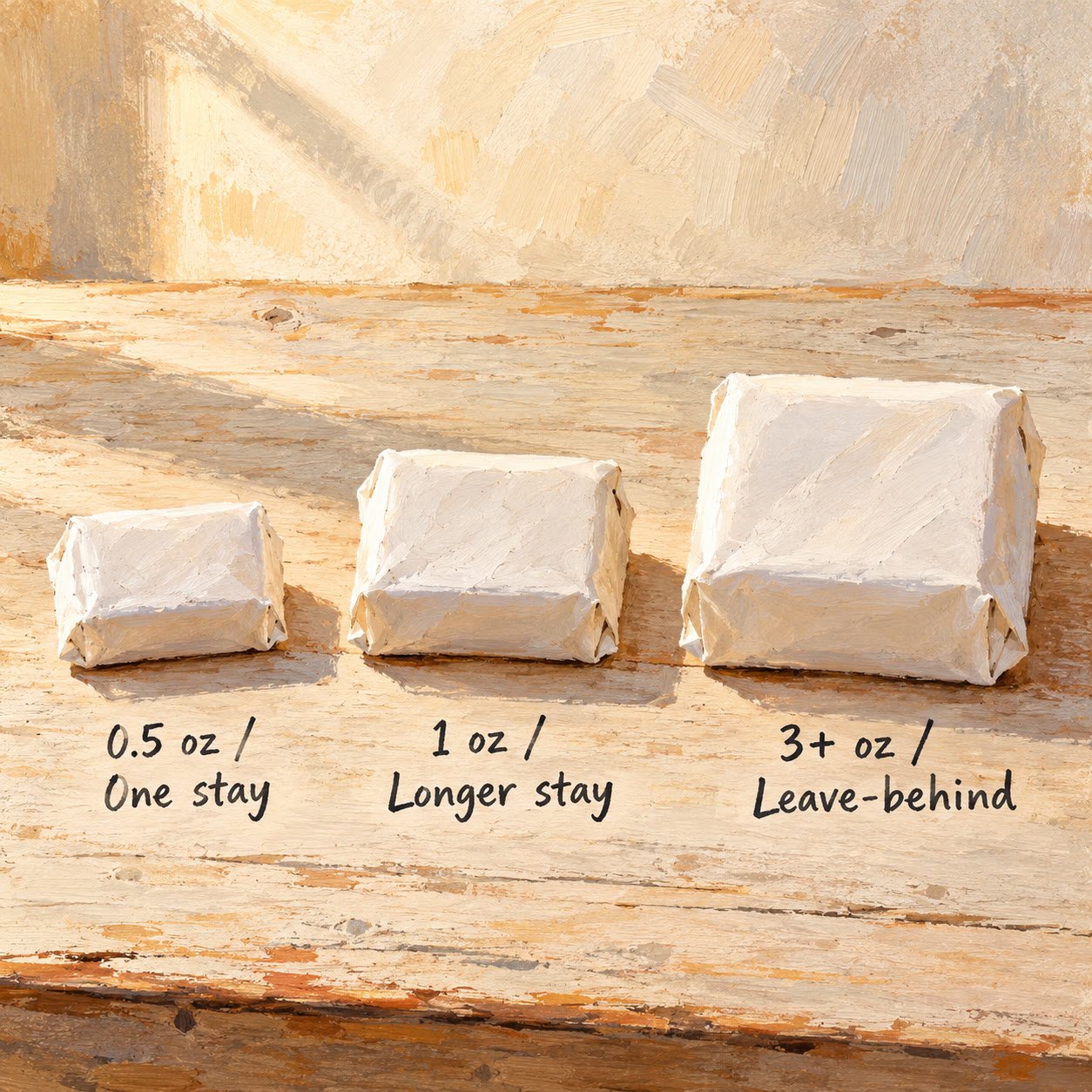
For most short-term rental operators and independent hotels, the 0.5 oz bar is the right choice. It's sized for one stay, it eliminates the awkward half-used bar you'd otherwise need to throw out or leave behind, and it ships and stores far more efficiently at bulk quantities. The exception is when your average stay runs four or more nights, or when you're deliberately positioning the bathroom experience at the premium end of your market.
The cost math also favors the smaller bar at scale. Per-unit pricing on a 360-pack of 0.5 oz bars is meaningfully lower than the same volume in 1 oz bars, and the per-stay cost comes out similar because guests typically use what's in front of them regardless of bar size. You're not saving money by giving them more soap.
The Per-Guest Cost Calculation Operators Actually Need
Most buyers compare price-per-unit. A more useful number is price-per-stay, and these diverge more than you'd expect.
Take 0.5 oz individually wrapped bars at roughly $0.42/unit on a starting pack. One bar per guest, per stay: $0.42. At 360-pack quantities, that per-unit cost drops further, meaning per-stay soap costs for a single-bathroom short-term rental can run under $100/year at full occupancy.
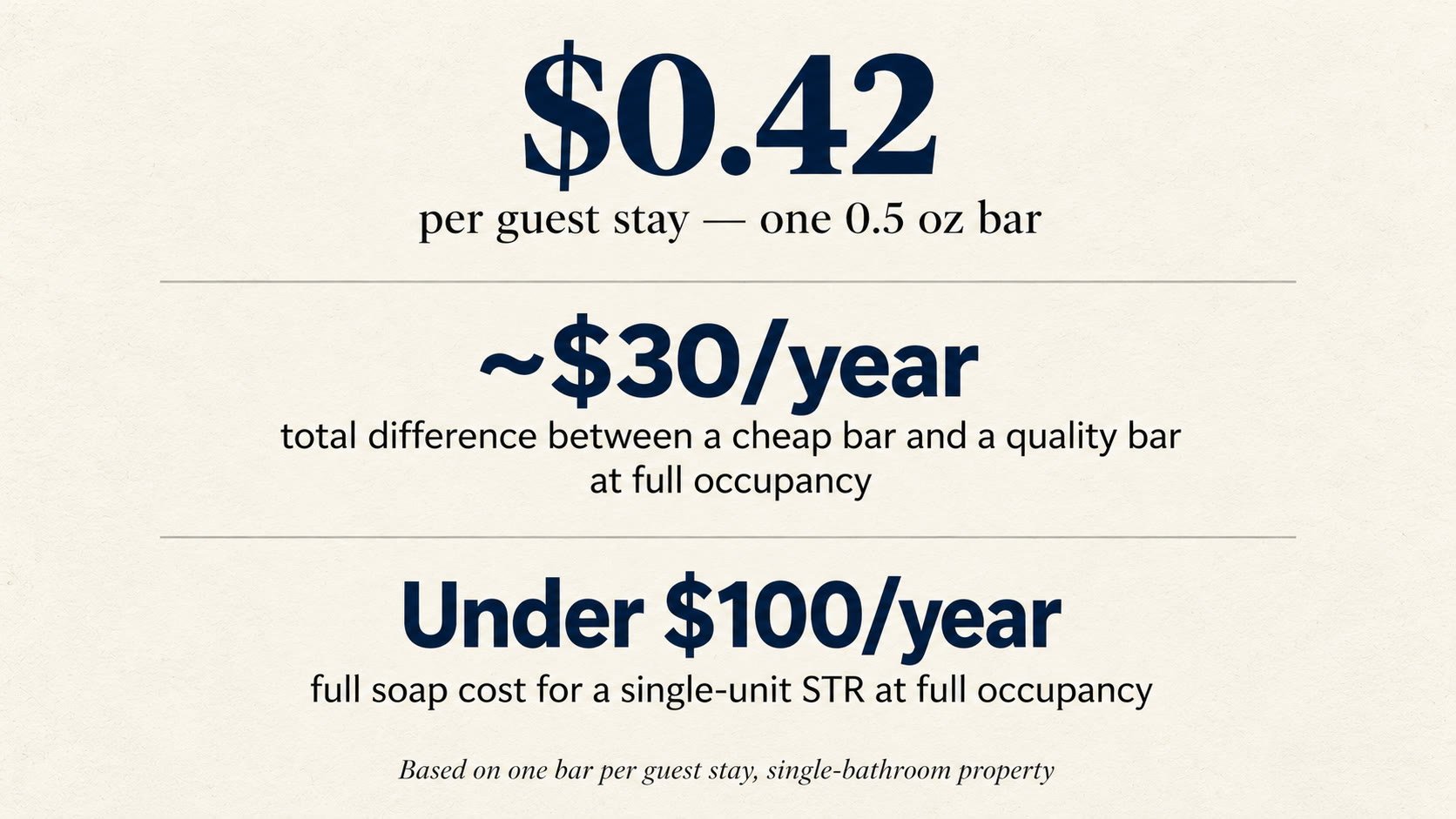
That number puts the cost optimization conversation in a different frame. The difference between a $0.30 bar and a $0.50 bar at full occupancy on one unit is approximately $30/year. The cost of putting a thin, harsh-smelling soap in your guest bathroom, through lost reviews and the impression it creates, is harder to quantify but almost certainly higher.
The right framing isn't "how cheap can I go?" It's "what's the per-stay cost of a soap I'd actually be comfortable using?" For most operators, that math lands somewhere in the $0.35–0.55 range per bar, which is a rounding error against nightly revenue.
What Makes a Bulk Hotel Soap Supplier Worth Using
Product quality matters. But what happens operationally after you place the first order is what determines whether you're reordering every eight weeks without thinking about it, or spending time on a problem that shouldn't require your attention.
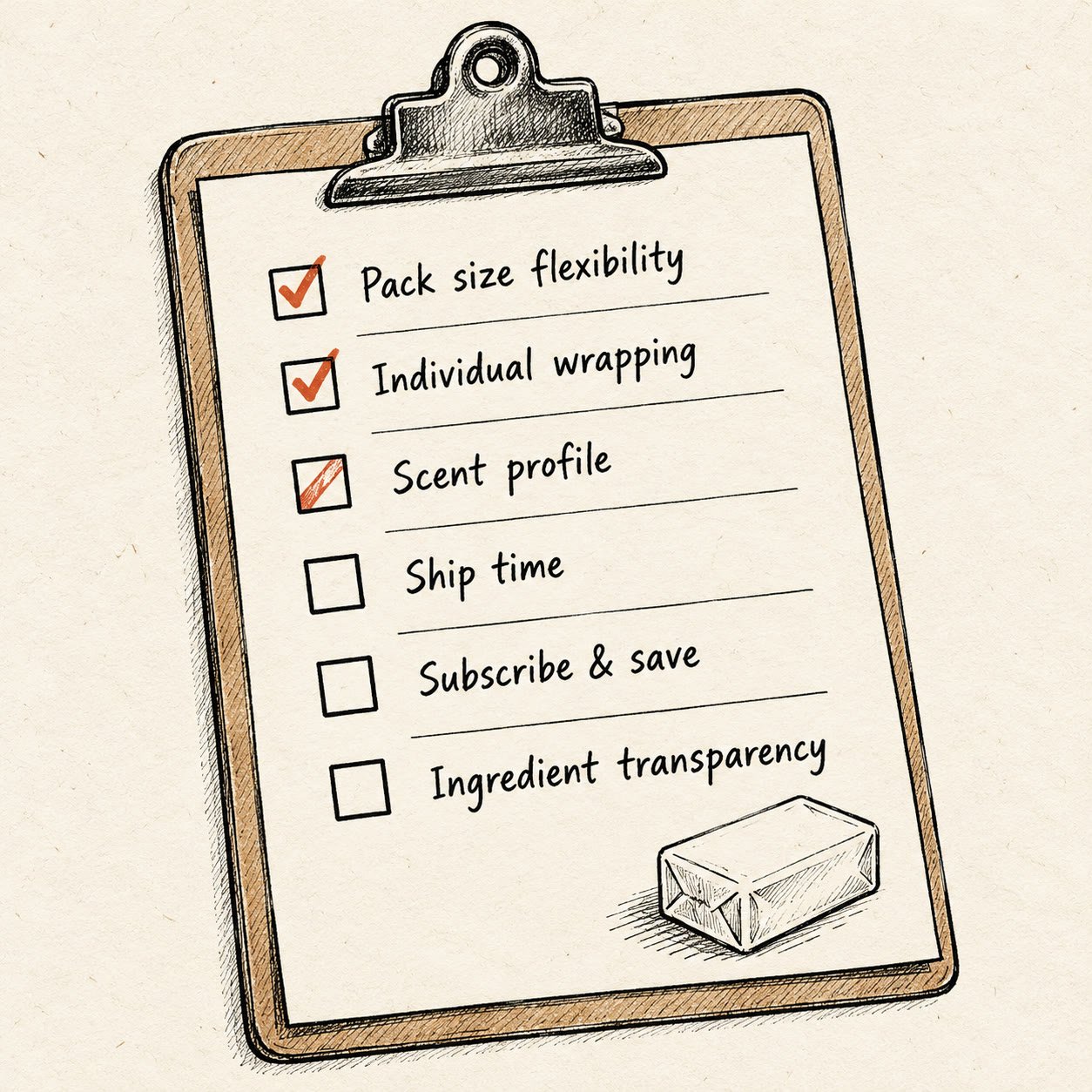
Here's what we look at when evaluating a supplier, in rough order of importance:
- Pack size flexibility. Can you start with a 60-pack to test and scale to 360 without switching products or suppliers? Suppliers that force large minimum orders upfront are a friction point, especially for newer hosts still calibrating their restocking cadence.
- Consistent individual wrapping. Every bar should arrive individually sealed, not loose in a bag. Loose bars degrade faster in storage and lose the hygiene signal entirely when you put them in a guest bathroom.
- Scent profile. Strongly scented soap is a genuinely divisive choice. Fragrance sensitivities are common enough that a lightly scented or fragrance-neutral formula is the better default for any property serving a broad guest demographic.
- Ship time. "Ships in 3-5 business days" is a materially different operational reality from "ships next business day." If you're managing a busy rental calendar, lead time is a real constraint.
- Subscription options. Manual restocking is fine for one unit. For a multi-unit operation, set-and-forget replenishment is meaningfully valuable. A supplier offering subscribe-and-save with flexibility to skip or cancel is a practical advantage.
- Ingredient transparency. For care facilities, assisted living operators, or any property with a formal intake or accommodation process, knowing what's in the soap matters. A supplier that can tell you clearly is more trustworthy than one that can't.
A Note on Our Perspective
Avistar supplies individually wrapped guest amenities to hotels, short-term rental hosts, and care facilities across the US. Soap is one of the first products operators ask us about, and the questions are almost always the same: which format, which size, how much, and how often. What's in this guide comes from working through those decisions with properties of very different sizes and types, not from aggregating product listings and calling it research.
Where Avistar's Soap Fits
Our Mini Bar Soap is a 0.5 oz individually wrapped bar designed specifically for the guest bathroom context: sealed until use, sized for one stay, and available in 60, 120, or 360-count packs so you can start small or stock a full season in one order.
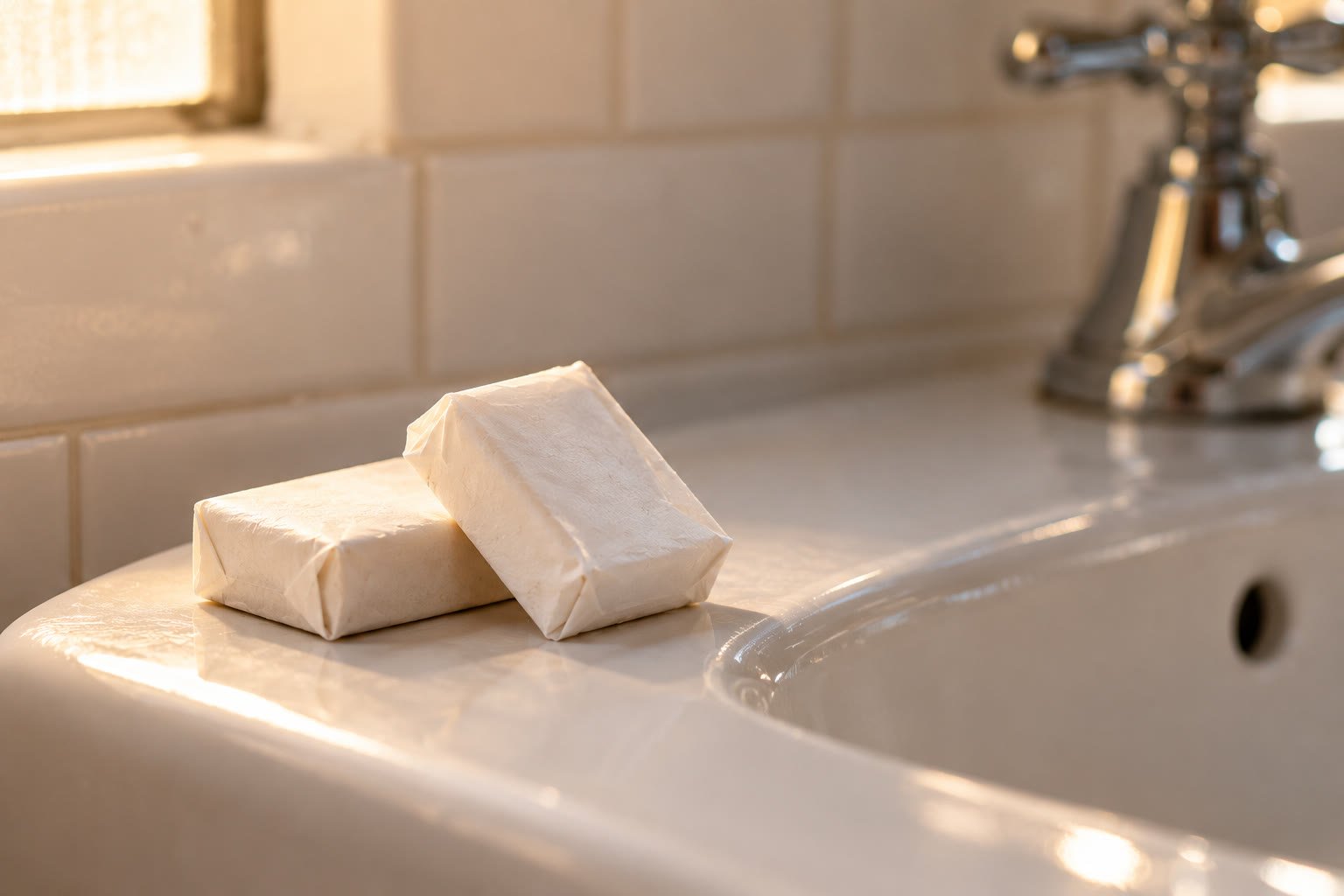
It ships next business day, carries a 4.6-star rating across 112 reviews, and has a subscribe-and-save option (15% off, skip or cancel anytime) for operators who want restocking to run without manual intervention.
We also carry dispenser products for properties where that format makes more sense; the right format depends on your operation, and we're not going to tell you otherwise. See the full Bath & Body collection for the current lineup.
If you're sourcing at volume for multiple properties or units, the wholesale program is the right starting point.
Frequently Asked Questions
How much hotel soap do I need per guest?
For a typical one-to-three-night stay, one 0.5 oz bar per guest is standard. For stays of four nights or more, consider either a 1 oz bar or two 0.5 oz bars, depending on your property's positioning. For care facilities or longer-term placements, calculate based on average length of stay and typical daily usage, then add a 15–20% buffer to give your housekeeping staff flexibility.
What size bar soap do hotels actually use?
Standard hotel bar soap ranges from 0.5 oz to 1.25 oz, individually wrapped. The 0.5 oz size is most common across independent hotels, short-term rentals, and B&Bs because it matches a single stay, minimizes waste, and stores efficiently in bulk. Premium or full-service hotels sometimes use 1 oz or 1.5 oz bars as a positioning signal, particularly in higher-end bathroom setups.
Is buying hotel soap in bulk actually cheaper?
Yes, consistently and meaningfully. A 360-count case of quality individually wrapped hotel bar soap typically runs $0.28–0.45 per bar depending on the supplier and product. Buying a 60-pack from the same supplier usually runs $0.40–0.55 per bar. The difference compounds across high-turnover occupancy; the cost case for bulk ordering is straightforward.
What makes hotel bar soap different from regular bar soap?
Hotel bar soap is sized for a single guest stay rather than a household, individually wrapped to signal that it's untouched, and typically formulated with a neutral or light scent to appeal across a broad guest demographic. Household bar soap is designed for ongoing use by known users with specific preferences. The format difference, per-stay unit versus ongoing household bar, is the practical distinction that matters most for sourcing.
Can Airbnb hosts use the same bulk soap supply as hotels?
Yes, and most individually wrapped hotel soap is explicitly sold to this market. Airbnb hosts, vacation rental operators, and hotel procurement teams are often buying from the same suppliers. The key specs to match are bar size (0.5 oz for standard stays), individual wrapping (important for the guest hygiene signal on every turnover), and pack size that fits your unit count and restocking frequency.
Is hotel soap FDA regulated in the US?
Bar soap sold in the US is regulated as a cosmetic product under FDA guidelines. Manufacturers must accurately list ingredients on the packaging and comply with general cosmetic labeling requirements. Products marketed with drug claims, such as antibacterial or antimicrobial, are subject to additional OTC drug regulations. For standard hotel bar soap without drug claims, the key compliance requirement is accurate ingredient labeling. When sourcing for a care facility with formal intake protocols, confirm ingredient lists directly with the supplier.
More from Avistar:
- Hotel Amenity Kit: What to Stock, What to Skip, and How to Buy in Bulk: broader framework for building out a complete guest bathroom
- Bulk Hygiene Products: The Complete Sourcing Guide for Hospitality Operators: covers the full range of hygiene amenities beyond soap
- Vacation Rental Supplies: What Actually Gets Noticed (And What You're Probably Over-Buying): where soap fits in the bigger guest experience picture