A good hotel amenities supplier saves you money, keeps your housekeeping operations predictable, and quietly contributes to the kind of guest experience that earns five-star reviews. A bad one creates stockouts at the worst possible moment, ships inconsistent product, and forces you into MOQs your property can't absorb. The gap between the two is bigger than most buyers realize, and the decision doesn't start with price.
Here's what to actually evaluate before you commit to a supplier, and the questions the standard buying-guide lists don't tell you to ask.
What a Hotel Amenities Supplier Actually Does
A hotel amenities supplier sources and distributes the guest-facing consumables placed in rooms, bathrooms, and common areas: soap, shampoo, conditioner, body wash, lotion, dental kits, and related personal care items. Most operate as wholesale distributors, meaning they handle fulfillment from stock; others manufacture to order or offer private-label services for branded product.
The phrase "hotel amenities" covers a specific category. It refers to the small-format, guest-facing toiletries provided as part of the stay, not cleaning supplies, linens, or housekeeping chemicals. If you run a hotel, Airbnb, vacation rental, or care facility and you're buying these products in volume, you need a supplier who understands the operational realities of that use case, not one who ships to retail consumers and calls the high-volume option "wholesale."
For a deeper look at how this category sits within the broader supply picture, our guide on what "hotel supplies" actually means is worth reading first.
The Format Question You Have to Settle Before Anything Else
Before you look at a single supplier, you need to decide on product format: individually wrapped amenities or wall-mounted dispensers. This isn't a small operational preference. It determines which suppliers you're even talking to, what your housekeeping workflow looks like, and how guests perceive the room.
| Format | Best Fit | Key Consideration |
|---|---|---|
| Individually wrapped | Turnover-heavy STRs, short stays, hygiene-sensitive care settings | Higher per-unit cost; simpler restocking; strong perceived hygiene |
| Dispenser (wall-mounted) | Extended-stay properties, eco-focused brands, properties with stable occupancy | Lower unit cost at scale; requires installation; dispenser refill logistics |
| Both | Mid-size hotels with mixed room categories | Operational complexity increases; benefit from a single supplier who offers both |
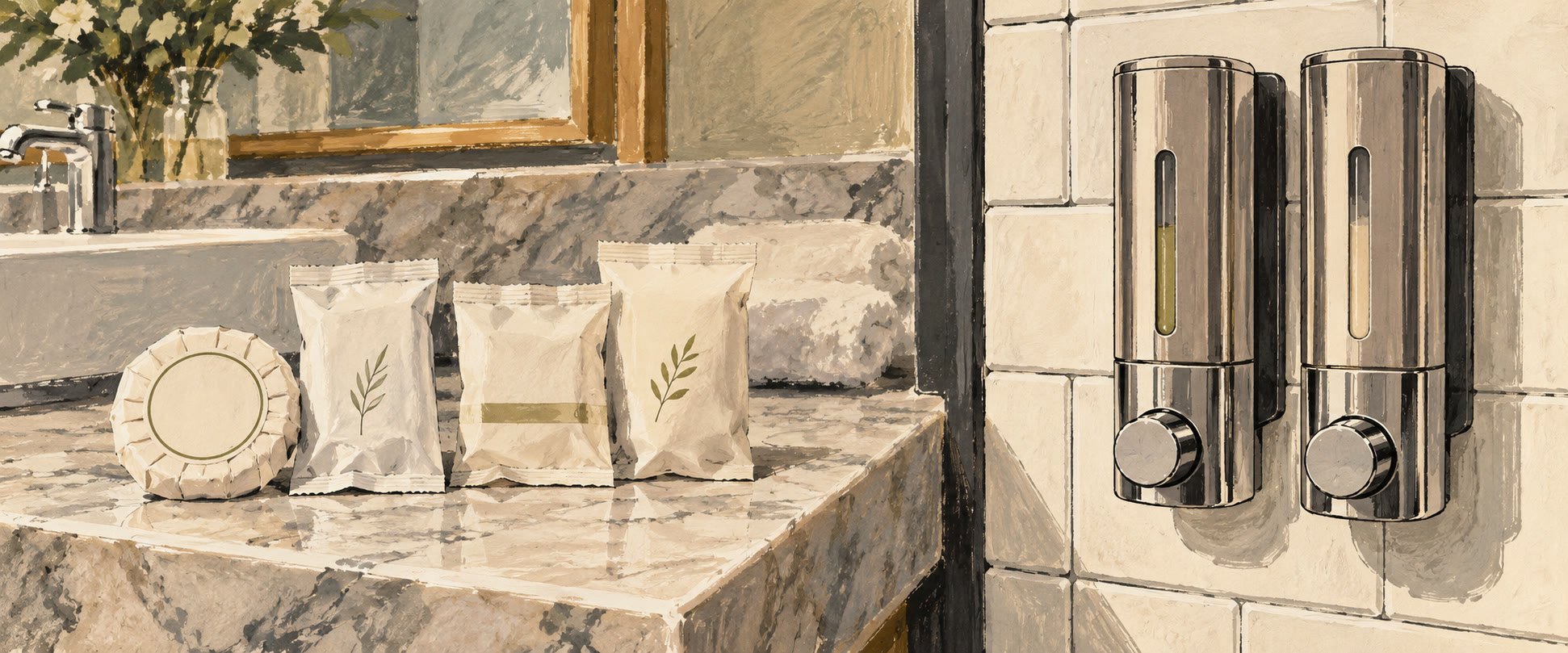
Most of the buying guides you'll find online gloss over this, or assume you've already made the call. We'd push back on that. The format decision directly affects your cost structure, your housekeeping training, your guest experience score, and your supplier shortlist. Get clear on it first.
If you're a short-term rental host running high turnover, individually wrapped products almost always make more sense: they're ready to place, signal cleanliness to guests, and eliminate the ambiguity of a partially used dispenser. If you're running a 60-room extended-stay property, the math starts looking different.
Avistar offers both individually wrapped amenities and dispenser options. What we've found, supplying a range of property types, is that the format question usually resolves itself once you map it to guest type and turnover rate.
What to Actually Evaluate in a Hotel Amenities Supplier
Most supplier evaluation guides give you a five-bullet checklist: product quality, price, reliability, customization, eco-friendliness. That list is true, in the way that "buy low, sell high" is true. Here's what it leaves out.
Minimum Order Quantities and How They Scale
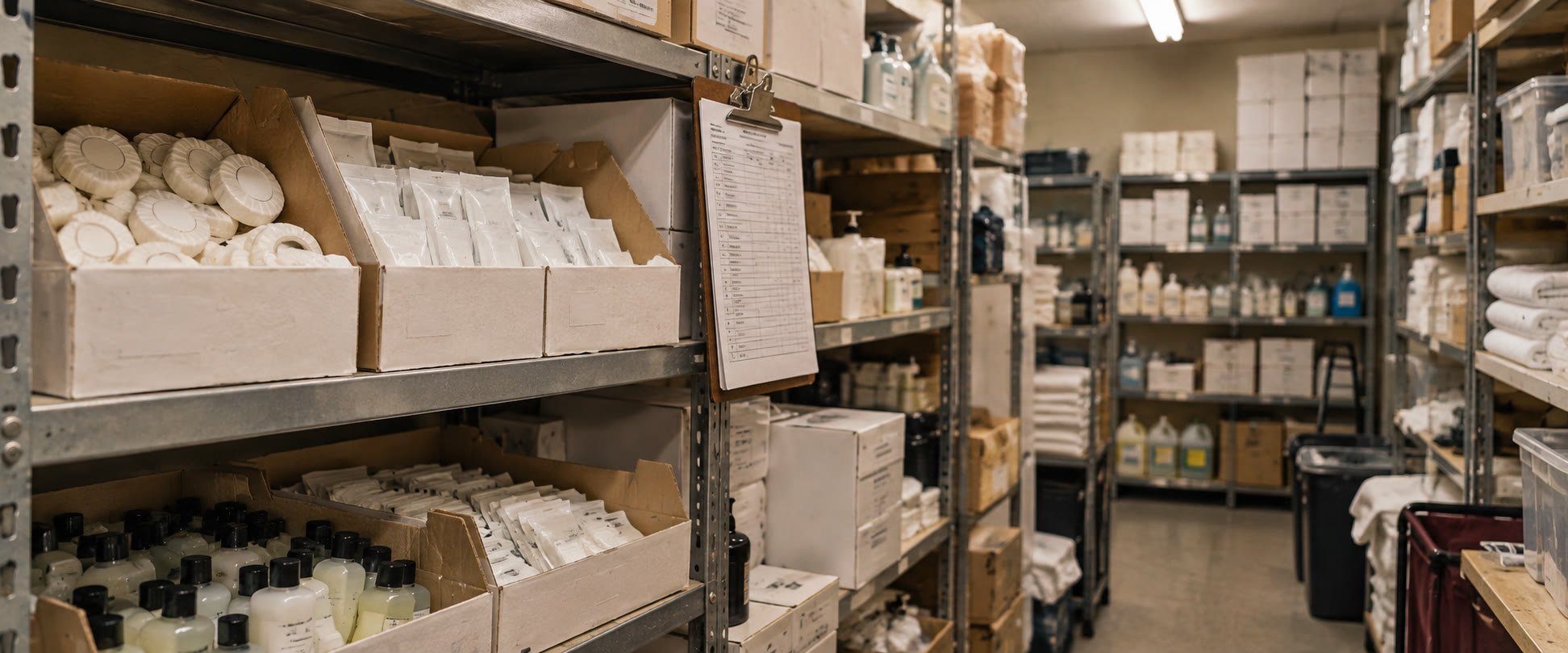
MOQ is the first hard filter for most buyers, and suppliers vary enormously here. A specialty supplier might require 5,000 units minimum per SKU to make private-label manufacturing viable. A wholesale distributor might carry bulk stock with no minimums or low-case minimums that work fine for a 10-room property.
The question isn't just "what's the MOQ?" It's: how does the MOQ interact with your turnover rate? A property cycling 50 rooms per night burns through 300 to 500 individual amenity pieces each turnover, across all SKUs combined. At that volume, a standard case of 144 soap bars is roughly a three-day supply, not a monthly stock. A vacation rental host running 3 units needs something that doesn't force a six-month inventory commitment on a single SKU.
Ask suppliers:
- What's the minimum per SKU, and is there a minimum order value?
- Can you mix SKUs within a case or order?
- Is there a price break at higher volumes, and at what threshold?
Price Transparency and True Cost Per Amenity
List price is almost meaningless without knowing unit count, format, and shipping cost. Two suppliers both quoting "$0.45 per unit" can be very different deals depending on whether that's a 1.0 oz bottle or a 1.35 oz bottle, whether it includes a dust cover, and whether the freight cost is bundled or added at checkout.
Build a simple comparison on cost per ounce, not cost per unit:
- Cost per unit divided by product volume in oz
- Add estimated freight to your per-unit calculation
- Factor restocking frequency (a cheap per-unit price loses its advantage if you're placing orders every two weeks and paying shipping each time)
For soap specifically, our wholesale soap supplies buying guide walks through exactly this calculation in the context of hotel and host procurement.
Certifications That Matter in the US Market
This is where a lot of supplier evaluation guides fall apart, either listing generic certifications that don't map to US operations, or skipping this section entirely.
For US hospitality buyers, the credentials worth verifying:
- Cruelty-free / Leaping Bunny certification: Relevant for branded guest experience positioning and increasingly expected at wellness-oriented and higher-end properties
- Paraben-free / sulfate-free formulation disclosure: These are label claims rather than third-party certifications, but many guests read ingredient panels and wellness-positioned properties are asked about them
- California Prop 65 compliance: If you operate in California or ship products there, this matters for ingredient-related liability on personal care products; enforcement continues to be active in 2026
- FDA-compliant labeling under 21 CFR Part 701: This applies to cosmetics: shampoo, conditioner, body wash, and lotion all fall under FDA jurisdiction and must meet Part 701 labeling requirements. Bar soap is a notable exception: true soap (made from an alkali salt of fatty acid, with only a cleansing claim) is regulated by the CPSC, not the FDA. Ask suppliers which regulatory framework applies to each SKU they supply
- Green Seal GS-44 certification: Green Seal's GS-44 standard covers soaps, cleansers, hand sanitizers, and shower products. It's a recognized hospitality-sector certification for sustainability and ingredient safety, and a stronger verification signal than generic "eco-friendly" branding

Do not let a supplier's sustainability branding substitute for actual certification documentation. Ask for the certs. Legitimate suppliers have them and can produce them quickly.
Lead Time and In-Stock Reliability
This one separates the suppliers who have worked with hospitality operators from those who haven't. Hotels and STRs can't absorb a two-week stockout. The supplier who offers the best per-unit price but runs on a 10-day manufacturing lead time is a liability if you order reactively.
Key questions:
- What's the typical lead time from order placement to delivery for in-stock items?
- Do you carry safety stock, or is inventory made to order?
- What's your out-of-stock rate on top SKUs over the past 12 months?
- How do you communicate when a SKU is delayed or discontinued?
Ask for references from hotel or hospitality accounts specifically, not retail buyers. The reliability standards are different.
Sample Ordering Before You Commit
Any supplier worth working with will send samples. If they won't, or if the sample program has significant friction (minimum purchase, long lead time, limited SKUs), treat that as a signal.
What you're evaluating in samples:
- Scent intensity and profile (guests notice this more than any single other quality cue)
- Packaging integrity: does the wrap or cap hold up to being placed in a bathroom environment for 2-3 days?
- Product volume: does the label volume match actual fill?
- Label quality and water resistance
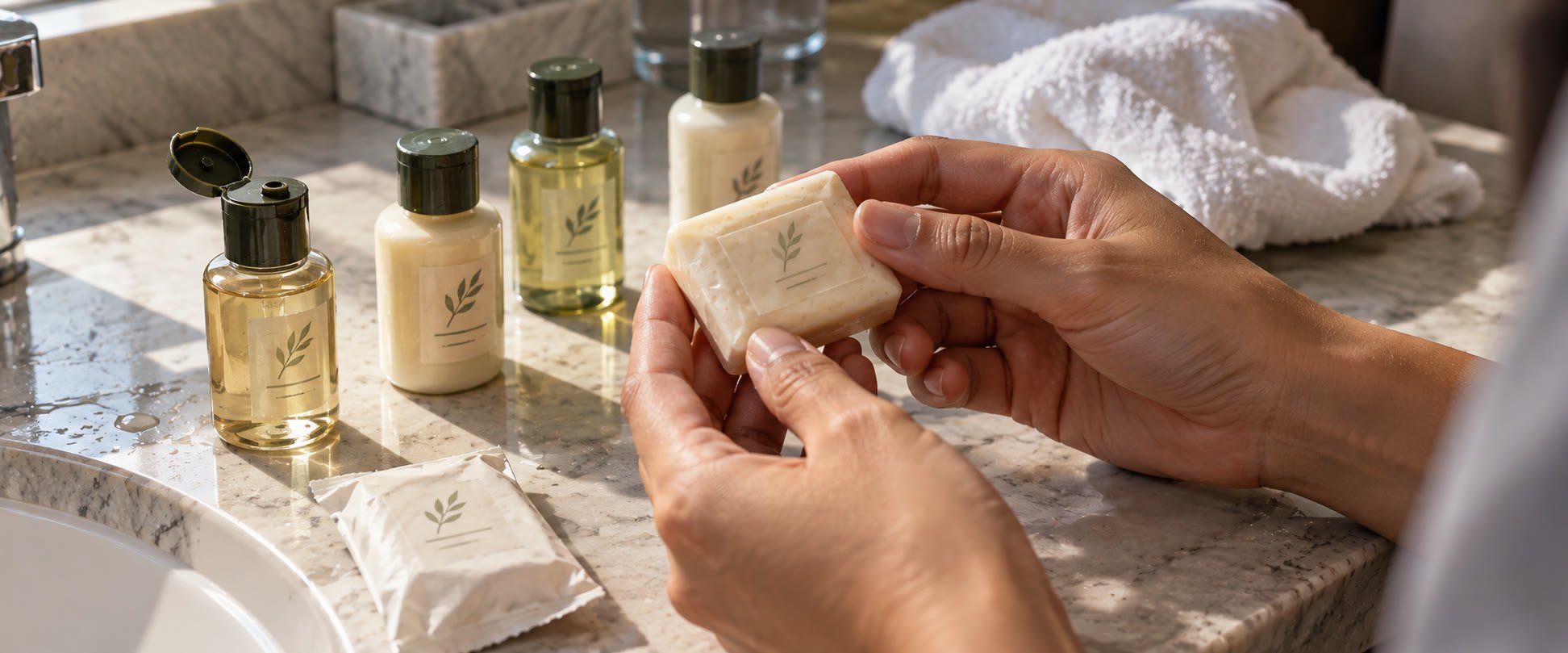
For individually wrapped items specifically, check whether the wrapper holds its seal after handling. Housekeeping staff will touch each piece dozens of times per week.
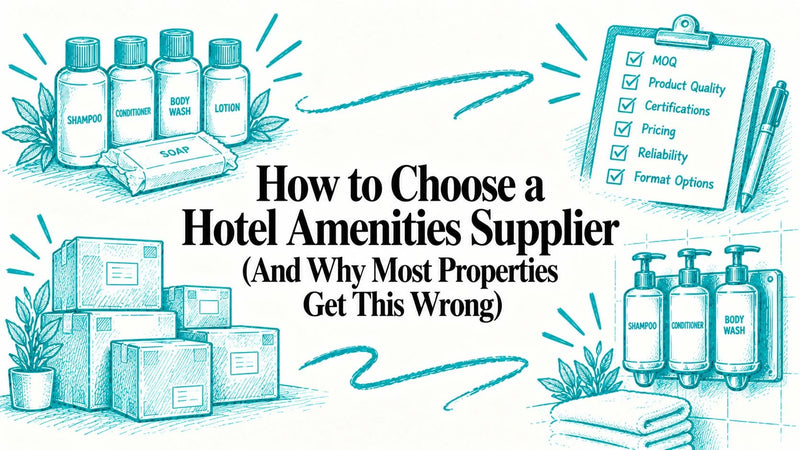
A Framework for Comparing Suppliers Side by Side
Once you have quotes and samples, here's the comparison framework that actually matters for an operations-focused buyer:
| Criteria | Why It Matters | What to Compare |
|---|---|---|
| Unit cost (per oz) | True cost basis | Normalize all quotes to $/oz to strip out format differences |
| MOQ per SKU | Cash flow and storage impact | Map to your weekly usage volume |
| Lead time | Operational reliability | Standard vs. rush; in-stock vs. make-to-order |
| Certification documentation | Compliance and brand positioning | Ask for copies, not verbal confirmation |
| Format options | Operational flexibility | Can the same supplier supply both formats? |
| Customization capability | Brand differentiation | Minimum for custom label; turnaround time |
| Sample availability | Pre-commit quality verification | Any friction here is a red flag |
Run every shortlisted supplier through this table with real data, not marketing language. The supplier who wins on every marketing metric but can't tell you their standard lead time on in-stock soap is not the supplier you want running your amenities program.
Red Flags Worth Walking Away From
We've seen enough supplier pitches to know what the warning signs look like:
- No clear MOQ information on the website or in initial communication. Legitimate wholesale suppliers know their MOQs cold.
- Sustainability claims with no third-party certification. "Eco-friendly" and "natural" are marketing words. Certifications are verifiable facts.
- No sample program, or samples that require a purchase order. A supplier confident in their product doesn't gate samples behind a sale.
- Pricing that requires a quote for every SKU without any public range. Opacity in pricing is usually opacity in markup.
- Lead times quoted as ranges like "10-21 business days." That range is too wide to run an operations plan around; ask for the typical, not the worst-case.
- No references from US hospitality accounts. A supplier who primarily serves retail or international markets has a fundamentally different supply chain than what hospitality operators need.

Why Trust This Article
We are a hotel amenities supplier. That's not a conflict of interest disclaimer; it's the reason this guide exists.
We supply hotels, short-term rental hosts, property managers, and care facilities with guest amenities. We take the calls when an order goes wrong. We hear what buyers wish they'd known before they committed to a supplier. We know which questions are missing from every "how to evaluate a hotel amenities supplier" checklist floating around the internet, because we deal with the fallout when buyers didn't ask them.
Where We Fit in the Shortlist
We built Avistar specifically for the property operators who find themselves between the two bad options: commercial hotel distributors with minimum order requirements most small and mid-size properties can't absorb, and retail-facing brands that treat bulk orders as an afterthought.
Our catalog covers individually wrapped soap, shampoo and conditioner, body wash, and oral care, with options in both individually wrapped format and dispenser-ready bulk. Minimum orders are designed to work for properties at scale and for hosts running a handful of units. Samples are available before you commit.
If you're evaluating your current amenities supplier or sourcing for the first time, our hotel toiletries guide is the place to start on the product side.
Frequently Asked Questions
What is a hotel amenities supplier?
A hotel amenities supplier is a wholesale distributor or manufacturer that provides the small-format personal care products placed in hotel rooms and rental properties for guests: typically soap, shampoo, conditioner, body wash, lotion, and dental kits. Unlike retail brands, hotel amenities suppliers are set up for bulk volume purchasing, consistent restocking, and hospitality-specific packaging formats.
What's a typical MOQ for hotel amenities wholesale?
MOQs vary significantly by supplier and product format. Wholesale distributors carrying in-stock inventory often set minimums at the case level, which can be as low as 144 or 500 units per SKU. Private-label and custom-manufactured suppliers typically set minimums at 1,000 to 5,000+ units per SKU. For properties running fewer than 20 rooms, look specifically for suppliers advertising low or case-level minimums.
How do I compare hotel amenities suppliers on price?
Compare cost per ounce of product, not cost per unit, since bottle sizes vary widely across suppliers and formats. Factor in shipping costs, which can add $0.05 to $0.15 per unit at typical hospitality order volumes. Also factor restocking frequency: a marginally cheaper supplier who requires weekly orders may cost more in shipping annually than a slightly pricier supplier you order from monthly.
What certifications should a hotel amenities supplier have?
For US hospitality buyers, the most relevant credentials are FDA-compliant labeling under 21 CFR Part 701, California Prop 65 compliance if you operate in that market, and any relevant third-party certifications for specific claims like cruelty-free or paraben-free formulation. Ask suppliers to provide documentation rather than accepting verbal confirmation of any certification claim.
Should I use individually wrapped amenities or dispensers?
The right format depends on your property type and turnover pattern. Individually wrapped amenities work best for high-turnover short-term rentals, hygiene-sensitive care settings, and properties where guests associate sealed packaging with cleanliness. Dispensers are a better fit for extended-stay properties, eco-focused brands, and higher room counts where the unit cost savings compound meaningfully. Many operators use both, and a supplier who carries both formats simplifies procurement.
How long does it take to receive a hotel amenities order?
For in-stock wholesale inventory, most US-based suppliers ship within 1 to 3 business days, with delivery times of 3 to 7 business days depending on location. Custom or private-label orders typically run 3 to 6 weeks from proof approval to delivery. Always confirm lead times before placing a first order, and ask about stock availability on specific SKUs rather than assuming product is on hand.
Can I order samples before committing to a hotel amenities supplier?
Yes, and you should. Any supplier operating at a professional level in the hospitality space will offer a sample program, either at cost or free for qualified buyers. Use samples to evaluate scent, packaging integrity, product volume accuracy, and label durability in a real bathroom environment before placing a bulk order. If a supplier declines to provide samples or makes the process unnecessarily difficult, that's worth noting.