Hotel soap and shampoo suppliers in the US fall into three distinct types: specialty hospitality amenity wholesalers, general wholesale distributors with a hospitality line, and private-label manufacturers. Which one you need depends on your property size, order volume, and whether you want branded-name product or your own label. Most operators default to the wrong category because nobody explains the difference clearly.
Here's the map. If you're still deciding what to put in the kit before worrying about who supplies it, our hotel amenity kit guide is worth reading first.
The Landscape Most Guides Skip Entirely
Search for hotel soap and shampoo suppliers and you'll get two kinds of results. Product listing pages from distributors who want your order. And vague blog posts telling you to try "specialized hospitality suppliers" or "online marketplaces" without ever naming one.
Neither actually helps you understand how this market works.
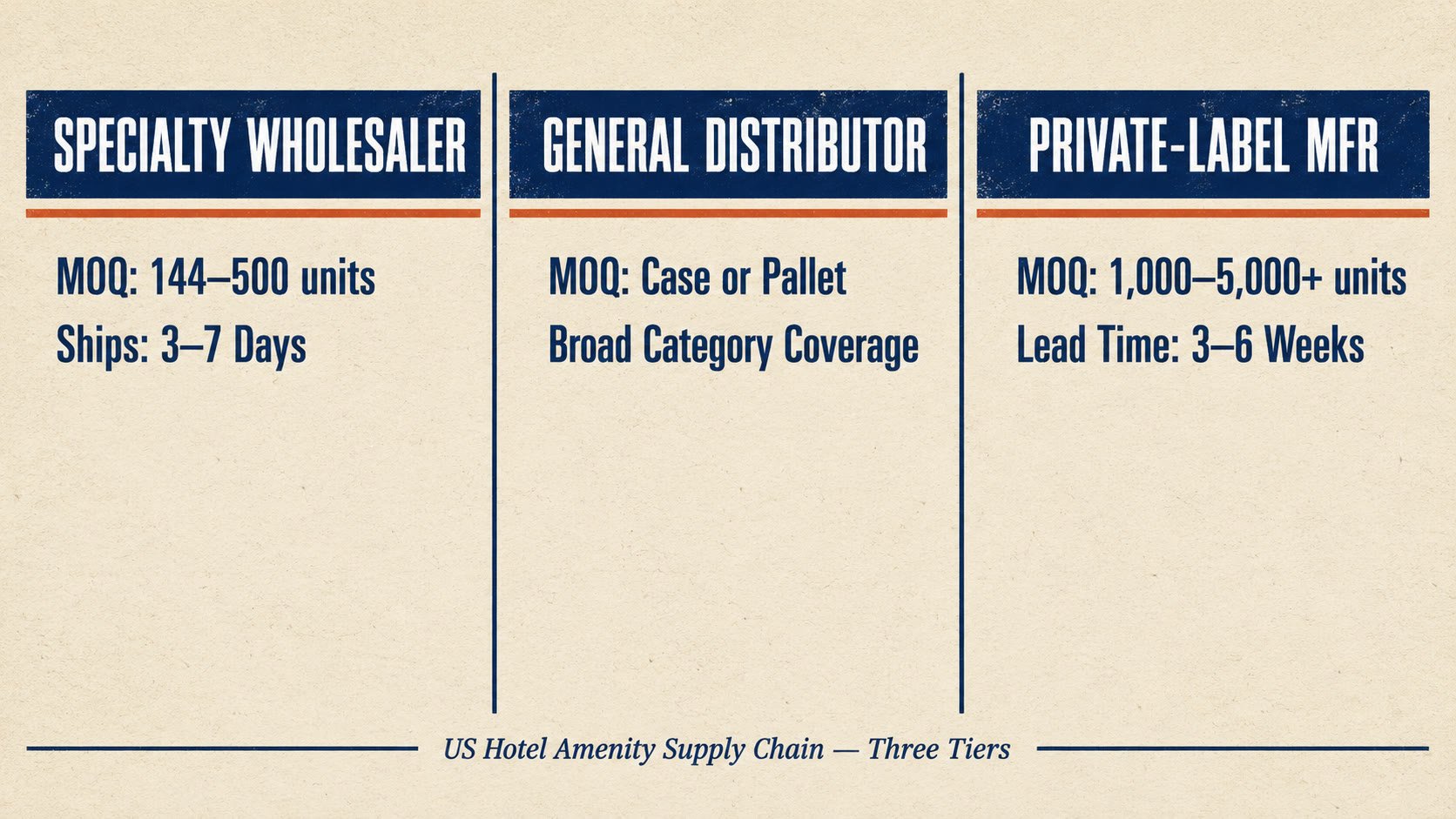
So before we get into specific names, here's the structure: the US hotel soap and shampoo supplier market operates in three tiers, and they serve very different buyers.
| Supplier Type | Best For | Typical MOQ | What You're Trading For |
|---|---|---|---|
| Specialty hospitality amenity wholesaler | Hotels, STRs, care facilities buying branded guest-facing product | Low (case-level, often 144–500 units per SKU) | Ready-to-place product, fast shipping, hospitality-specific formats |
| General wholesale distributor | Mid-to-large properties that need broader categories in one order | Medium (varies by brand; can be case-level or pallet) | Consolidation and price; less curation for hospitality use cases |
| Private-label manufacturer | Branded hotels, hotel groups, or larger operators wanting custom labels | High (typically 1,000–5,000+ units per SKU) | Your brand on the bottle; longer lead times, higher commitment |
Most Airbnb hosts, independent hoteliers, and property managers running fewer than 100 rooms belong in the first category. The second category makes more sense as volume grows or when you're already buying other supplies from a distributor and want to consolidate. The third is a different business decision entirely: more of a brand investment than a procurement call.
Specialty Hospitality Amenity Wholesalers: Where Most Properties Should Start
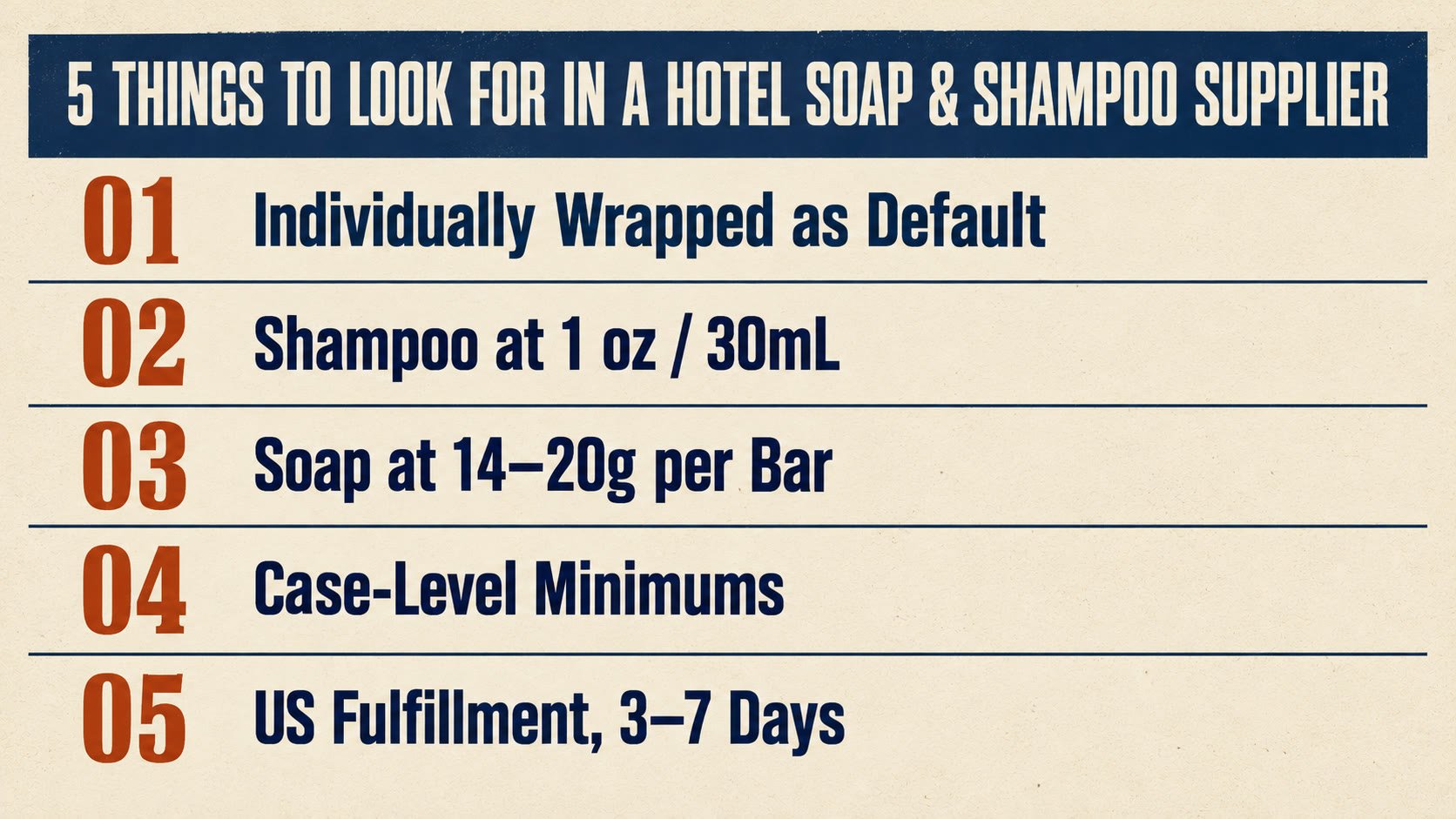
This is the category built specifically for the problem you're trying to solve. These suppliers carry individually wrapped soap, shampoo, conditioner, body wash, and related amenities in formats designed for room placement, with SKUs sized for hospitality use (typically 1 oz or 30mL shampoo, 0.85–1 oz bar soap) and packaging that signals cleanliness to guests.
The operational reality is that this category matters: a general wholesale distributor might carry soap in bulk cases sized for gym showers. A specialty hospitality wholesaler carries individually wrapped bar soap in the right gram weight (usually 14g–20g for a guest bar), with wrappers that hold up to a housekeeping cart.
What to look for in this category:
- Individually wrapped formats as a default, not an add-on
- Shampoo in travel-size bottles (0.85 oz/25mL to 1 oz/30mL) or tubes, not bulk gallons (unless you're running dispensers)
- Soap sized for guest use, not commercial hand-wash bars
- Case minimums that work for your property size: at 30 rooms cycling daily, a case of 144 soap bars is roughly a 5-day supply
- US-based fulfillment and standard shipping (3–7 business days) rather than a 3-week lead time
For par-level math and how much to order by property scale across your full bathroom setup, our bulk hygiene products sourcing guide has the numbers.
US players in this space:
Zogics is one of the better-known wholesale hospitality suppliers in the US. They carry branded product (Beekman 1802, Soapbox, PAYA, Apotheke, Pharmacopia) in hotel-amenity formats alongside their own Zogics label. They serve hotels, spas, gyms, and Airbnbs. Their catalog is broad and their brand selection is stronger than most, which makes them a reasonable default for a property that wants recognizable names.
Amenities Depot (Rancho Cucamonga, CA) is a specialty supplier focused on luxury hotel amenities, including soap and shampoo. Worth evaluating if you're running a boutique property or care facility where perceived quality matters more than price per unit.
Linen Plus operates out of Canada but ships to US buyers. They carry hotel amenity collections in the spa-grade tier with proprietary branded lines. Their low-minimum-order policy is genuinely low by industry standards, which makes them viable for smaller properties. Worth comparing if you want a cohesive collection look across soap, shampoo, conditioner, and lotion.
Avistar sits in this category. Our catalog covers individually wrapped soap, shampoo, conditioner, and body wash in both individually wrapped and dispenser formats. We built the operation specifically for hotels, short-term rentals, and care facilities who find themselves between commercial distributors requiring large minimums and retail brands that treat bulk orders as an afterthought. More on that at the end.
For a deeper look at what to actually evaluate when comparing these suppliers, our hotel amenities supplier guide covers the criteria in full.
General Wholesale Distributors: Bigger Catalogs, Different Trade-offs
This is the category where you find names like Uline, Guest Supply (a Sysco company), and various regional broadline distributors that sell everything from janitorial supplies to paper towels to soap.
The advantage here is consolidation. If you're already ordering six product categories from a distributor, adding soap and shampoo to the same PO makes sense operationally. The disadvantage is that soap and shampoo are not their primary expertise, and it shows.
Uline, for example, carries hotel toiletries under their Apotheke and PAYA lines. The product is legitimate; PAYA is a real brand. But the catalog depth for soap and shampoo specifically is thin compared to specialty suppliers, the SKU count is limited, and the buyer experience is oriented toward industrial purchasers rather than hospitality operators. You can get what you need there. You're just not going to find a lot of guidance on which format is right for a 15-room boutique property versus a 100-room extended-stay.
The practical guidance: use this category when consolidation value outweighs product curation, not as your default for guest-facing amenities.
Private-Label Manufacturing: A Different Conversation Entirely
Private-label manufacturing for hotel soap and shampoo means commissioning product with your property's branding on the label. It is not a sourcing decision; it is a brand investment. The MOQs are typically 1,000 to 5,000 units per SKU minimum, the lead time from proof approval to delivery runs 3 to 6 weeks, and the setup costs are real.
This tier makes sense for hotel groups, branded boutique properties, or larger operators where the brand experience extends to the bathroom and is worth the capital commitment. For a single-property host or a small hotel, it almost never pencils out.
If you're researching private-label options: look for US-based manufacturers with FDA-compliant cosmetic manufacturing credentials and documented Good Manufacturing Practice (GMP) processes. Dynamic Blending and Commonwealth Soap & Toiletries are US-based examples in this space. Xiran Skincare operates internationally and serves the mid-range hotel tier. For any private-label manufacturer, ask for GMP documentation upfront and confirm their FDA labeling compliance under 21 CFR Part 701 before committing.
Soap vs. Shampoo: What You Should Actually Be Evaluating Differently
Most buyers treat soap and shampoo as one category when they're sourcing. They're not. The evaluation criteria are different enough that it's worth separating them.
For hotel soap specifically
Bar soap and liquid hand soap follow different regulatory frameworks in the US. True bar soap (made from an alkali salt of a fatty acid with only a cleansing claim) falls under CPSC regulation, not FDA. Liquid soap and body wash fall under FDA cosmetic regulation and must comply with 21 CFR Part 701 labeling requirements. This matters when you're asking a supplier for compliance documentation: ask separately for each format.
What to evaluate for hotel bar soap:
- Weight per bar: 14–20g is standard for individually wrapped guest bars; lighter than 14g is common in budget tiers and guests notice
- Wrapper integrity: does the packaging stay sealed after sitting in a bathroom environment for 2–3 days?
- Scent profile: neutral to light is safer than strong fragrance for a general audience
- Formulation: glycerin-based bars last longer and feel better than heavily surfactant-based bars at the same price point
- California Prop 65 compliance if you operate in that state

For a product-specific deep dive, our wholesale soap supplies buying guide covers pricing by tier, format tradeoffs, and what the regulatory landscape actually requires.
For hotel shampoo specifically
Hotel shampoo is an FDA-regulated cosmetic under 21 CFR Part 701, full stop. The labeling requirements are specific: ingredient declaration in descending order of predominance, net quantity of contents in US customary and metric units, and responsible party name and address.
Ask any shampoo supplier you're evaluating whether their labels meet Part 701. Legitimate wholesale suppliers have this covered and can show you. If a supplier can't answer the question or deflects, that's information.
What to evaluate for hotel shampoo:
- Volume per unit: 1 oz (30mL) is the standard individual serving for one wash; some budget tiers drop to 25mL, which guests sometimes notice as insufficient
- Lather performance: shampoo that doesn't lather well in hard-water environments is one of the most common complaints in property reviews that mention bathroom amenities
- Scent intensity: light-to-moderate; you want something guests notice positively, not something that lingers in the room
- Hair-type neutrality: formulated for normal hair types, pH-balanced, without heavy conditioning agents that leave fine hair flat
- Label durability: can the bottle sit in a steam shower environment for a day without the label separating?
For the full buying framework on shampoo and conditioner specifically, see our bulk shampoo and conditioner guide.
The Format Question That Changes Everything
If you landed on "hotel soap and shampoo suppliers" because you're stocking a property, you need to answer one question before any supplier conversation: individually wrapped or dispenser?
This isn't just a preference call. It changes which suppliers you're talking to, what your housekeeping workflow looks like, and how guests perceive the room.
| Format | Works Best When | Key Operational Reality |
|---|---|---|
| Individually wrapped | High turnover (multiple guests/week), hygiene-sensitive care settings, STRs where sealed packaging signals cleanliness | Higher per-unit cost; simpler restocking; no installation required |
| Dispenser (wall-mounted) | Extended-stay or branded hotels, eco-focused properties, stable occupancy | Lower per-unit cost at scale; requires installation; refill management |
| Both | Mid-size hotels with mixed room types or multiple property segments | Same supplier for both simplifies procurement; adds complexity in operations |
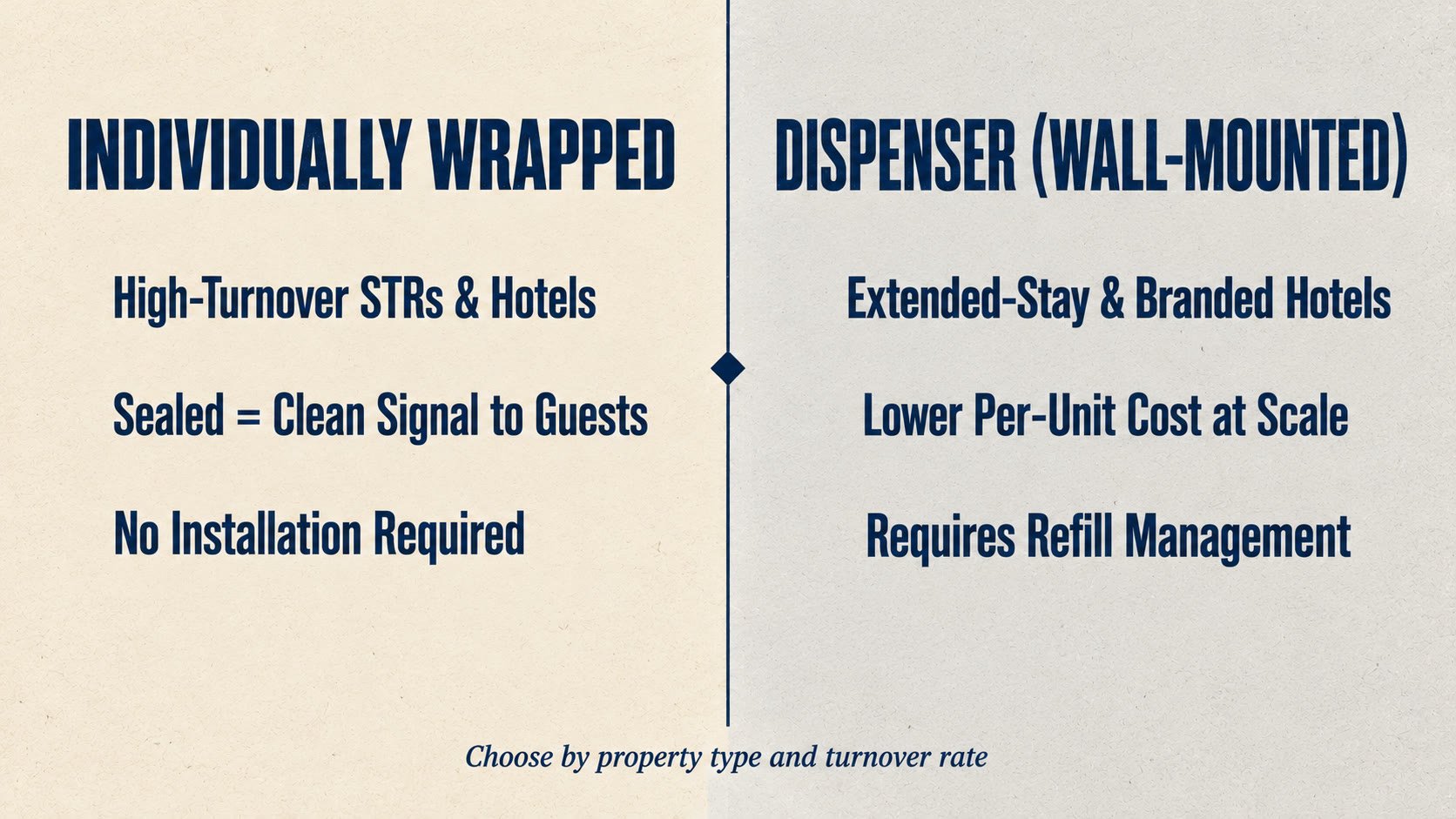
Individually wrapped soap and shampoo are the right call for the vast majority of Airbnb hosts, vacation rental operators, and turnover-heavy short-term rentals. A partially used dispenser is ambiguous to a guest in a way that a sealed wrapper never is. That ambiguity costs you reviews.
Dispensers start making more sense when you're running 50 or more rooms with stable occupancy and a housekeeping team that can manage the refill cycle. The unit economics shift meaningfully at that scale.
Both formats are available through specialty hospitality suppliers; general wholesale distributors are more variable on individually wrapped options.
Before You Send a PO: Questions Worth Asking Every Supplier
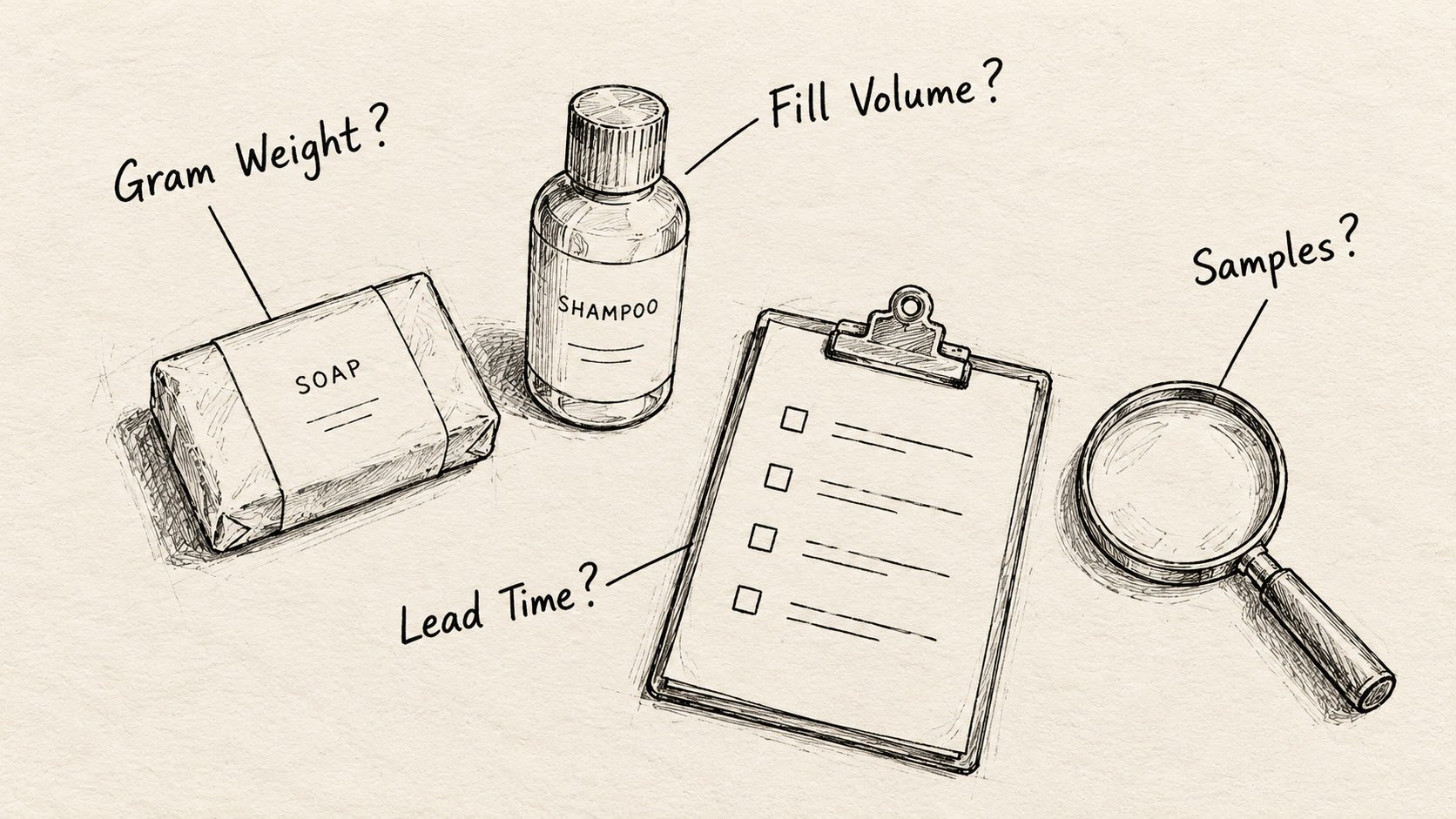
The standard "how to evaluate a supplier" lists are fine as far as they go. Here's what they consistently leave out for soap and shampoo specifically.
On product:
- What's the gram weight per bar soap, and what's the actual fill volume per shampoo bottle (not the label claim: what does a measured sample show)?
- Is the shampoo formulation pH-balanced for normal hair? Do you have technical documentation?
- For bar soap: CPSC compliance. For shampoo/conditioner/body wash: FDA 21 CFR Part 701 label compliance. Can you provide documentation?
On operations:
- What's the lead time on your top 3 soap and shampoo SKUs from the moment I place an order?
- Do you carry safety stock on those SKUs, or do you make to order?
- What's your communication process when a SKU is delayed or discontinued?
On samples:
- Can I get samples before committing to a case order? If there's a fee, what is it?
Any supplier who answers these questions clearly and without friction is worth taking seriously. Any supplier who hedges on the lead time question or can't produce compliance documentation promptly is telling you something important.
Where This Guide Comes From
We are Avistar, a wholesale supplier of individually wrapped guest amenities for hotels, short-term rentals, care facilities, and property managers in the US. We sell soap, shampoo, conditioner, body wash, and oral care in bulk.
We wrote this guide because we talk to hospitality buyers every day who are navigating these decisions without a clear picture of how the supplier landscape actually works. Having that map upfront saves time, bad orders, and the kind of stockout that happens on a busy weekend.
We supply these products, which means we've seen what works and what causes problems across a range of property types and order sizes. Everything in this guide reflects what we'd actually tell a buyer walking through the decision for the first time.
Where We Fit
Avistar sits in the specialty hospitality amenity wholesaler category. We built the operation for the buyers in the middle: properties too small for commercial distributor minimums, too serious about guest experience to default to whatever's cheapest on Amazon.
Our bath and body collection covers individually wrapped soap, shampoo, conditioner, and body wash, with dispenser options available. Minimums are designed to work at scale and for smaller properties. Samples are available before you commit to a case order.
If you're still in the "what should I be stocking?" phase before you start comparing suppliers, our hotel toiletries guide is the right starting point.
Frequently Asked Questions
What are hotel soap and shampoo suppliers?
Hotel soap and shampoo suppliers are wholesale distributors or manufacturers that provide individually wrapped or dispenser-format soap and shampoo to hospitality properties in bulk. They serve hotels, short-term rentals, care facilities, and property managers who need consistent supply in hospitality-specific formats, rather than retail-size products. In the US, the market divides into specialty hospitality amenity wholesalers, general wholesale distributors with a hospitality line, and private-label manufacturers.
Where do hotels actually get their soap and shampoo?
Most hotels source soap and shampoo through specialty hospitality amenity wholesalers or wholesale distributors. Larger branded hotel chains often use private-label manufacturing so the product carries the hotel's own label. Independent hotels, boutique properties, and Airbnb hosts more commonly work with specialty hospitality wholesalers who stock ready-to-place, individually wrapped amenities in hospitality-specific sizes, typically 1 oz shampoo and 14–20g bar soap.
What size shampoo and soap do hotels use?
Standard hotel shampoo bottles are 1 oz (approximately 30mL) for individual guest use. Some budget properties use 25mL; luxury properties may use 40mL or larger. Bar soap for hotel guest rooms typically runs 14g to 20g for a standard wrapped bar. Larger bars (40–60g) are used when the property wants soap to last across a multi-night stay rather than providing a new bar per turnover.
How much does hotel soap and shampoo cost wholesale?
Pricing varies by product tier and format. Entry-level individually wrapped hotel bar soap runs roughly $0.10–$0.25 per unit in case quantities. Mid-tier individually wrapped shampoo (1 oz bottles) typically runs $0.35–$0.75 per unit depending on brand and volume. Premium branded amenities (Beekman 1802, PAYA, Apotheke) run higher. To compare suppliers accurately, normalize all pricing to cost per ounce rather than cost per unit, since fill volumes vary and can obscure meaningful price differences.
Do I need a business license to buy hotel soap and shampoo wholesale?
Most US hospitality wholesale suppliers require you to be a legitimate business buyer (hotel, property manager, vacation rental host) but the specific documentation varies by supplier. Many specialty hospitality wholesalers allow online purchase with no formal account application. Others require a basic business verification, typically a business name, email, and sometimes a tax ID or resale certificate for sales-tax exemption. Confirm requirements directly with any supplier before assuming access is unrestricted.
What's the difference between individually wrapped and dispenser soap and shampoo for hotels?
Individually wrapped amenities are single-use products placed in the room for each guest; they signal cleanliness through the sealed packaging and are the standard format for short-term rentals and turnover-heavy hotels. Dispenser soap and shampoo are installed wall-mounted systems refilled from bulk containers; they reduce per-unit cost and packaging waste, but require installation and a refill management process. Individually wrapped formats are generally the better default for high-turnover properties; dispensers make more sense for extended-stay operations and eco-focused brands at higher room counts.
What should I look for in a hotel shampoo supplier specifically?
For hotel shampoo, confirm FDA-compliant labeling under 21 CFR Part 701, evaluate the actual fill volume per bottle (ask for a sample and measure it), check the formulation for pH balance and suitability for normal hair types, and assess lather performance: shampoo that doesn't lather adequately in hard-water conditions generates guest complaints. Ask for lead times on specific in-stock SKUs and whether the supplier carries safety stock. Any legitimate wholesale supplier should be able to provide compliance documentation without significant friction.