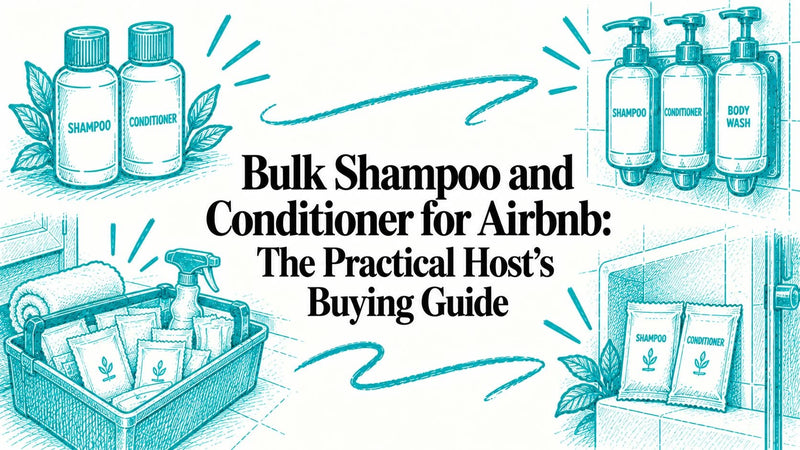
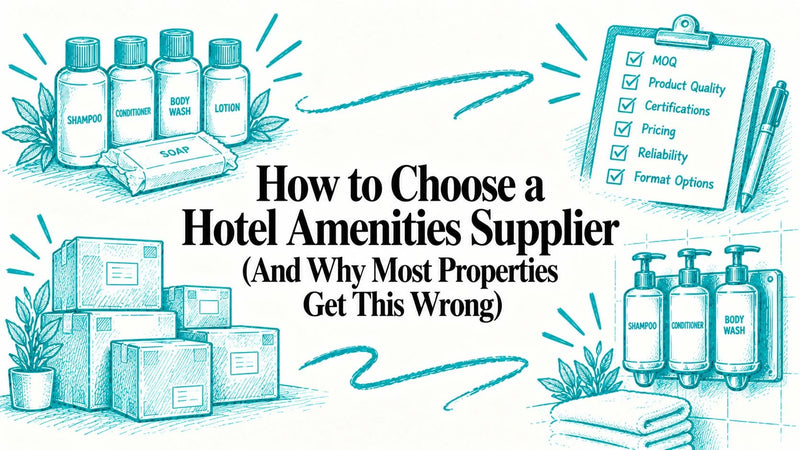
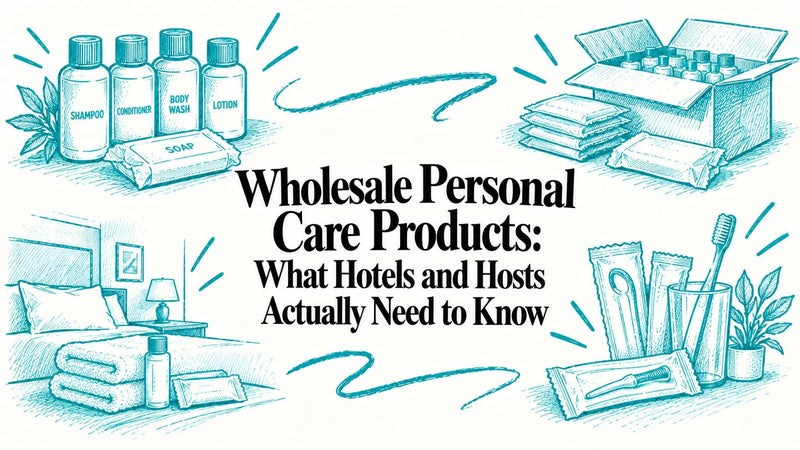
A note for hotel operators, Airbnb hosts, and property managers who want to stop treating hair care as an afterthought.
You've thought about the soap. You've thought about the towel fold. You've thought about the welcome card.
But the shampoo? Probably grabbed whatever came in a bulk case on Amazon, dropped it in the bathroom, and called it done.
We get it. Shampoo and conditioner feel like a commodity. A bottle is a bottle. And yet, it's one of the first things guests interact with on day one: before the bed, before the TV, often before anything else. They're in the shower, jet-lagged or road-tired, hoping for a moment that doesn't suck.
The wrong shampoo doesn't ruin a stay. But the right one, the one that smells clean without being chemical, that lathers on the first pump, that doesn't leave hair feeling stripped, gets noticed. Not always consciously. But it shows up in the reviews. The "little touches" comments. The five-star ratings that mention "felt like a hotel."
Here's what we've learned sourcing travel size shampoo and conditioner for properties across the country: most operators are making the same three mistakes, and they're easy to fix.
Mistake #1: Buying the cheapest thing and calling it "hotel quality"
There's a category of travel size shampoo that gets marketed as "hotel grade" while being, functionally, water with a drop of surfactant and a strong fragrance to cover it up. These products lather poorly, rinse sticky, and leave hair that smells like air freshener.
The irony is that they often cost nearly the same per unit as something significantly better.
What actually makes a good guest shampoo:
- Mild surfactant blend. Sodium laureth sulfate (SLES) is fine; it's gentler than straight SLS. Avoid formulas where the first ingredient is alcohol or fragrance.
- pH balance. Hair care that's too alkaline (above pH 5.5) causes frizz and breakage. It also makes guests feel like they used dish soap. Good manufacturers will list pH or specify "balanced formula."
- Scent that reads as clean, not perfumed. Light citrus, green tea, or neutral scents perform better across guest demographics than heavy florals or strong musk. A guest shouldn't be able to smell your shampoo from across the room.
- Clarity or light opacity. Clear or lightly pearlized formulas look higher quality in a bottle than thick white ones. It's superficial, but guests notice.
For conditioner specifically: the bar is even lower among operators, which is your opportunity. Most budget amenity sets skip conditioner entirely or include a watered-down version that barely coats the hair. A conditioner that actually detangles (even a basic 1 oz bottle) is a genuine differentiator at most price points.
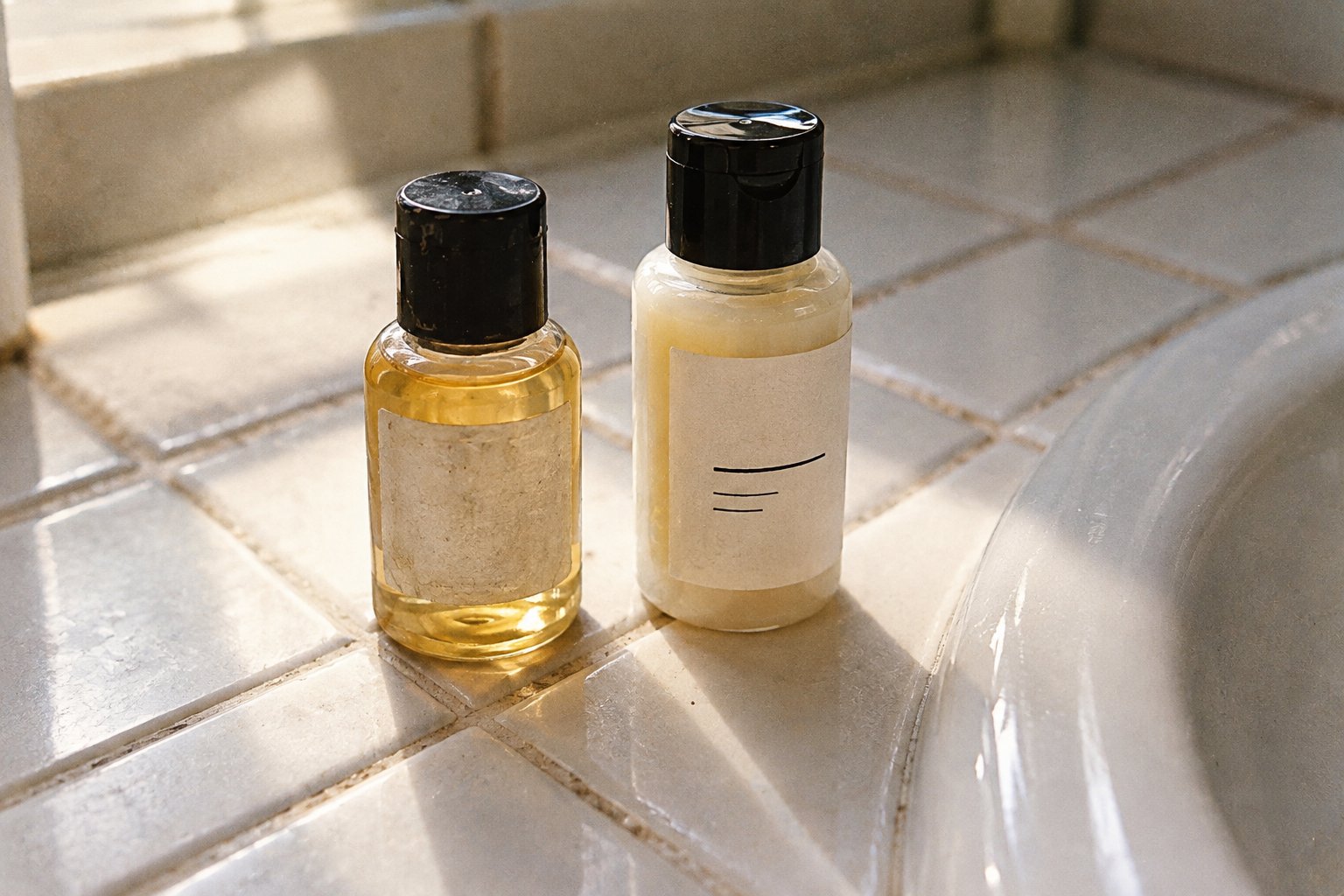
Mistake #2: Ignoring the format conversation
Travel size shampoo and conditioner comes in a few formats, and they're not interchangeable:
| Format | Best For | Watch Out For |
|---|---|---|
| Individual 0.85–1 oz bottles | STR turnover properties, care facilities, high-hygiene environments | Per-unit cost; storage volume |
| Sachets / pouches | Eco-conscious properties, reduced waste | Harder to use in the shower; some guests dislike them |
| Refillable dispensers (bulk fill) | Extended-stay, large hotels, sustainability-focused brands | Requires maintenance; perceived hygiene concerns in some markets |
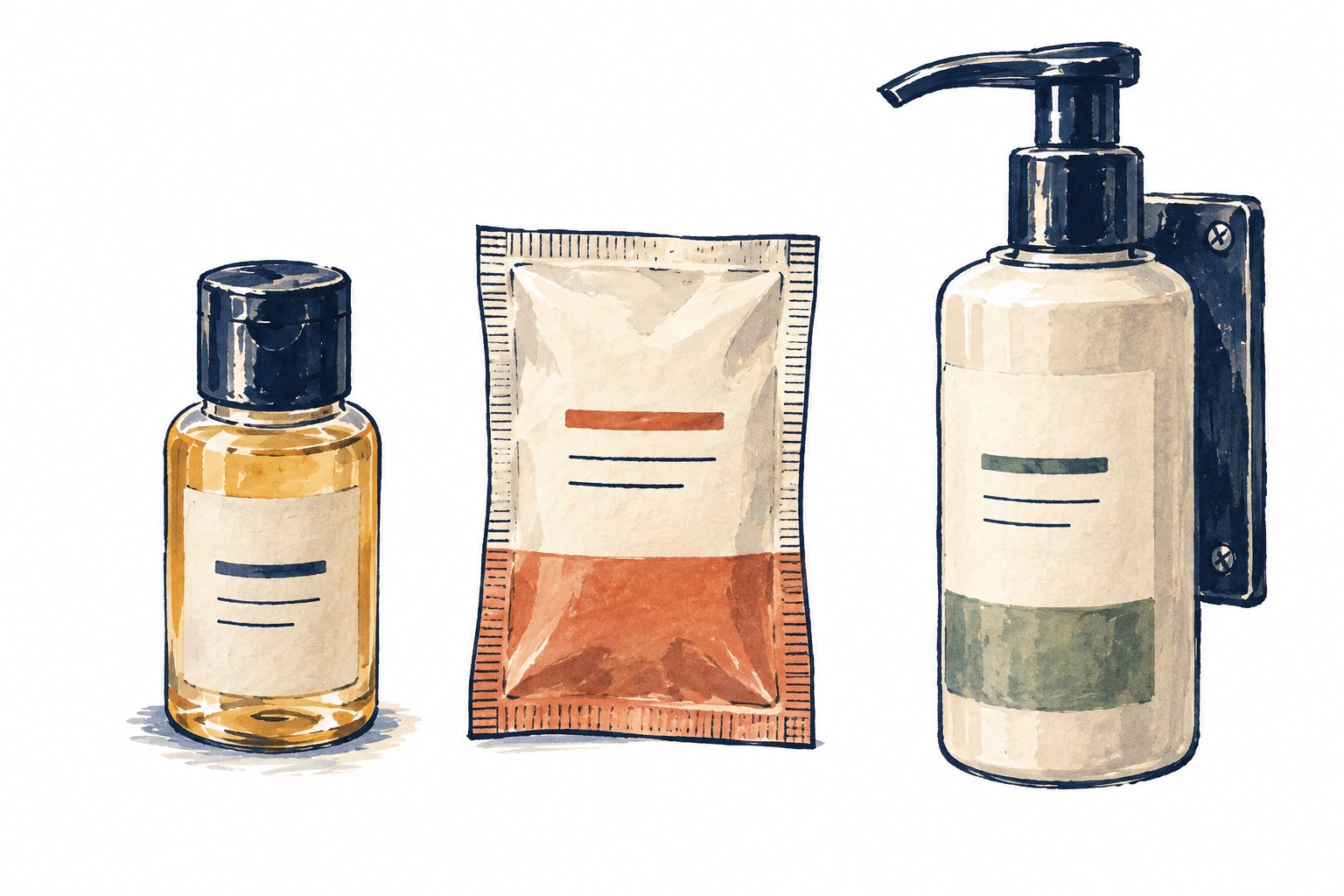
If you're running a short-term rental with frequent turnover, individually wrapped bottles are usually the right call. Guests use one or two, and you start fresh every time. No cross-contamination concern, no explaining why the dispenser is half-empty, no staff time refilling.
If you're running an extended-stay property or you've made a sustainability commitment to your guests, dispensers make more sense. The per-ounce cost is lower and the waste footprint is smaller, but you're taking on maintenance and a more involved restocking system.
Neither format is wrong. The mistake is choosing one without thinking through your operational model. We've worked with operators who switched to dispensers for cost savings and then spent that savings on the extra labor to maintain them. And we've worked with hosts who insisted on boutique individual bottles and kept running out mid-week because they underestimated how much a four-person family actually uses.
Match the format to how your property runs. Then optimize within that format for quality.
Our guide on bulk shampoo and conditioner for hotels and hosts goes deeper on the cost-per-unit math if you want to run the numbers.
Mistake #3: Buying the bottle, not the case
Here's the thing about travel size shampoo and conditioner: the unit economics only work if you're buying in volume. A 30-pack from Amazon costs more per bottle than a 300-pack from a wholesale supplier, usually significantly more.
The operators who get stuck in the expensive loop are the ones who:
- Reorder reactively (running out and buying whatever ships fastest)
- Buy in small quantities "to try it first" and then never formalize the order
- Source from retail channels (Target, Costco) when wholesale channels are available
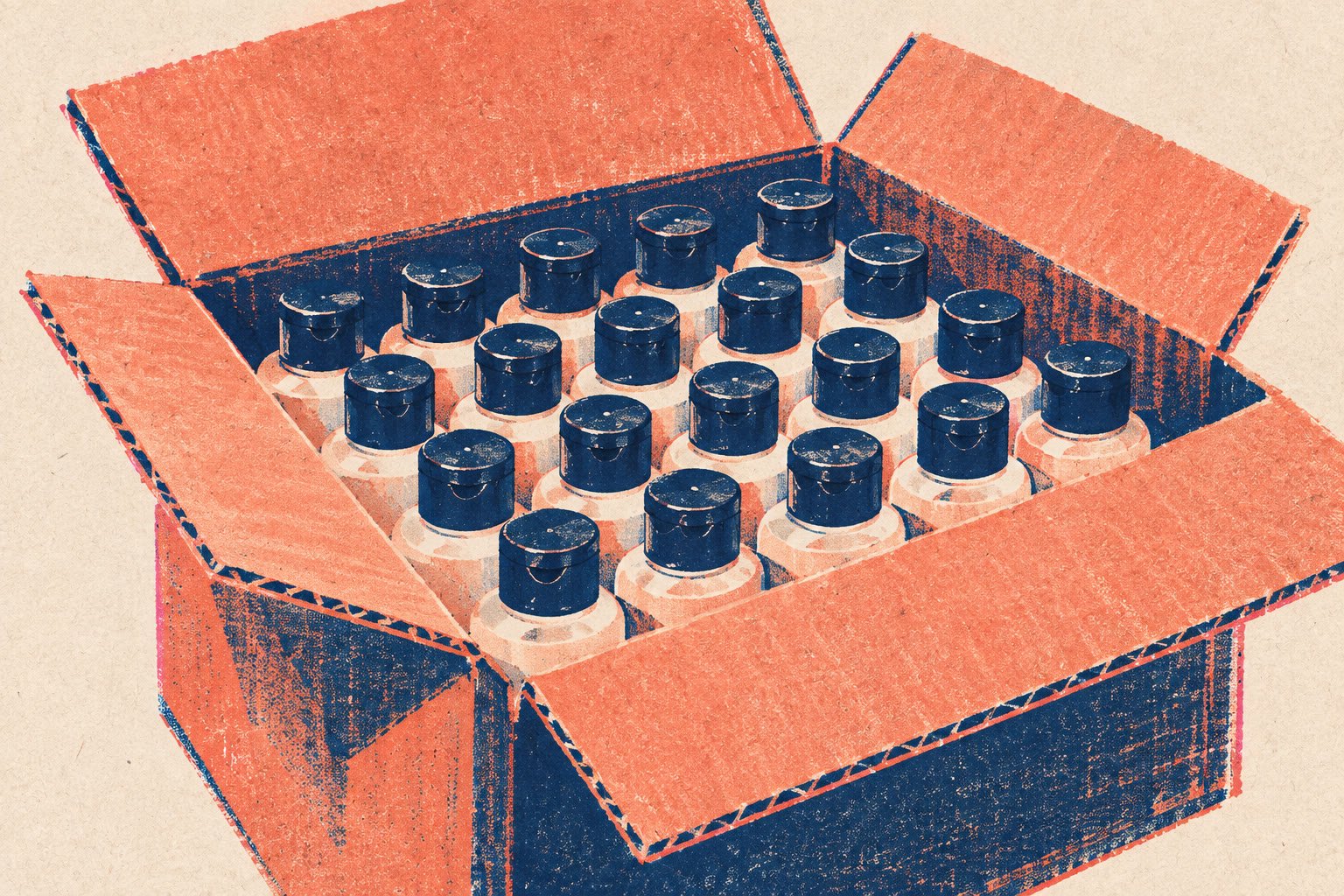
A reasonable minimum order quantity for a short-term rental host running 3–5 units is around 100–200 bottles per product. That's roughly a 2–3 month supply at full occupancy, depending on unit size and guest count. For hotels above 20 rooms, you're looking at case quantities of 300–500+ for anything to make sense on the per-unit math.
The quality ceiling at wholesale pricing is also higher than most operators expect. You're not choosing between "cheap junk" and "expensive boutique." There's a wide band of genuinely good shampoo and conditioner available at $0.30–$0.60 per unit when you're buying in proper volume. That's not a meaningful budget line for most properties.
If you're still figuring out your full amenities setup, the Airbnb supplies room-by-room guide has a useful framework for thinking about how shampoo and conditioner fits into the broader amenity budget.
What Avistar stocks, and why we think about it this way
At Avistar, we supply individually wrapped travel size shampoo and conditioner to hotels, Airbnb hosts, property managers, and care facilities.
Our starting point when helping operators choose: what story do you want your bathroom to tell?
A budget motel telling guests "we cover the basics" needs a different answer than a boutique vacation rental telling guests "we thought about every detail." The product has to match the positioning, or guests feel the mismatch even if they can't name it.
We also think about the downstream stuff operators often don't: storage, stacking, shelf life (most quality shampoos have an 18–24 month shelf life; verify before buying in very large volume), and reorder logistics. The best-priced shampoo in the world isn't a good deal if it arrives inconsistently or in damaged packaging.
If you're rethinking your amenity setup, start with what your guests actually notice before going straight to the product sourcing question.
The quick checklist before your next order
Before you reorder (or place your first real wholesale order), run through this:
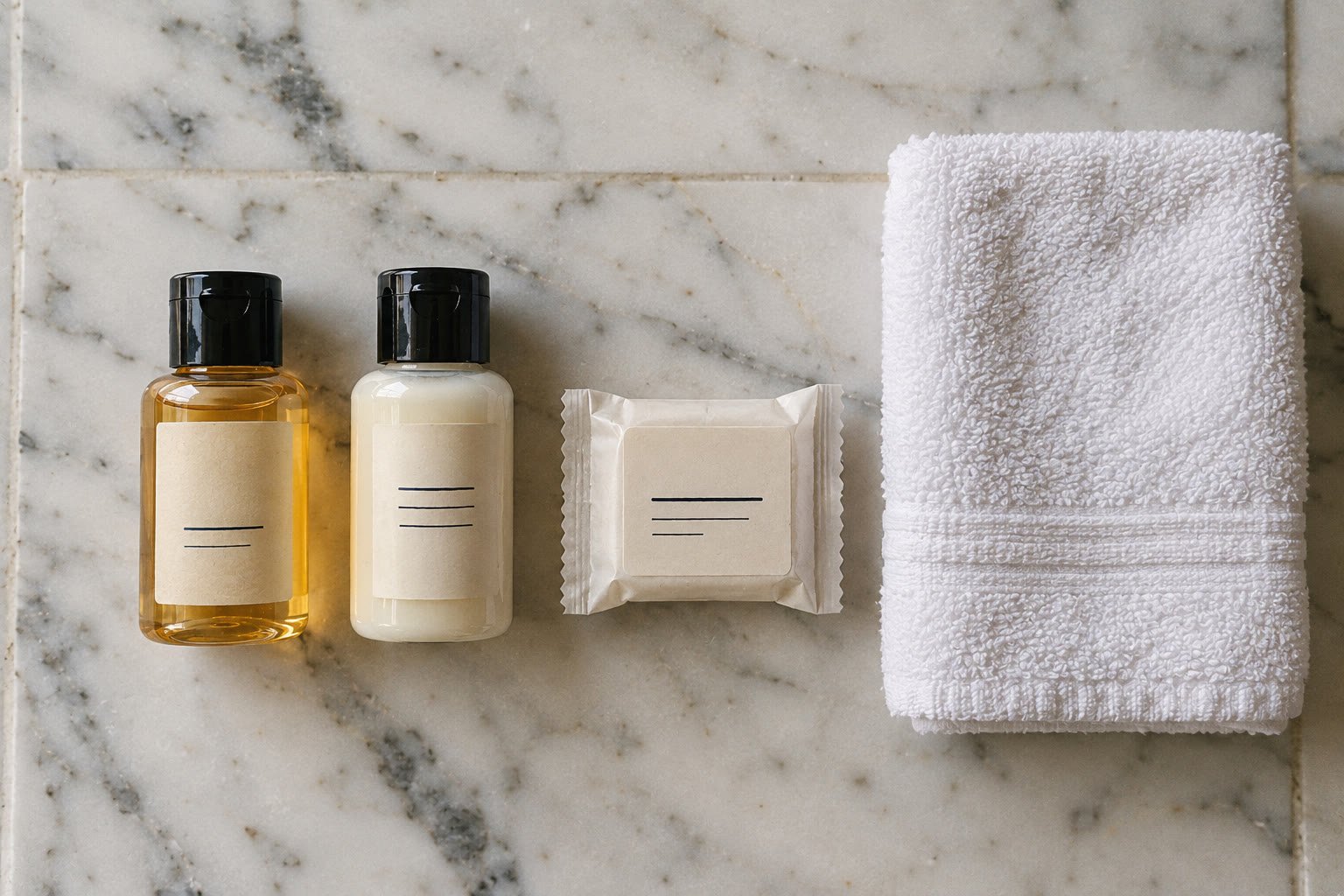
- Format locked in? Bottles vs. sachets vs. dispensers. Don't mix formats across units unless you have a good reason.
- Scent tested? Order a sample case. Don't commit to 500 units of something you've never smelled.
- Per-unit price confirmed at your actual order volume? The price at 50 units is not the price at 500.
- Conditioner included? Don't be the host who stocks shampoo without conditioner. It reads as incomplete.
- Shelf life checked? Especially if you're buying 6–12 months of inventory upfront.
- Supplier reliability verified? Can they fulfill the same SKU consistently? Switching products mid-season means mismatched bottles in your bathrooms.
Travel size shampoo and conditioner is a small thing. But in hospitality, small things are the whole job.
Avistar supplies individually wrapped guest amenities, including shampoo and conditioner, to hotels, Airbnb hosts, property managers, and care facilities. Browse the full amenities catalog at avistarcare.com.
Frequently Asked Questions
What size is considered "travel size" for hotel shampoo and conditioner?
The hospitality industry standard is 0.85 oz (25ml) to 1 oz (30ml). These fit standard amenity trays and represent a practical single-use volume for most hair types. Some premium properties go up to 1.5 oz, but 1 oz is the most common baseline for hotels and short-term rentals.
How much travel size shampoo and conditioner does each guest use per stay?
Plan for one bottle of shampoo and one conditioner per guest per night. A safe rule: assume 100% of bottles placed will be used, and build your reorder cadence around full occupancy to avoid running short mid-season.
Should I offer shampoo and conditioner as separate bottles or as a 2-in-1?
Separate bottles are the better choice for most properties. A 2-in-1 reads as a budget signal, and conditioner is one of the most noticed missing amenities in guest reviews. If cost is a constraint, a lower-cost conditioner still beats no conditioner.
What's the minimum order quantity for travel size shampoo and conditioner from a wholesale supplier?
Most hospitality wholesale suppliers set MOQs between 100 and 300 units per SKU. For a short-term rental host at high occupancy, 100–200 bottles is roughly a 2–3 month supply; hotels above 20 rooms should plan for 300–500 units per order cycle.
What's the difference between hotel shampoo and regular shampoo?
Hotel amenity shampoo is formulated for broad appeal rather than specific hair types, using mild surfactants, neutral scents, and balanced pH to perform acceptably for the widest range of guests. It's designed for a single application by someone in an unfamiliar shower, which is actually a higher bar for consistency than most consumer products.
Can I use retail travel-size bottles (from Target or Costco) for my rental property?
The economics don't work at scale. Retail travel-size bottles typically cost $1.50–$3.00 per unit; wholesale amenity suppliers offer comparable or better quality at $0.30–$0.70 per unit in case quantities. Retail is a short-term fix, not a supply strategy.
Are there sustainability regulations for travel size shampoo and conditioner in hotels?
Several US states have moved to restrict single-use plastic amenity bottles in hotels, with California's law in effect for larger properties. If your property is in a regulated market, confirm your supplier's format options before committing to large-volume orders of single-use plastic bottles.